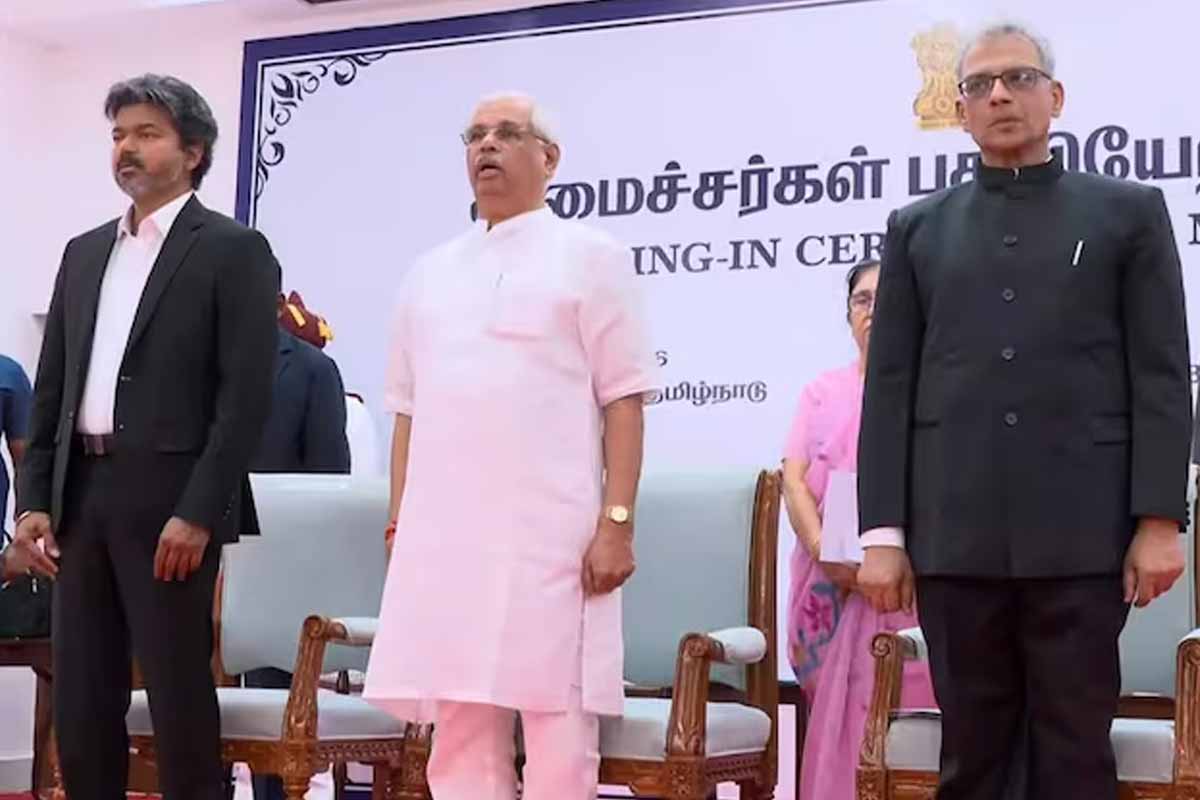
Just a week ago, a controversy had thickened in Tamil Nadu. At the swearing-in ceremony of the new Chief Minister Vijay, after ‘Jana Gana Mana’ and ‘Vande Mataram’, the state anthem ‘Tamil Thai Valthu’ was sung at the very end. This sparked intense debate. Although the new government stated that such an order was given in accordance with the central notification, and also assured that it would not happen again, the same scene was witnessed during the swearing-in of 23 MLAs. The state anthem was sung as the third song. This has reignited controversy. The DMK taunts, “Where is Vijay’s ‘guarantee’?”
However, TVK has once again put forward the same argument. They have said that this decision was the governor’s. A leader of Vijay’s party, Nanjil Sampath, said, “Today’s swearing-in ceremony at Raj Bhavan was organized. The Tamil state anthem was sung at the very end. The Tamil Nadu government has no role in this. However, in the assembly, the state anthem will be sung first.” Meanwhile, DMK spokesperson Saravanan Annadurai wrote on his X handle, ‘Where is your guarantee? Despite the assurance last time, TVK has failed again. They cannot protect the rights of Tamils.’
Read more:
At the swearing-in ceremony of the new Chief Minister Vijay, after ‘Jana Gana Mana’ and ‘Vande Mataram’, the state anthem ‘Tamil Thai Valthu’ was sung at the very end. This had sparked intense controversy.
It is worth noting that the tradition for official events in Tamil Nadu is that the Tamil state anthem ‘Tamil Thai Valthu’ is sung first, followed by the national anthem ‘Jana Gana Mana’. However, at the TVK government’s swearing-in ceremony, ‘Vande Mataram’ was sung first, then ‘Jana Gana Mana’, and only at the end was ‘Tamil Thai Valthu’ sung. The question arose: was the tradition broken just to please Tamil Nadu Governor Rajendra Arlekar?
Additionally, by singing the full version of ‘Vande Mataram’, questions have been raised about TVK’s secular stance by VCK chief Thol. Thirumavalavan. He said, “TVK sought support from Congress, left parties, IUML, and VCK by demanding the formation of a secular government. But the incident at the swearing-in ceremony has caused widespread discomfort among the parties supporting TVK.”
Tamil Nadu
Tamil Nadu, a state in southern India, is renowned for its rich cultural heritage and ancient Dravidian history, with its roots tracing back over 2,000 years to the classical Sangam period. It is home to iconic temples like the Meenakshi Amman Temple and Brihadeeswarar Temple, showcasing magnificent Chola architecture. The region has been a center of Tamil language, literature, and art, with a history shaped by powerful dynasties such as the Cholas, Pandyas, and Vijayanagara Empire.
Raj Bhavan
Raj Bhavan is the official residence of the Governor of a state in India, with many such buildings dating back to the British colonial era. Originally built as Government Houses for British officials, these grand structures often reflect a blend of European and Indian architectural styles. After India’s independence, they were repurposed as state governor residences and continue to serve as important administrative and ceremonial centers.
<div class="my-4 p-4 rounded-lg shadow-md bg-blue-50 border-l-4 border-blue-
Raj Bhavan
Raj Bhavan is the official residence of the Governor of a state in India, with several such buildings located across different states. Historically, many Raj Bhavans were constructed during the British colonial period, serving as the homes of Viceroys or Governors, and later became symbols of state governance after India’s independence. For example, the Raj Bhavan in Kolkata, originally known as Government House, was built in the early 19th century and reflects British architectural influence.
Tamil Nadu
Tamil Nadu is a state in southern India known for its rich cultural heritage, classical arts, and ancient Dravidian architecture. Historically, it was home to powerful dynasties like the Cholas, Pandyas, and Pallavas, who built magnificent temples and left a lasting legacy in literature and trade. Today, it remains a vibrant center of Tamil language and traditions, attracting visitors to sites like the Meenakshi Temple and the city of Madurai.
Meenakshi Amman Temple
The Meenakshi Amman Temple is a historic Hindu temple located in Madurai, India, dedicated to the goddess Meenakshi (a form of Parvati) and her consort Sundareswarar (Shiva). Originally built in the 6th century by the Pandya dynasty, its current grand structure—featuring 14 towering gopurams (gateway towers) adorned with thousands of colorful sculptures—was largely reconstructed in the 16th–17th centuries under the Nayak rulers. It remains a major pilgrimage site and a stunning example of Dravidian architecture.
Brihadeeswarar Temple
The Brihadeeswarar Temple, located in Thanjavur, India, is a masterpiece of Chola architecture built between 1003 and 1010 CE under Emperor Rajaraja I. It is renowned for its massive granite vimana (temple tower) standing over 60 meters tall, which remains one of the tallest of its kind in the world. A UNESCO World Heritage Site, the temple is dedicated to Lord Shiva and exemplifies the pinnacle of South Indian temple art and engineering.