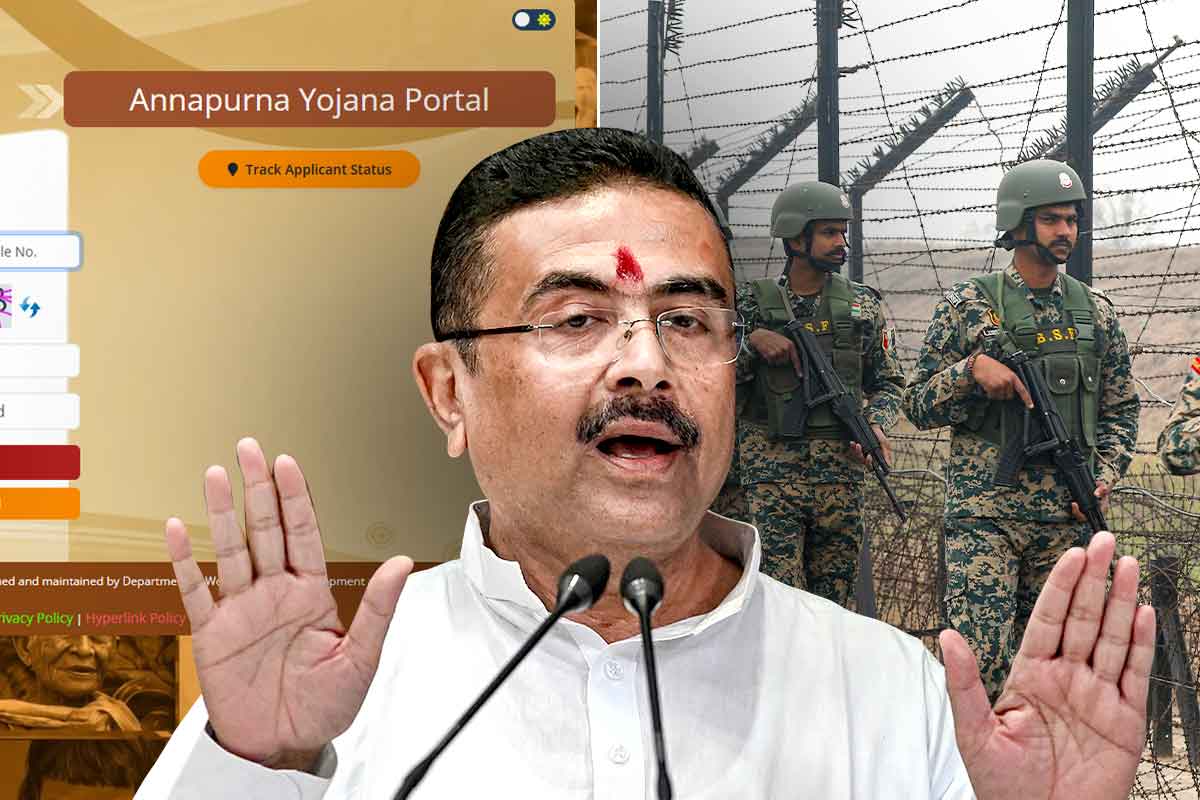
The 2026 election was like a ‘do or die’ match. During the campaign, BJP leaders made numerous promises. On May 4, they won Bengal with a massive majority. On May 9, Suvendu Adhikari was sworn in as the eighth Chief Minister of the state. The current state government is only 11 days old. In this short time, Chief Minister Suvendu Adhikari has fulfilled his promises. Since forming the government, he has been committed to implementing pledges. From the Annapurna scheme to transferring land to the BSF for barbed wire fencing, the new Chief Minister has taken several important steps.
More news on this topic
Seventh Pay Commission: The BJP had promised to implement the Seventh Pay Commission within 45 days of coming to power. After forming the government, the state cabinet approved the Seventh Pay Commission in its second meeting. As a result, state government employees received a significant salary hike at once.
Annapurna Yojana: Those who used to receive Rs 1,500 per month under Lakshmir Bhandar thought they might not get it anymore. However, even after the change of government, the administration clearly stated that no previous government scheme would be discontinued. Accordingly, the Annapurna Yojana has been launched. From next month, women will receive Rs 3,000 each. The money will be directly deposited into their bank accounts.
Free bus travel for women: Women will no longer have to pay fares on government buses. After coming to power, the BJP government kept its word. As a result, women traveling from Digha to Darjeeling or within their own district on government buses will not have to spend a single rupee. This rule will take effect from June 1.
Land transfer for barbed wire fencing: The BJP aimed to free Bengal from the problem of infiltrators. After capturing Bengal for the first time, the land dispute over barbed wire fencing was resolved. 27 kilometers of land have been handed over to the BSF for fencing.
‘Pushback’ law implemented: Suvendu Adhikari’s government has taken a major step to secure West Bengal. Following central directives, the ‘pushback’ law has been implemented in the state. The center had written to the state in 2025 to repel infiltrators. The then Trinamool government did not follow those directives. Now, keeping national security in mind, the state government has enforced the law.
RG Kar files: After coming to power, the saffron camp had promised to take appropriate action against those involved in the RG Kar case. Chief Minister Suvendu Adhikari kept his word. The RG Kar files have been reopened. Three police officers have been suspended.
Multiple steps for corruption investigation: A ‘zero tolerance’ policy for investigating crimes against women and any kind of institutional corruption. The new Chief Minister has formed two separate commissions. Investigations will begin from June 1.
Ayushman Bharat: During the previous government’s tenure, Bengal residents received health cards worth Rs 5 lakh under the Health Sathi scheme, which provided some medical benefits. However, there were allegations that the Ayushman Bharat service was not allowed to be launched in Bengal at that time. After forming the government in Bengal, Ayushman Bharat has been launched.
National Education Policy implemented: Bengal is now included under the National Education Policy. As a result, the quality of education in every government school in the state will improve. PM SHRI schools will be established in every block.
Age limit increase for government jobs: Recruitment of government employees in the state has been stalled since 2013, leading to increased unemployment. In this situation, to boost employment opportunities, the age limit for government jobs has been increased. The upper age limit has been raised by 5 years.
More news on this topic
Annapurna Yojana
Annapurna Yojana is a significant social security initiative by the Government of India, launched in 2000 to provide food security to senior citizens who are not covered under the National Old Age Pension Scheme. Under this scheme, eligible individuals aged 65 years or above receive 10 kilograms of free food grains (wheat or rice) per month. It aims to ensure that the most vulnerable elderly population has access to basic nutrition.
Lakshmir Bhandar
Lakshmir Bhandar, located in Kolkata, India, is a historic building known for its role in the region’s economic and cultural development. Originally established in the 19th century as a financial institution and later used as a storehouse for goods, it reflects the colonial-era trading practices of Bengal. Today, it stands as a notable architectural landmark, preserving the legacy of Kolkata’s mercantile history.
Seventh Pay Commission
The Seventh Pay Commission is a significant Indian government body established to review and revise the salary structure, allowances, and pension benefits for central government employees and pensioners. Its recommendations, implemented in 2016, aimed to improve living standards and address disparities in compensation across various sectors. The commission’s report marked a major reform in public sector pay, impacting millions of workers and the national budget.
Ayushman Bharat
Ayushman Bharat is a flagship health initiative launched by the Government of India in 2018, aimed at providing universal health coverage. It consists of two main components: the Health and Wellness Centres (HWCs) for primary care, and the Pradhan Mantri Jan Arogya Yojana (PM-JAY), which offers secondary and tertiary care hospitalization coverage to over 100 million poor and vulnerable families. This program represents one of the world’s largest government-funded health insurance schemes, significantly expanding access to affordable healthcare across the country.
National Education Policy
The National Education Policy (NEP) 2020 is a comprehensive framework for education in India, replacing the previous policy from 1986. It aims to transform the country’s education system by making it more holistic, flexible, and multidisciplinary, with a focus on early childhood care, foundational literacy, and vocational skills. The policy also emphasizes experiential learning, critical thinking, and the integration of technology, while promoting Indian languages and cultural heritage.
PM SHRI schools
PM SHRI (PM Schools for Rising India) is a centrally sponsored scheme launched by the Indian government in 2022 to upgrade and modernize over 14,500 existing schools across the country. These schools aim to serve as model institutions, offering a holistic, innovative, and experiential learning environment aligned with the National Education Policy 2020. The initiative focuses on improving infrastructure, teacher training, and digital resources to provide high-quality education, with the goal of nurturing well-rounded students for the future.
RG Kar
RG Kar is a prominent medical institution in Kolkata, India, formally known as R.G. Kar Medical College and Hospital. Established in 1886, it is one of the oldest medical colleges in Asia, originally founded as the Calcutta Medical School and later renamed after its first Indian principal, Dr. Radha Gobinda Kar. The institution has a rich history of medical education and service, playing a key role in healthcare in the region for over a century.
Health Sathi
Health Sathi is a community health initiative in Nepal that provides basic healthcare services, primarily through trained female community health volunteers. Founded to address gaps in rural healthcare access, it focuses on maternal and child health, family planning, and disease prevention. The program has helped improve health outcomes in underserved areas by offering affordable and accessible medical support.