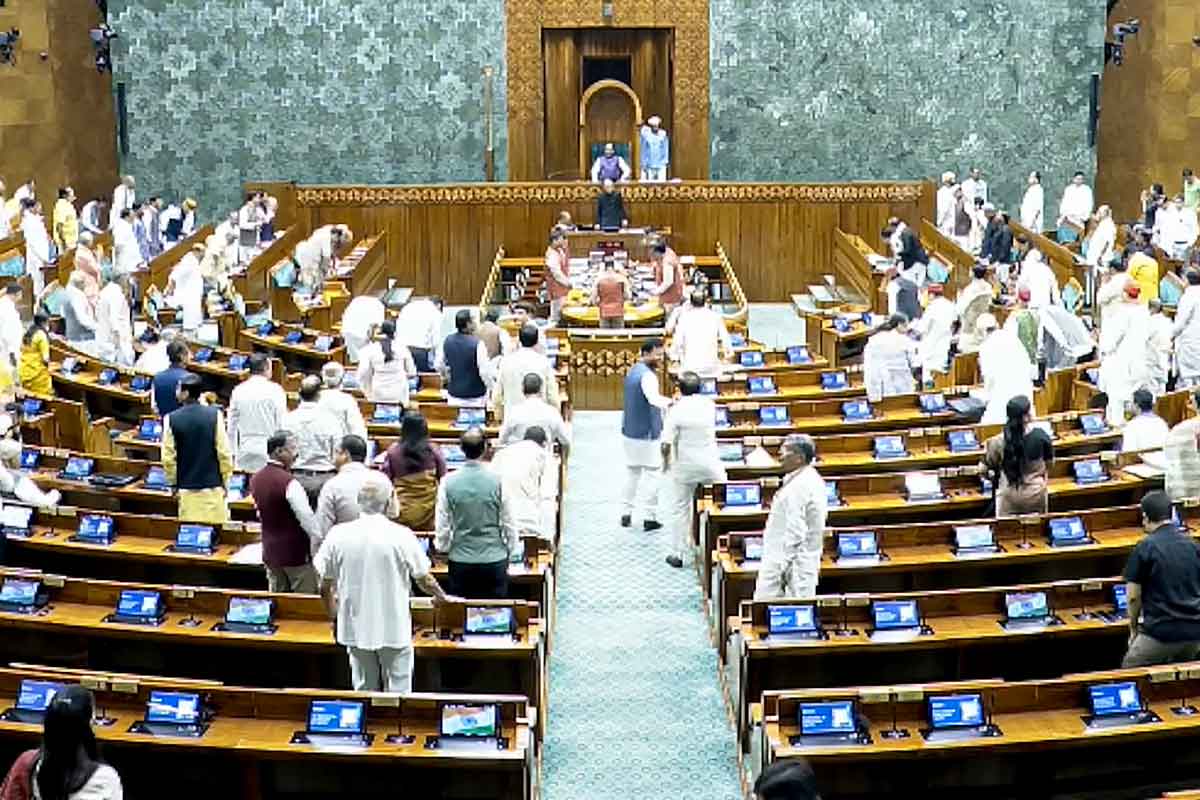
The 131st Constitution Amendment Bill concerning women’s reservation and the increase of Lok Sabha seats did not pass in the Lok Sabha due to insufficient support. After two days of discussion, the bill (Women Reservation Bill) was presented on Friday, receiving 298 votes in favor and 230 votes against. A total of 528 MPs participated in the voting. Passing the bill required a two-thirds majority, meaning 352 votes.
The government was active in passing three bills during the three-day special session, the first of which was to reserve one-third of seats in the Lok Sabha and State Legislative Assemblies for women. This bill was named the ‘Nari Shakti Vandan Act’. The second was the Lok Sabha seat redistribution bill. And the third was the Union Territory Law Amendment Bill. However, the opposition alleged that the Modi government was trying to change India’s electoral map under the guise of women’s reservation. The opposition camp united in opposing the bill. During the voting, although 298 votes were cast in favor of the bill, 230 were cast against. Ultimately, the bill could not be passed as the two-thirds majority support was not achieved.
Read More:
298 votes were cast in favor of the bill. On the other hand, 230 votes were cast against. A total of 528 MPs participated in the voting. Passing the bill required a two-thirds majority, meaning 352 votes.
The government side had already received indications that the bill would not pass. The final speaker targeted the opposition, calling them anti-women, and also said, “Trust us. Let the bill pass.” However, as the bill did not gain a majority, a central minister said, “This bill was a bill for women’s development. What happened is opposition to women’s power.” In response, a Congress MP said, “We will not hear about women’s development from those who bear the stains of Hathras.”
Furthermore, on a social media platform, the Trinamool’s All India General Secretary wrote, ‘The BJP’s discomfort is now out in the open due to the Lok Sabha seat redistribution bill not passing. Although an amended version of the Women’s Reservation Bill was presented today, it had been passed unanimously in 2023. If the NDA government is truly sincere about women, they should implement that bill for one-third reservation. Trinamool supports this issue; currently, over 41% of Trinamool representatives in Parliament are women.’ He also wrote, ‘The 131st Constitution Amendment Bill, 2026 has been rejected by the INDIA alliance. There are serious questions regarding the justification and balance of the attempt to increase Lok Sabha seats to 850 and redistribute seats based on the 2011 census.’ Finally, he wrote, ‘The NDA government’s time is running out. The illusion they created is now clear to the people.’
It is noteworthy that the ‘Nari Shakti Vandan Act’ bill was passed in Parliament in 2023. The bill stated that 33 percent of seats would be reserved for women. It was further stated that seat redistribution would occur after the census. Then, 33 percent of those seats would be reserved for women. But now the center is not waiting for the census. The Modi government wants seat redistribution to be based on the 2011 census. Based on that redistribution, seats would be reserved for women. It is this that the INDIA camp has united to oppose.
Lok Sabha
The Lok Sabha is the lower house of India’s bicameral Parliament, located in New Delhi. It was established under the Constitution of India in 1952, following the nation’s independence, and its members are directly elected by the people. As the primary legislative body, it holds significant powers, including approving the national budget and overseeing the executive branch.
State Legislative Assemblies
State Legislative Assemblies are the lower houses of state legislatures in India, modeled after the Lok Sabha (national parliament). They are directly elected bodies responsible for making laws on state subjects, overseeing the state government, and approving the state budget. Their history dates to the Government of India Act 1935, which established provincial legislatures, with the current structure being formalized under the Constitution of India in 1950.
Nari Shakti Vandan Act
The “Nari Shakti Vandan Act” is not a physical place or cultural site, but a landmark Indian legislation. Formally known as the Constitution (One Hundred and Sixth Amendment) Act, 2023, it mandates the reservation of one-third of seats for women in the Lok Sabha (India’s lower house of Parliament) and state legislative assemblies. This historic act, passed after decades of advocacy, aims to significantly enhance women’s political representation in India.
Union Territory Law Amendment Bill
The “Union Territory Law Amendment Bill” is not a specific place or cultural site, but a type of proposed legislation in India. It refers to a bill intended to amend existing laws or introduce new ones specifically for a Union Territory (a region governed directly by the central government). Such bills are part of the legislative process and their history would be tied to the particular legal and administrative changes being proposed for a territory, such as Delhi, Puducherry, or Jammu & Kashmir.
Hathras
Hathras is a city in the Indian state of Uttar Pradesh, historically known for its association with the 19th-century Hathras scandal and as a center for the followers of the saint Soamiji Maharaj. It is also recognized for its traditional stone carving and pottery industries. The city’s history is deeply intertwined with the broader cultural and political developments of the Braj region.
Parliament
The term “Parliament” most commonly refers to the Palace of Westminster in London, the meeting place of the UK’s House of Commons and House of Lords. The current Gothic Revival building was constructed between 1840 and 1870 after a fire destroyed much of the old palace, though the site has been a centre of political power since the 11th century. It is a UNESCO World Heritage Site, famous for its iconic clock tower, Big Ben.
INDIA alliance
The INDIA alliance, formally known as the Indian National Developmental Inclusive Alliance, is a coalition of over two dozen opposition political parties in India, formed in July 2023. Its primary objective is to contest and challenge the ruling National Democratic Alliance (NDA) in the 2024 Indian general election, aiming to present a united front. As a contemporary political bloc, it does not have a long historical legacy, but it represents a significant recent effort to consolidate diverse regional and national parties around a shared platform.
NDA government
The term “NDA government” does not refer to a specific place or cultural site. It is a political acronym for the **National Democratic Alliance**, a coalition of political parties in India that has formed the central government at various times since 1998, most notably under Prime Ministers Atal Bihari Vajpayee and Narendra Modi. Its history is therefore part of India’s contemporary political landscape rather than a geographical or cultural heritage location.