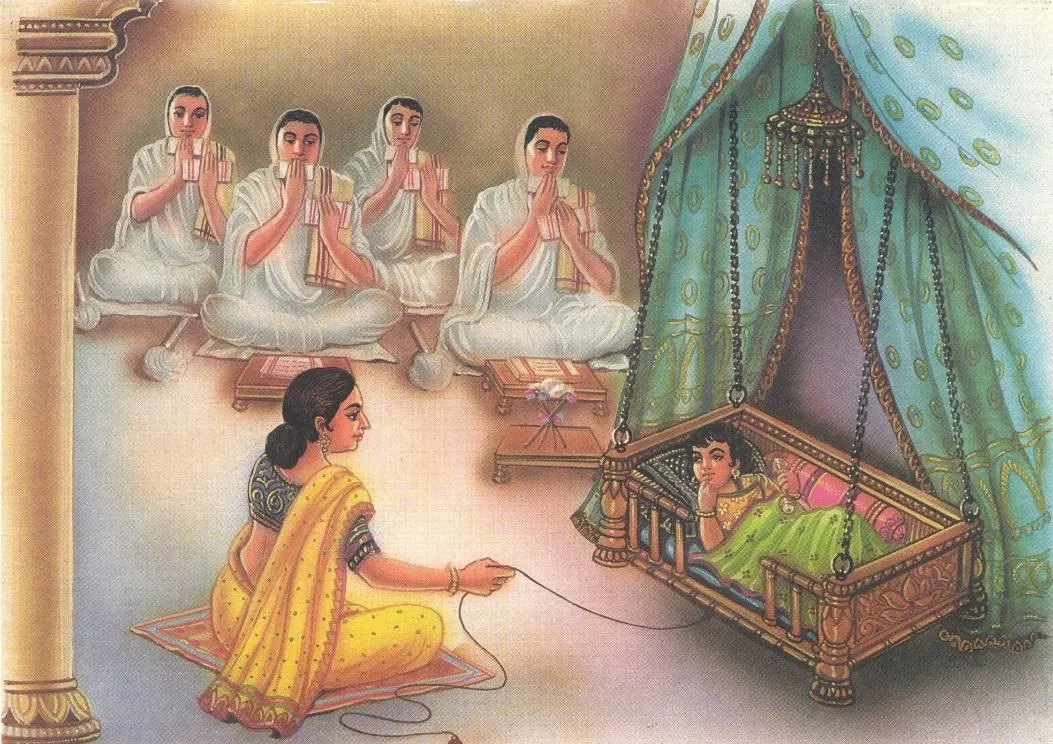
King Dasharatha of Ayodhya had no children, which caused him great distress. He asked his guru, Maharishi Vashishtha, for a solution to this problem. Guru Vashishtha advised him to perform a special yajna for obtaining a son. King Dasharath organized the Putrakameshti Yajna with full rituals, to which many sages and scholars were invited.
Upon the completion of the yajna, the fire god Agni appeared. He offered the king a sacred pudding as prasad. King Dasharatha distributed this prasad among his three queens (Kaushalya, Kaikeyi, and Sumitra). Due to the effect of that prasad, all three queens conceived. When the time came, on the ninth day of the bright fortnight in the month of Chaitra, Queen Kaushalya gave birth to a radiant son, who was named Ram.
After this, Queen Kaikeyi gave birth to Bharat, and Queen Sumitra gave birth to Lakshman and Shatrughna. The birth of the four princes sent a wave of joy through Ayodhya, and celebrations were held across the entire kingdom. Upon growing up, Lord Shri Ram received his education from Guru Vashishtha and became proficient in weaponry, statecraft, and dharma. He broke Lord Shiva’s bow at Sita’s swayamvara and married Mother Sita.
Lord Ram always followed dharma and truth in his life. Respecting his father’s command, he accepted fourteen years of exile. While living in the forest, he killed Ravana and established dharma. Through his life, Lord Shri Ram set an example of being an ideal son, an ideal brother, an ideal husband, and an ideal king. This is why he is called Maryada Purushottam.
Ayodhya
Ayodhya is a historic city in northern India, revered in Hinduism as the legendary birthplace of Lord Rama. It has been a major pilgrimage site for centuries and is also significant in Jainism and Buddhism. The city’s history has been marked by a long-standing religious dispute over the Babri Masjid-Ram Janmabhoomi site, culminating in the construction of the new Ram Mandir temple, inaugurated in 2024.
Lord Shri Ram
Lord Shri Ram is a major deity in Hinduism, revered as the seventh avatar of the god Vishnu and the righteous king of the ancient city of Ayodhya. His life and ideals, primarily narrated in the epic Ramayana, form a cornerstone of Hindu culture, emphasizing duty, morality, and the victory of good over evil. The recently inaugurated Ram Mandir in Ayodhya, built at a site traditionally believed to be his birthplace, stands as a significant modern cultural and pilgrimage site.
King Dasharatha
“King Dasharatha” refers to the legendary emperor and father of Lord Rama in the Hindu epic, the Ramayana. While not a physical site, his story is central to the cultural history of Ayodhya in India, believed to be the capital of his ancient kingdom. His life and decisions, particularly the promise to his wife Kaikeyi, set in motion the events of Rama’s exile, a foundational narrative in Hindu tradition.
Maharishi Vashishtha
Maharishi Vashishtha is a revered Hindu sage (rishi) prominently featured in ancient Indian scriptures like the Rigveda and the Ramayana. He is traditionally known as the family priest (kulguru) of the Solar Dynasty (Ikshvaku) and the teacher of Lord Rama, symbolizing wisdom, austerity, and dharma. While not a physical site, numerous temples and ashrams across India, such as the Vashishtha Cave in Rishikesh, are dedicated to him, commemorating his legendary spiritual legacy.
Putrakameshti Yajna
The Putrakameshti Yajna is a sacred Vedic fire ritual from ancient Hindu tradition, most famously described in the Ramayana. It was performed by King Dasharatha of Ayodhya to invoke the gods for a progeny, leading to the birth of his sons Rama, Bharata, Lakshmana, and Shatrughna. This ritual remains a symbolic reference in Hindu culture for ceremonies seeking the blessing of children.
Agni
“Agni” refers to the ancient Vedic fire god in Hinduism, who is considered the messenger between humans and the gods and a central deity in early rituals. Historically, the concept originates from the oldest Hindu scriptures, the Vedas (composed c. 1500–500 BCE), where Agni is celebrated as the sacred fire of sacrifice, purification, and the hearth. While not a physical site, the enduring cultural and ritual significance of Agni is embodied in Hindu temples and ceremonies, where fire remains a primary element of worship.
Lord Shiva’s bow
“Lord Shiva’s bow” is a legendary divine weapon from Hindu mythology, most famously associated with the epic Ramayana. According to the story, the god Shiva gave his immense bow to King Janaka, who later set the condition that whoever could string it would marry his daughter, Sita—a feat only the prince Rama accomplished. This event is a pivotal moment leading to Rama and Sita’s marriage and the subsequent narrative of the epic.
Sita’s swayamvara
“Sita’s swayamvara” refers to the pivotal event in the Hindu epic Ramayana where Princess Sita chooses her husband, Lord Rama, by stringing a divine bow. This ceremony, held in her father King Janaka’s kingdom of Mithila, was a contest where many princes failed before Rama succeeded, leading to their marriage and setting the epic’s central narrative in motion.