Hyderabad, Embrace truth in life, without it life will not be excellent. Those beings who resolve to follow truth, their worship of Lord Shiva, visiting temples, and listening to the Katha become meaningful. If truth is not adopted in life, none of these are meaningful. Truth is Narayana and Narayana is truth, Satyam Param Dhimahi.
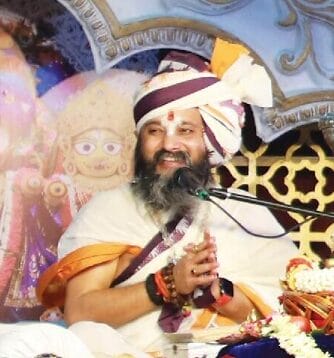
These sentiments were expressed on the second day of the Shrimad Bhagavat Katha Jnana Mahayagna organized by Srinivas Sanjay Kumar Totla at Maheshwari Bhavan in Begum Bazaar by the Katha speaker, Mahamandaleshwar Balyogi Brahmarshi Shree Shree 1008 Mahant Amritdas Khakiji. Maharaj said that when special grace occurs in a being’s life, then devotion to God enters.
Just as food cooked and offered to God becomes Prasad, similarly, when devotion is incorporated into a being’s life, the devotee attains salvation. In the world of emotions, emotion itself is the cause of grace. Therefore, the Supreme Being is never a subject of logic but of faith and trust.
Chanting God’s name described as the easiest path to attain the Lord in Kali Yuga
In Kali Yuga, there are very few means to attain the Lord. Among them, the simplest means is chanting the Lord’s name. So wherever you are, keep chanting the Lord’s name. Maharaj said that among all the scriptures in the world, at the beginning of each, there is praise of some deity, but only the Shrimad Bhagavat Katha is such a scripture that does not praise any deity but only venerates truth.
The Supreme Being by whose will the entire universe is created, sustained, and finally dissolved, that Lord alone illuminates everyone with His light. In this illusion of the world, even the wise and learned wander in delusion trying to understand truth. They perceive land in water and water on land, but cannot recognize it. Only the Lord is always beyond the workings of Maya. Such ultimate truth is venerated in the Shrimad Bhagavat Katha.
Message to adopt truth as the supreme duty of life
Truth is established at the beginning, middle, and end of the Katha. In the beginning, middle, and end of the Bhagavat, only the Lord is truth; nothing else in the world is truth. Maharaj said that Maharishi Vedavyas has written that truth is the greatest; there is no other duty. One in whose heart there is truth, the Supreme Being resides in that heart.
Adopt truth in your life, stay away from falsehood. If truth comes, our salvation will happen. The Shrimad Bhagavat describes those saints and devotees who remember the Lord’s name with a sincere and desireless heart. The Lord’s Katha not only brings salvation but also destroys the three types of afflictions: physical, divine, and material.
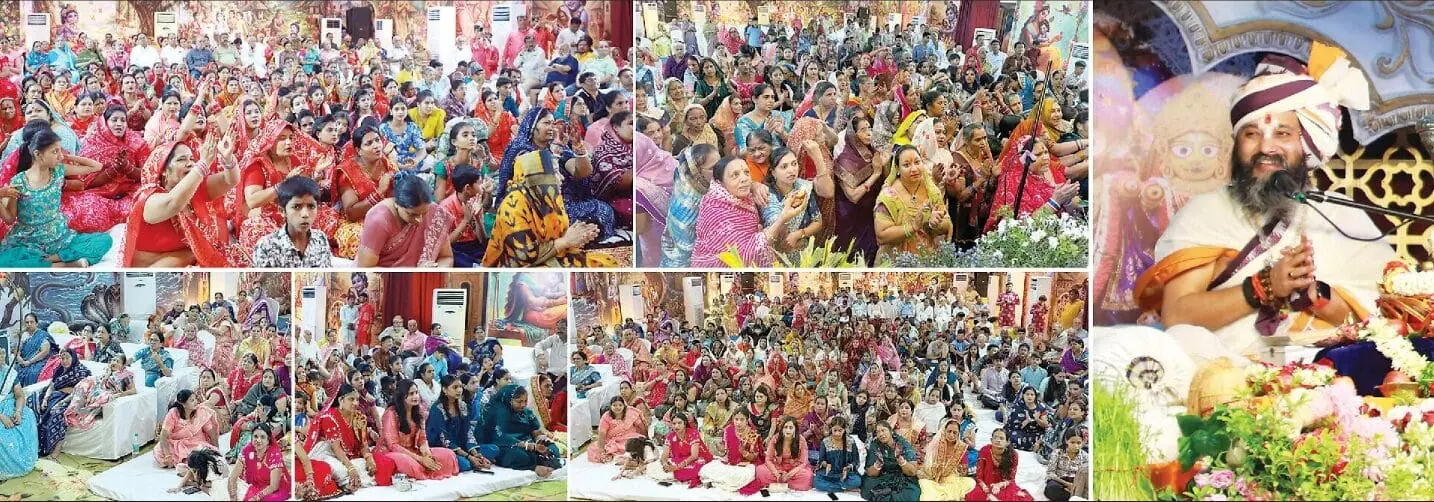
Listening to the Lord’s Katha brings Shri Krishna’s manifestation in the heart
Maharaj said that even if a person does not get time to read any other scripture, but takes refuge only in the Shrimad Bhagavat in life, salvation will still be attained