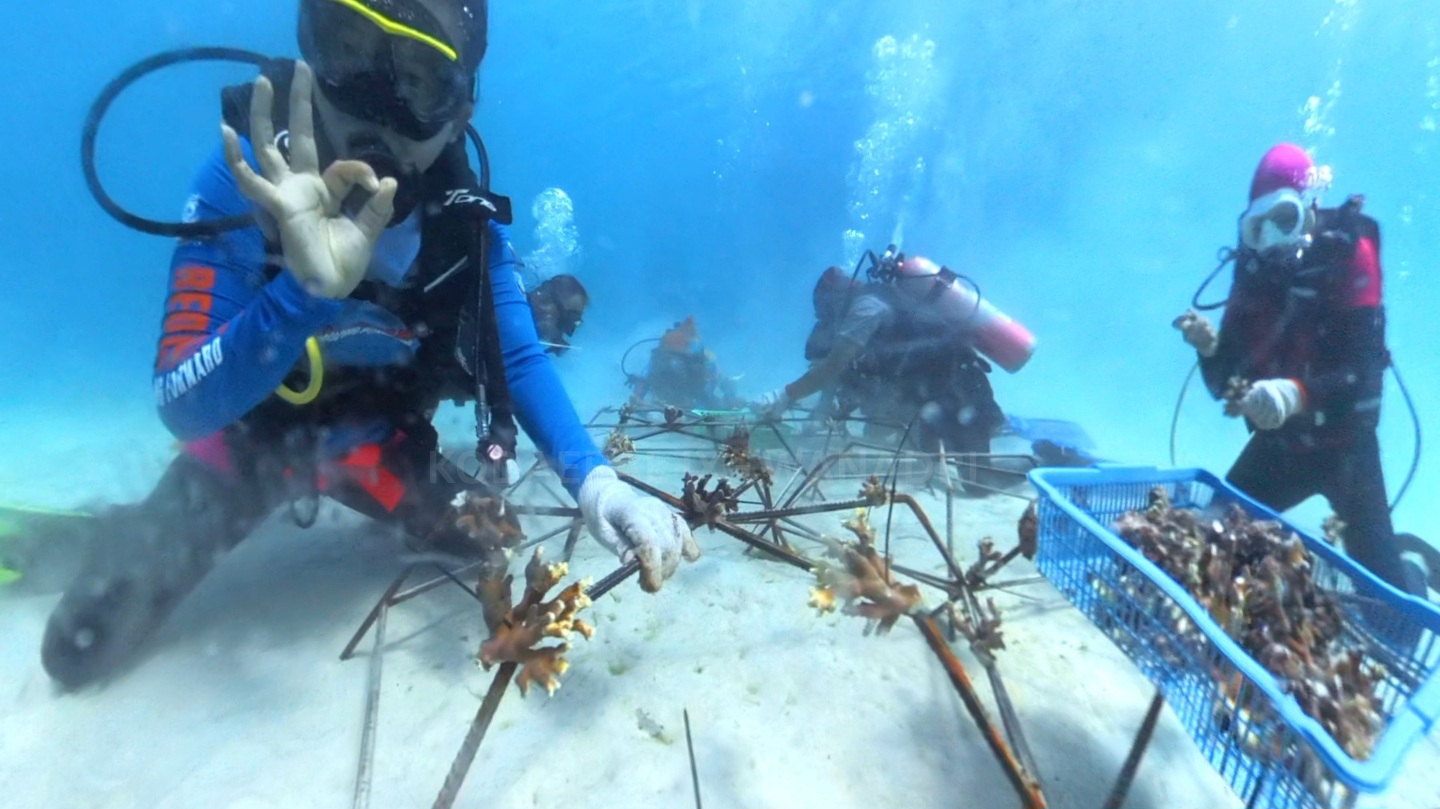
The commemoration of World Oceans Day 2026 became an important moment for efforts to save Indonesia’s marine ecosystem. On Buru Island, Maluku, hundreds of participants from researchers, divers, the Indonesian Navy, academics, and coastal communities united in a conservation expedition targeting the transplantation of 2,500 coral reef fragments while empowering women as frontline guardians of the sea.
Through the diving expedition “Rediscover Buru: Moving Forward – Coral Restoration and Beyond,” various parties collaborated to maintain the sustainability of the marine ecosystem in one of Indonesia’s high-biodiversity regions.
The activity, which has been ongoing since June 1, 2026, was initiated by Wanadri Women Divers (WWD) together with the Indonesian Navy through the Maritime Regional Command (Kodaeral) IX Maluku. The expedition involved the National Research and Innovation Agency (BRIN), local governments, universities, local communities, and several institutions concerned with the preservation of coastal and marine resources.
The momentum of this year’s World Oceans Day is considered increasingly relevant amid growing pressure on marine ecosystems due to climate change, pollution, and human activities that are not yet fully sustainable. Buru Island is one of the areas demonstrating these challenges.
Over the past week, the expedition team conducted mapping of coral reef conditions, documentation of marine biodiversity, analysis of water quality, and identification of various environmental threats that could disrupt coastal ecosystem sustainability.
The collected data is expected to serve as a scientific basis for developing long-term conservation strategies. Initial findings indicate signs of coral reef degradation in several coastal areas of Buru Island, potentially disrupting ecosystem balance and affecting the livelihoods of coastal communities.
As a concrete step, the expedition targets the transplantation of 2,500 coral reef fragments in the coastal areas of Jikumerasa Village and Hatawano Village. This restoration program is expected to accelerate the recovery of underwater habitats while raising public awareness about the importance of maintaining the health of Indonesian seas.
The peak of the activities took place on Monday (June 8, 2026) at Jikumerasa Beach, Buru Regency, coinciding with World Oceans Day. The event was attended by elements of local government, the Indonesian Navy, academics, and community leaders as a symbol of joint commitment to maintaining the sustainability of marine and coastal ecosystems.
Not only focusing on coral reef restoration, this expedition also developed a coastal women’s empowerment program called “Ibu Karang” (Mother Coral). Through this program, local women receive training in marine conservation, environmental education, capacity building for conservation cadres, and diving certification.
This approach places the community as the main actors in conservation, not just beneficiaries. Thus, efforts to protect the sea do not stop at physical restoration alone but also build social capacity that ensures the program’s sustainability in the long term.
The head of the Wanadri Women Divers expedition emphasized that successful marine conservation requires the involvement of various parties.
“The sea is not only a living space but also a heritage that must be protected together. Through Rediscover Buru: Moving Forward, we want to build a conservation movement that does not stop at ceremonial activities but produces real impacts for the ecosystem and coastal communities,” she said on Monday (June 8, 2026).
Amid increasing global attention to ocean health, the activities on Buru Island serve as an example of how cross-sector collaboration can be realized in concrete action. From scientific research and coral reef restoration to empowering coastal women, the entire series of activities shows that marine conservation requires the involvement of many parties and sustained commitment.
This expedition is a collaboration between Wanadri and the Indonesian Navy through Kodaeral IX Maluku, with support from Pattimura University, BRIN, BNPB, the Ministry of Tourism, Basarnas Ambon, the Maluku Provincial Government, Korem 151/Binaiya, and the Buru Regency Government through the Marine and Fisheries Office, Tourism Office, and Health Office.
The activity also received support from several partners, including PT Antam, PT Eiger, PT Pelni, and Pembangunan Jaya, which contributed to efforts to preserve Indonesian seas.
From Buru Island, the commemoration of World Oceans Day 2026 sends a strong message that the future of Indonesia’s seas is determined not only by policy but also by collective action taken today to protect the ecosystem that is the source of life for millions of coastal communities.