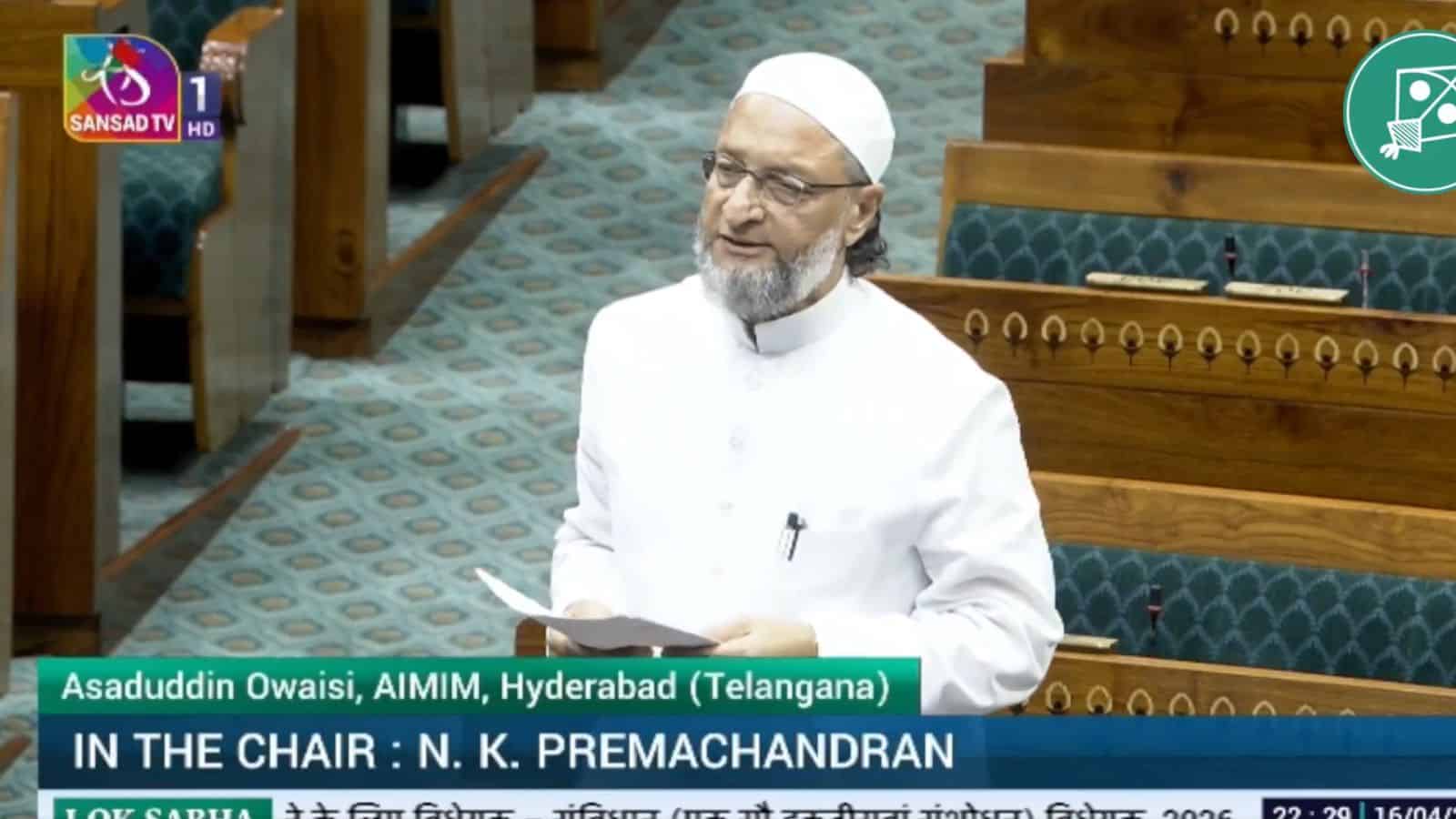
Hyderabad: AIMIM chief and Hyderabad MP Asaduddin Owaisi strongly opposed the Centre’s proposed Bills on delimitation, alleging that they would weaken the Opposition, distort federal balance, and dilute the political voice of minorities.
Speaking during a debate in the Lok Sabha on three bills introduced for amendments to the women’s quota law and setting up a delimitation commission, Owaisi said the government had brought the Bills at a time when Opposition members were engaged in Assembly elections, accusing it of attempting to push legislation using its “brute majority”.
“If these bills are passed, the Opposition’s voice will be subdued,” he said.
Linking the proposed Constitutional Amendment Bill with delimitation, the Hyderabad MP argued that allocating seats purely on the basis of population would disadvantage southern states. “Delimitation may not necessarily follow a fixed 10-year cycle or be strictly tied to the census. Instead, it would be influenced by the government’s discretion,” he said.
“The northern states will dominate politically while the southern states, despite contributing significantly to the economy, lose representation. This is not good for India’s democracy,” Asaduddin Owaisi said.
India’s southern states contribute nearly 30 per cent of Gross Domestic Product (GDP) and around 21 per cent of tax revenue, and a 19 per cent population growth contribution.
Owaisi also raised concerns about alleged “gerrymandering”, citing examples from Assam and Jammu and Kashmir, and claimed that Muslim-majority constituencies had been altered in a way that reduced their representation. “Minorities, particularly Muslims, were already underrepresented and cautioned that delimitation could further weaken their political voice. Is it in the national interest that a large section of the population would have limited representation in Parliament? Democracy should enable citizens not only to vote but also to become representatives and leaders,” he pointed out.
Calling India a “Union of States”, Owaisi stressed that diversity was the country’s strength and warned that the proposed changes could undermine it. He suggested adopting a model similar to Canada’s “grandfather clause” to ensure states do not lose seats solely based on population, and called for giving greater legislative balance between states.
He warned that delimitation could become a “permanent wound,” and accused the Centre of pursuing political gains at the cost of national unity. Asaduddin Owaisi also referred to a “hybrid model” proposed by the Telangana Chief Minister, suggesting seat allocation based on a mix of population, economic performance and federal balance.
He urged the government not to alienate Muslims, OBCs and southern states, and demanded that assurances made by the Union Home Minister regarding increased seats for states like Telangana be clearly incorporated into law rather than remaining verbal commitments.
Hyderabad assembly
The Hyderabad Legislative Assembly, officially known as the Telangana Legislative Assembly, is the state legislature for the Indian state of Telangana. Its history traces back to the Andhra Pradesh Legislative Assembly after which, following the Telangana movement, the new state and its assembly were formally established in 2014. The assembly currently convenes in Hyderabad, the joint capital of Telangana and Andhra Pradesh, within the historic **Legislative Assembly Building** constructed in 1913 for the Nizam’s administration.
Lok Sabha
The Lok Sabha is the lower house of India’s bicameral Parliament, located in New Delhi. Established by the Constitution of India in 1952, it is the primary legislative body where members are directly elected by the people. It holds significant power, including overseeing the government and approving the national budget.
Assam
Assam is a state in northeastern India known for its lush tea plantations, the mighty Brahmaputra River, and rich biodiversity, including Kaziranga National Park. Historically, it was the powerful ancient kingdom of Kamarupa and later the medieval Ahom Kingdom, which ruled for nearly 600 years and successfully resisted Mughal expansion. Its unique culture is a blend of various ethnic groups, celebrated through festivals like Bihu, traditional crafts, and distinctive cuisine.
Jammu and Kashmir
Jammu and Kashmir is a region in northern India, historically a princely state, known for its stunning Himalayan landscapes and diverse cultural heritage blending Hindu, Buddhist, and Islamic influences. Its modern history has been marked by the partition of British India in 1947, leading to a territorial dispute between India and Pakistan over the region. Today, it is administered by India as a union territory, renowned for destinations like Srinagar, the Dal Lake, and Hindu pilgrimage sites such as the Vaishno Devi temple.
Canada
Canada is a vast North American country that evolved from centuries of Indigenous history, followed by European colonization beginning in the 16th century, notably by France and Britain. It was formally established as a self-governing dominion in 1867 and is now a bilingual, multicultural federation known for its diverse landscapes and cities. Key cultural sites include national historic locations like the Quebec City fortifications, the Canadian Rocky Mountain Parks, and the Parliament Buildings in Ottawa.
Telangana
Telangana is a state in southern India, officially formed in 2014 after a movement to separate from Andhra Pradesh. Its history is deeply rooted in the region of the Deccan plateau, having been a major center of power for dynasties like the Satavahanas, Kakatiyas (notably at the Warangal Fort), and the Qutb Shahis of Golconda. The state’s culture is a distinct blend of Telugu traditions, celebrated through festivals, cuisine like Hyderabadi biryani, and historic monuments.
Union of States
The “Union of States” is not a specific cultural site, but a foundational political concept, most famously embodied by the United States of America. It refers to a federal union where individual states cede some sovereignty to a central government, a structure established by the U.S. Constitution in 1789 following the American Revolution. This model of governance has influenced numerous other federal systems around the world.
Parliament
The term “Parliament” most commonly refers to the Palace of Westminster in London, the meeting place of the UK’s House of Commons and House of Lords. The current Gothic Revival building was constructed between 1840 and 1870 after a fire destroyed much of the old palace, though the site’s history as a center of government dates back to the 11th century. It is a UNESCO World Heritage Site, famous for its iconic clock tower, Big Ben, and its role as the heart of British political life.