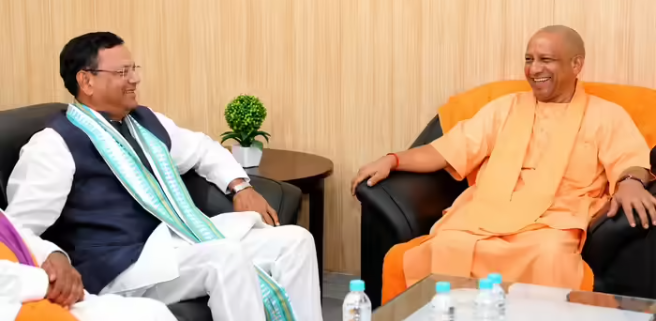
Lucknow, June 4, 2026. A new discussion began in Uttar Pradesh politics when Union Minister Pankaj Chaudhary met with Chief Minister Yogi Adityanath. This meeting is not being seen merely as a formal courtesy visit, but is being linked to the upcoming elections and the organizational restructuring of the Bharatiya Janata Party. Political analysts believe that the party has now fully entered election mode and is rapidly working on a strategy to strengthen the organization down to the booth level.
Over the past week, state president Pankaj Chaudhary and organization general secretary Dharmpal Singh had detailed discussions on all these issues with the high command in Delhi. Following that, consultations were also held with Chief Minister Yogi. The BJP stated that the reason behind this meeting was to review preparations for events and celebrations marking 12 years of the Modi government.
According to sources, the BJP may soon announce a new team for the state organization. It is anticipated that new faces will be given responsibilities in several districts and regional units. The party leadership is focused on promoting workers and leaders who have played a significant role in strengthening the organization in recent years. Additionally, responsibilities may be distributed keeping in mind social and regional balance.
Pankaj Chaudhary’s meeting with Chief Minister Yogi Adityanath is also considered important from the perspective of Purvanchal politics. The Purvanchal region plays a decisive role in upcoming electoral equations, and the BJP is preparing to further strengthen its hold there. It is believed that the meeting likely discussed issues such as organizational strengthening, electoral strategy, worker activism, and the party’s expansion in various regions.
The BJP leadership is continuously trying to convey that better coordination between the government and the organization is the key to electoral success. This is why the cycle of meetings and dialogues at the state level continues. The party is working on plans to activate workers through large-scale public outreach campaigns, membership drives, and organizational meetings in the coming days.
Political observers believe that after the new organizational team and new responsibilities are finalized, the BJP’s election campaign may become more aggressive. In this context, the meeting between Chief Minister Yogi and Pankaj Chaudhary is seen as an indicator of upcoming political developments, which the opposition is also keeping a close watch on.