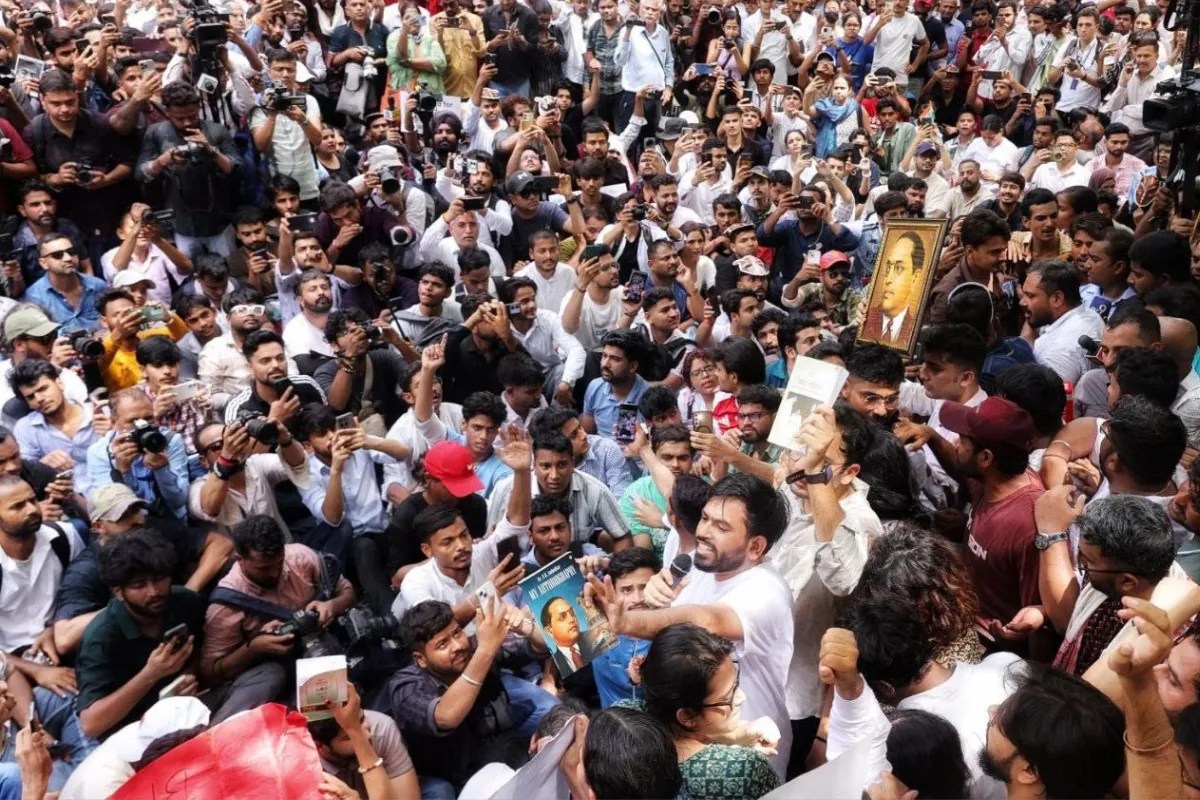
Delhi Protest CJP Takeaways: A day after the protest at Delhi’s Jantar Mantar, the founder of CJP targeted the central government over issues of national politics, the education system, and employment. He stated that over the last 10-12 years, the country’s politics has revolved around issues like Hindu-Muslim, but this has neither provided jobs for the youth nor solved problems related to their future.
At a press conference held in Chhatrapati Sambhajinagar, Maharashtra, he said that the focus of politics should now be on education, employment, and the future of the youth. He also reiterated the demand for the resignation of Union Education Minister Dharmendra Pradhan over the NEET paper leak and irregularities in the CBSE’s On-Screen Marking (OSM) system.
He said that his movement is not limited to the resignation of any minister. His aim is to reform the education system and ensure better opportunities for the youth. He stated that the movement will continue even after Dharmendra Pradhan’s resignation, and a broad agenda will be prepared for reforms in the education sector.
At the press conference, justifying the demand for Education Minister Dharmendra Pradhan’s resignation, he said that accountability should be fixed in controversies related to the examination system. He questioned that if mistakes occur repeatedly in a private company, the responsible person is removed, but despite serious incidents like exam paper leaks, no accountability is being fixed.
He said that until responsibility is fixed, the trust of students and parents in the system will not be fully restored.
He also responded to alleged comments made about the people who participated in the Jantar Mantar protest. He said that a large number of students and youth participated in the protest, raising their voices about their problems.
He questioned whether every person who asks questions of the government would be labeled anti-national. He said that instead of ignoring the questions of students, the opposition, and the media, they should be answered.
He disagreed with some people comparing his movement to youth movements and regime changes in neighboring countries. He said that India is a democratic country and there are constitutional and peaceful ways to express one’s views.
He said that the Jantar Mantar protest was completely peaceful and involved youth from different parts of the country. He also indicated that larger protests could be organized in the future.
He said that in the coming days, the movement will be expanded further on issues like employment, education, and examination system reforms. He believes that the voice of the country’s youth should be heard at the policy level, and the government should work seriously on these issues.
He said that this is not just a protest, but a campaign demanding improvement in the future of the youth and the country’s education system, which will continue further.