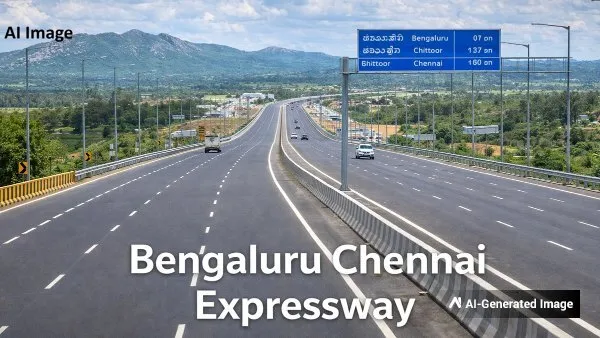
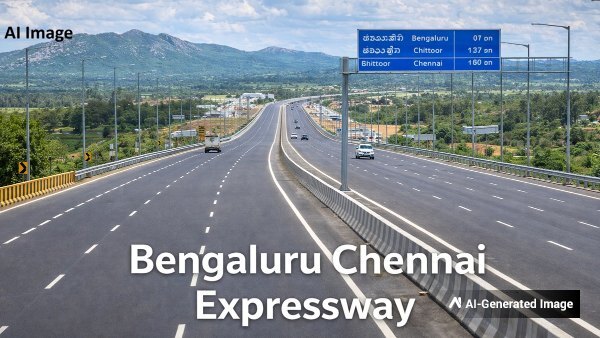
Bengaluru Chennai Expressway: Good news for the 262 km high-speed corridor, set to open on this day.
Bengaluru Chennai Expressway: The construction of the Bengaluru-Chennai Expressway, one of South India’s most significant infrastructure projects, has rapidly entered its final stages. Over 90% of the work on this expressway is already complete as of April 2026. The central government aims to open it to the public by June 2026.
This high-speed expressway connects Bengaluru to Chennai, and its inauguration is expected to revolutionize travel between the two cities. The current distance of 326 kilometers will be reduced to approximately 262 kilometers. Travel time is estimated to drop from 6-7 hours to just 2.5 to 3 hours.
Bengaluru Chennai Expressway: Work Completed Even in Hilly Terrain
– However, the most significant challenge in this project has been the section between Bayyareddypalli and Bangarupalem in Chittoor district. Construction was slow here due to the hilly and forested terrain, but this section has now also reached its final phase.
– The expressway has been designed as an 8-lane (initially 4-lane) access-controlled highway with the future in mind. The maximum speed limit for vehicles here is set at 120 km/h.
– Its route passes through Hoskote, Malur, V. Kota, Palamaner, Chittoor, and Ranipet before reaching Sriperumbudur.
Bengaluru Chennai Distance: Travel from Bengaluru to Chennai Will Become Easier
The impact of this project will not be limited to travel time alone; it will also give new momentum to economic development. Logistics hubs and industrial corridors are being developed in areas like Malur and Chittoor, which will create new employment opportunities. Meanwhile, real estate prices in Sriperumbudur and Hoskote have already seen a sharp rise.
Bengaluru Chennai High Speed Corridor: Announcement of Toll Rates
Regarding toll rates, it is estimated that the one-way toll for a car could be between ₹550 and ₹650, although the official announcement will be made at the time of inauguration. Furthermore, wayside amenities are being developed every 30-40 km, which will include facilities like petrol pumps, restaurants, and electric vehicle charging stations. This expressway is set to completely transform connectivity, business, and the way of travel in South India.
Bengaluru
Bengaluru, the capital of India’s Karnataka state, is a major tech hub known as the “Silicon Valley of India.” Historically, it was founded in the 16th century by Kempe Gowda I and later became a prominent British military station in the 19th century. Today, it blends its rich history, visible in sites like the Bangalore Palace and Tipu Sultan’s Summer Palace, with rapid modern urbanization.
Chennai
Chennai, formerly known as Madras, is the capital of the Indian state of Tamil Nadu and a major cultural and economic hub on the Coromandel Coast. Founded in 1639 by the British East India Company, its history is deeply tied to colonial trade and administration. The city is renowned for its classical South Indian arts, historic landmarks like Fort St. George and Kapaleeshwarar Temple, and as a center for the Tamil film industry.
Chittoor
Chittoor is a city in the southern Indian state of Andhra Pradesh, historically significant as part of various South Indian dynasties like the Pallavas, Cholas, and Vijayanagara Empire. It is best known as the gateway to the revered hill temple of Tirumala Venkateswara, a major Hindu pilgrimage site. The region’s history is also marked by its role in the medieval Carnatic wars and its agricultural prominence.
Sriperumbudur
Sriperumbudur is a town in Tamil Nadu, India, most famously known as the birthplace and memorial site of the 11th-century Hindu philosopher and saint Ramanuja. It gained global attention in 1991 as the location where former Indian Prime Minister Rajiv Gandhi was assassinated. Today, it is part of a major industrial and technological corridor, while remaining a significant pilgrimage center for Sri Vaishnavism.
Hoskote
Hoskote is a town in the Indian state of Karnataka, located about 30 kilometers east of Bangalore. Historically, it was a significant military outpost and a *jagir* (land grant) during the rule of the Mysore Kingdom, particularly under Hyder Ali and Tipu Sultan in the 18th century. Today, it is primarily known as a growing residential and industrial suburb, with its historical legacy overshadowed by its modern development.
Malur
Malur is a town in the Kolar district of Karnataka, India, with historical roots tracing back to the medieval period when it was a notable administrative and military outpost under the Vijayanagara Empire. Today, it is primarily known as an industrial and residential suburb near Bengaluru, with its historical significance reflected in local temples and remnants of its past fortifications.
Palamaner
Palamaner is a town in the Chittoor district of Andhra Pradesh, India, historically known for its 14th-century fort built by the Vijayanagara Empire. The site served as a strategic military outpost and later came under the control of local chieftains and the British. Today, its fort ruins and ancient temples reflect its significance in the region’s medieval history.
Ranipet
Ranipet is a town in Tamil Nadu, India, historically known for its large military cantonment established by the British East India Company in the late 18th century. It later became a major center for leather processing and tanning industries, which remain economically significant today. The town’s name is believed to derive from “Rani,” meaning queen, though the specific historical figure is unclear.