Japan’s stricter visa rules may drive away key contributors to society.
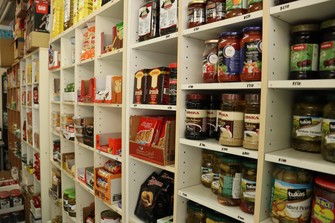
An import food shop run by a man from Bangladesh is seen in Saitama Prefecture in May 2026.
Foreign nationals running international restaurants and import food shops in Japan are facing the threat of going out of business. This is due to stricter requirements for the business manager visa, which is intended for foreign entrepreneurs.
Previously, people could obtain this status of residence by meeting one of two requirements: having over 5 million yen in capital or employing two or more people. But since October last year, capital of at least 30 million yen has become mandatory.
The hurdle was raised significantly after concerns were voiced in the Diet and elsewhere that some foreigners were abusing the system, using it to set up dummy companies and illicitly enter the country. Following the implementation of the tougher regulations, the number of monthly applications for the visa has dropped by 96%.
A three-year grace period has been implemented for people with this status of residence who are already running businesses. But they will still eventually need to meet the requirements.
On a national scale, fewer than 10% of companies have capital of 30 million yen or more. For small business owners, such as restaurant operators, raising that much money is extremely difficult. Some have already given up on continuing their businesses and have decided to return to their home countries.
There are areas across the country, such as the Shin-Okubo district of Tokyo, where clusters of shops selling foods from various countries have helped revitalize neighborhoods. If such stores were to close in succession, diversity in society would be lost.
Many ethnic restaurants also serve as places where foreign workers can enjoy the tastes of home and relax. There are concerns that the tougher rules could result in such communities disappearing.
People protest in front of the Diet against higher fees for residence status procedures, in Tokyo’s Chiyoda Ward, May 21, 2026.
It must be said that the Japanese government lightly imposed these uniform, stricter regulations without considering business owners’ circumstances. All the measures do is afflict those legitimately running businesses, and they should be reviewed without delay.
If there is misconduct, the proper course is first to grasp the actual situation and then respond case by case.
In the first place, the business manager status of residence was created to encourage entrepreneurship and contribute to Japan’s economic growth. The new policy runs counter to that very purpose.
For foreigners’ residence status in general, the burden of changes and renewals is also set to become much heavier. The Diet has passed a revision to the Immigration Control and Refugee Recognition Act that raises the maximum fee to 10 times the previous amount. There is a possibility that with expenses mounting, some may give up on living in Japan.
As depopulation advances in Japan, the presence of foreign nationals supports society. If Japan does nothing but tighten regulations, the number of people wanting to work in Japan could decline. If Japan comes across as exclusionary, it will become unable to sustain itself.
Shin-Okubo district of Tokyo
Shin-Okubo is a vibrant district in Tokyo known as the city’s main hub for Korean culture, often called “Tokyo’s Little Korea.” Its history began in the early 20th century when Korean residents settled there, and it grew significantly during the 1990s and 2000s with the rise of the Korean Wave (Hallyu), attracting young people with K-pop, Korean food, and cosmetics shops. Today, it remains a lively, multicultural area where visitors can experience Korean street food, music, and fashion alongside diverse international influences.
Diet
“Diet” is not a single place or cultural site, but rather a term referring to a legislative assembly, most famously the Imperial Diet of the Holy Roman Empire and the modern National Diet of Japan. The Imperial Diet was a deliberative body of the empire’s princes and estates that met from the Middle Ages until 1806, playing a key role in political and religious decisions. Today, the term is most commonly associated with Japan’s bicameral legislature, established in 1889 as part of the Meiji Constitution, which serves as
<
Shin-Okubo district of Tokyo
Shin-Okubo is a vibrant district in Tokyo known as Korea Town, centered around the area near Shin-Okubo Station on the Yamanote Line. Its history as a Korean cultural hub began in the 1980s and 1990s, when many Korean residents and businesses moved there from the older Ikebukuro area, attracted by lower rents. Today, it is famous for its Korean restaurants, K-pop shops, and street food, making it a major center for Korean pop culture in Japan.
Diet
The Diet, officially the National Diet Building, is the seat of Japan’s bicameral legislature, located in Tokyo’s Nagatachō district. Its construction began in 1920 and was completed in 1936, designed by architect Watanabe Fukuzo in a distinctive Western neoclassical style. The building has witnessed key moments in Japan’s modern political history, including the post-war adoption of the current constitution in 1947.
Saitama Prefecture
Saitama Prefecture, located just north of Tokyo, is a region that blends modern suburban life with rich historical roots. Historically part of Musashi Province, it developed as a key agricultural area and post-town on the Nakasendo highway during the Edo period. Today, Saitama is known for its cultural sites like the ancient Omiya Bonsai Village and the scenic Chichibu region, offering a mix of tradition and accessibility to the capital.
Tokyo’s Chiyoda Ward
Chiyoda Ward is the political and administrative heart of Tokyo, home to the Imperial Palace, which was the site of the Edo Castle during the Tokugawa shogunate. It also houses the National Diet Building, the Prime Minister’s Office, and numerous government ministries, making it Japan’s center of governance. The ward’s name, meaning “field of a thousand generations,” reflects its historical and symbolic role as the nation’s capital.