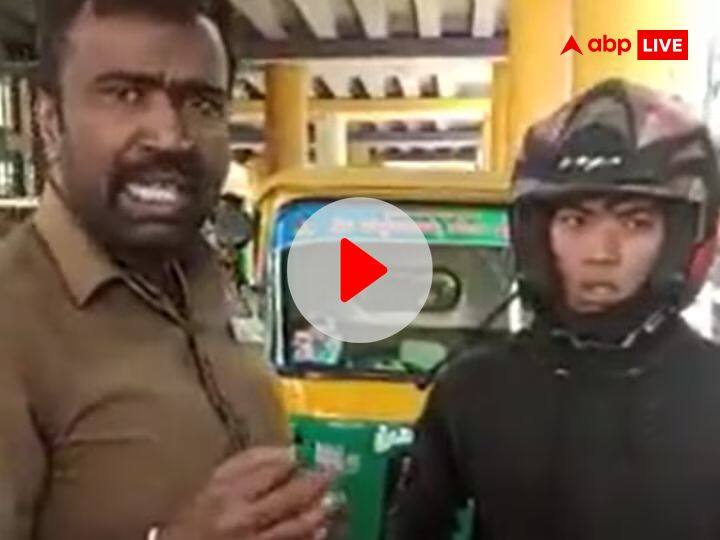
Auto Driver Assaults Rapido Driver: Bengaluru Police have registered a case based on a viral video in which an auto-rickshaw driver is seen breaking a bike taxi rider’s helmet, abusing him, and issuing threats. The video was flagged on social media and has been widely criticized. The bike taxi driver is reported to be from the northeast and works with Rapido.
In the video, the auto driver can be heard saying that Rapido was running an illegal business. He claimed the bike taxi driver had come from another country and was taking business away from other auto drivers. He said this is a threat to the auto industry.
Police Take Immediate Action
The video was shot by a witness, who later posted about the incident on Twitter, tagging the police and requesting action. Bengaluru Police immediately took note of the tweet and assured that strict action would be taken against the accused. Responding in a tweet, Bengaluru City Police stated that police in Indiranagar are investigating the incident. Strict and necessary action will be taken following the investigation.
Strict action should be taken against this auto driver under the law.
Is there no such thing as law in Bangalore City?
Meanwhile, other social media users responded with tweets condemning the incident, with one section also questioning the police. One user wrote that they also have the auto’s number – Ka03AJ6248. He was being very rude to the Rapido driver and even snatched his helmet. They said if bike taxis were illegal, the government would have banned them.
Case Against Rapido is Pending in Court
Another social media user commented, stating that those commenting against the auto driver should please note that the case against Rapido is still in court. As per rules, vehicles with white boards cannot be used for taxis. Despite operating as a taxi, the driver does not pay any additional tax to the RTO due to the white number plate. They also have no insurance, which is a risk for passengers.
Bengaluru
Bengaluru, the capital of India’s Karnataka state, is a major tech hub known as the “Silicon Valley of India.” Historically, it was founded in the 16th century by Kempe Gowda I, with its modern growth stemming from its establishment as a British military station in the 19th century and later as a major center for public sector industry and science after Indian independence. Today, it blends its historic landmarks like the Bangalore Palace with a dynamic, cosmopolitan culture.
Karnataka
Karnataka is a state in southwestern India with a rich cultural heritage shaped by successive empires like the Chalukyas, Hoysalas, and Vijayanagara. It is renowned for historical sites such as the ruins of Hampi, the intricate temples of Belur and Halebid, and the colonial architecture of Bengaluru. Today, it is a major hub for technology and industry while preserving classical arts like Carnatic music and Bharatanatyam dance.
Indiranagar
Indiranagar is a vibrant, upscale residential and commercial neighborhood in eastern Bengaluru, India. It was developed in the 1970s on land that was once part of the historic Domlur village, named after former Prime Minister Indira Gandhi. Today, it is famous for its bustling streets lined with cafes, boutiques, and pubs, representing the modern, cosmopolitan face of the city.
Bangalore City
Bangalore (officially Bengaluru) is the capital of India’s Karnataka state, known globally as a major technology and innovation hub often called the “Silicon Valley of India.” Historically founded in the 16th century, it later became a prominent British colonial military station in the 19th century, which influenced its famous parks and temperate climate. Today, it blends its historic landmarks like the Bangalore Palace and Tipu Sultan’s Summer Palace with a dynamic, modern metropolitan culture.
RTO
“RTO” is not a widely recognized specific cultural site or place in a historical context. It is most commonly an abbreviation for **Regional Transport Office** in India, which is a government agency responsible for vehicle registration and driver licensing, established as part of national transport administration. Therefore, it lacks a historical narrative as a cultural destination but is a modern administrative entity critical to daily civic life.