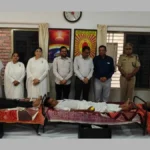
Devprayag, June 3. A severe road accident occurred in Devprayag, Uttarakhand on the morning of June 2, where an Innova car carrying pilgrims from Rajasthan on the Char Dham Yatra went out of control, plunged into a deep gorge, and then fell into the Ganga River.
The accident was so horrific that the car broke through the safety railing and sank directly into the river. A total of 8 people were in the vehicle, one of whom, a child, has been hospitalized in critical condition.
Upon receiving information about the incident, various teams of the SDRF immediately began a rescue operation. After intense efforts, the teams have so far recovered 4 bodies from the river, which have been handed over to the police.
To search for the 3 missing travelers, SDRF teams are conducting an intensive search operation in potential areas of the river using rafts and modern equipment.
On this tragic incident, Rajasthan Chief Minister Bhajanlal Sharma expressed deep condolences and discussed the matter over the phone with Uttarakhand Chief Minister Pushkar Singh Dhami.
Chief Minister Dhami has given strict instructions to the local administration to provide treatment for the injured and all possible assistance to the affected families. Currently, the entire administration and rescue teams are engaged in searching for the missing travelers to clarify the situation of the incident.
Devprayag
Devprayag is a sacred town in the Indian state of Uttarakhand, known as the confluence of the Alaknanda and Bhagirathi rivers, which together form the holy Ganges River. According to Hindu mythology, it is the site where the sage Dev Shringi performed penance, and it holds deep religious significance as one of the Panch Prayag (five confluences). Historically, it has been a key pilgrimage destination for centuries, with ancient temples like the Raghunathji Temple adding to its spiritual and cultural heritage.
Uttarakhand
Uttarakhand, known as the “Land of the Gods,” is a state in northern India renowned for its stunning Himalayan landscapes and sacred Hindu pilgrimage sites. Historically, the region was part of the ancient kingdom of Kuru and later the Garhwal and Kumaon kingdoms, before being carved out of Uttar Pradesh to become a separate state in 2000. Its rich cultural heritage includes the Char Dham pilgrimage circuit (Badrinath, Kedarnath, Gangotri, and Yamunotri) and the origins of the Ganges River.
Char Dham Yatra
The Char Dham Yatra is a revered Hindu pilgrimage circuit in the Indian Himalayas, encompassing four sacred sites: Yamunotri, Gangotri, Kedarnath, and Badrinath. Each site is dedicated to a different deity and is believed to offer spiritual liberation, with the tradition dating back to the 8th-century philosopher Adi Shankaracharya, who established the pilgrimage to unite diverse Hindu traditions. The journey, often undertaken between April and November, involves trekking through rugged terrain and is considered a life-changing experience for devotees seeking purification and blessings.
Ganga River
The Ganga River, considered the holiest
Devprayag
Devprayag is a sacred town in the Indian state of Uttarakhand, renowned as the confluence (sangam) of the Alaknanda and Bhagirathi rivers, which together form the holy Ganges River. According to Hindu mythology, this is where the sage Devsharma meditated, and it is also believed that Lord Rama performed a ritual here to atone for killing the demon king Ravana. The town’s history is deeply intertwined with ancient Hindu texts, and it remains a significant pilgrimage site, featuring the Raghunathji Temple dedicated to Lord Rama.
Uttarakhand
Uttarakhand, known as the “Land of the Gods,” is a state in northern India renowned for its Himalayan landscapes and sacred Hindu pilgrimage sites. Historically, the region was part of the ancient kingdom of Kuru and later ruled by the Katyuri and Chand dynasties before becoming a part of British India. It was carved out of Uttar Pradesh in 2000 to become India’s 27th state, preserving its rich cultural heritage and natural beauty.
Char Dham Yatra
The Char Dham Yatra is a revered Hindu pilgrimage circuit in the Indian Himalayas, encompassing four sacred sites: Yamunotri, Gangotri, Kedarnath, and Badrinath. Each site is dedicated to a different deity—Yamuna, Ganga, Shiva, and Vishnu respectively—and is believed to offer spiritual liberation. The tradition dates back centuries, with roots in ancient scriptures, and was formally revived in the 19th century by the 8th-century philosopher Adi Shankaracharya, who established the pilgrimage as a path to salvation.
Ganga River
The Ganges (Ganga) River is a sacred and vital waterway in India, flowing over 2,500 kilometers from the Himalayas to the Bay of Bengal. For millennia, it has been revered in Hinduism as a goddess and a purifier, supporting countless civilizations, cities, and agricultural communities along its banks. Its history is deeply intertwined with Indian culture, serving as a site for spiritual rituals, trade, and daily life, though modern pollution poses significant challenges to its ecosystem and religious significance.
Alaknanda River
The Alaknanda River is a major tributary of the Ganges in northern India, originating from the Satopanth Glacier and the Bhagirath Kharak Glacier in the Himalayas. It holds great religious significance in Hinduism, as it flows through sacred towns like Badrinath and is considered the source of the Ganges at its confluence with the Bhagirathi River in Devprayag. Historically, the river has been a vital route for pilgrims and trade, and it is known for its powerful currents and the 2013 Uttarakhand floods that devastated the region.
Bhagirathi River
The Bhagirathi River is a sacred Himalayan river in India, considered the source stream of the Ganges. It originates from the Gangotri Glacier at Gaumukh and flows through the town of Gangotri, a major Hindu pilgrimage site. According to Hindu mythology, the river is named after King Bhagiratha, who performed intense penance to bring the Ganges down to Earth to purify the ashes of his ancestors.
Raghunathji Temple
Raghunathji Temple is a prominent Hindu temple located in Jammu, India, dedicated to Lord Rama, an incarnation of Vishnu. Built by the Dogra king Maharaja Gulab Singh in the 19th century and completed by his son Maharaja Ranbir Singh, it is a significant example of Sikh and Mughal architectural styles. The temple complex houses several shrines and is known for its historical and religious importance in the region.
Badrinath
Badrinath is a sacred Hindu town located in the Indian state of Uttarakhand, nestled in the Garhwal Himalayas. It is one of the four sites in the Char Dham pilgrimage circuit and is dedicated to Lord Vishnu, who is worshipped as Badrinarayan. The town’s history dates back thousands of years, with the main temple believed to have been established by the 9th-century philosopher Adi Shankaracharya, though it has undergone several renovations over the centuries.