Jakarta –
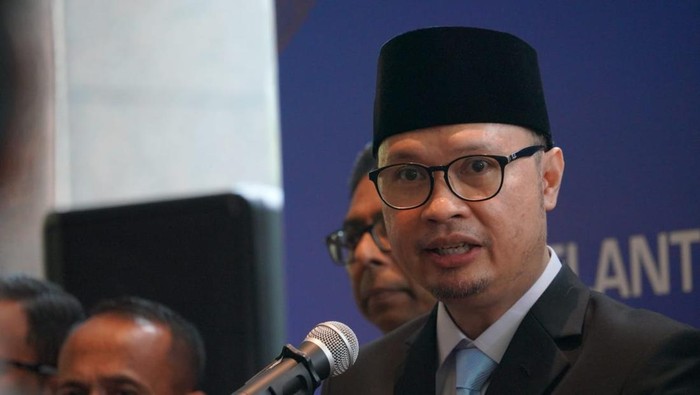
The Director General of Immigration at the Ministry of Immigration and Corrections, Hendarsam Marantoko, explained how the fugitive status of a U.S. citizen identified as AW, also known as BW, AYW, or JW, was uncovered. He said it began with a woman identified as NM, who came to the Indonesian Directorate General of Immigration with her two children in early December 2024.
NM claimed that her husband, the perpetrator AW, restricted her freedom of movement. As a result, NM’s residence permit had expired for about five years and was not renewed.
NM also stated that she had been a victim of sexual abuse by her husband. The Indonesian Immigration then facilitated NM and her children’s return to the United States on December 7, 2024.
“The principle of selective policy in Indonesian immigration is consistently enforced,” said Hendarsam in a statement on Monday, June 8, 2026.
Subsequently, Immigration coordinated with the U.S. Embassy regarding the perpetrator’s profile. It was discovered that the perpetrator’s legal status showed he had changed his identity multiple times over 15 years since entering Indonesia.
Hendarsam explained that AW entered Indonesia on November 7, 2011. He fled legal proceedings for a sexual abuse case in the U.S.
AW became a U.S. citizen through naturalization on May 4, 2000. He held a U.S. passport that expired in 2010.
Finally, the Directorate General of Immigration received a request for arrest assistance from the U.S. Embassy on March 5, 2026, to apprehend AW. Investigation results and public information led the team to AW’s residence in Sawangan, Depok.
“We ensure that every foreigner in Indonesian territory must not only meet administrative requirements. They must also not endanger public security and order. For any violations, we will act firmly to uphold state sovereignty, because Immigration is for the people,” stated Hendarsam.
Hendarsam said AW committed serious immigration violations, namely using false identities and misusing travel documents. “As regulated in Law Number 6 of 2011,” Hendarsam emphasized.
AW was then detained at a detention and deportation facility on June 4, 2026. During AW’s deportation process, Indonesian Immigration collaborated with the U.S. Marshals.
“This success proves that immigration supervision and law enforcement functions run effectively through synergy and good cooperation with law enforcement agencies and friendly nations,” Hendarsam concluded.
AW Arrested in House Bunker
The Directorate General of Immigration arrested a foreign national from the United States identified as AW. The man was wanted by U.S. authorities for a sexual abuse case in his country.
AW was arrested while hiding in a bunker at his home in the Sawangan area, Depok City, West Java, on Thursday, April 23.
“Secured a U.S. foreign national identified as AW in a bunker at his residence in Sawangan, Depok,” stated the Directorate General of Immigration on their Instagram account @ditjen_imigrasi on Friday, June 5.
Sawangan
Sawangan is a coastal district in Depok, West Java, Indonesia, known for its scenic beaches and resorts. Historically, the area was a significant fishing village and later developed into a tourist destination, particularly popular for its sunset views and seafood. It also played a role in local trade routes, connecting the inland region of Depok to the Sunda Strait.
Depok
Depok is a city in West Java, Indonesia, known historically as a planned colonial settlement established in the 18th century by Cornelis Chastelein, a Dutch East India
Sawangan
Sawangan is a coastal district in Depok, West Java, Indonesia, historically known as a fishing village and a popular weekend retreat for Jakarta residents. Its name is believed to derive from the Sundanese word “sawangan,” meaning a place to view or look out, referencing its scenic beaches along the Sunda Strait. While modern development has transformed much of the area into a tourist destination with resorts and water parks, it retains a laid-back atmosphere and remains a gateway to the nearby Thousand Islands.
Depok
Depok is a city in West Java, Indonesia, known historically as a former colonial plantation estate established by Cornelis Chastelein, a Dutch merchant, in the 18th century. It later developed into a key educational hub, home to the University of Indonesia. Today, Depok is a rapidly growing suburban area within the Greater Jakarta region, blending its colonial past with modern urban development.
West Java
West Java is a province in Indonesia known for its rich cultural heritage and natural beauty, including volcanic landscapes and tea plantations. Historically, it was a center of the Sundanese kingdom of Pajajaran, which thrived before the arrival of Islam and later European colonization. Today, it remains a vibrant region where traditional arts like angklung music and wayang golek puppetry are preserved.
Jakarta
Jakarta is the capital and largest city of Indonesia, located on the northwest coast of Java. Originally a small port town called Sunda Kelapa, it was renamed Jayakarta in the 16th century, then Batavia under Dutch colonial rule, before becoming Jakarta after Indonesia’s independence in 1945. Today, it is a bustling metropolis known for its mix of cultures, historic landmarks like the Old Town (Kota Tua), and ongoing challenges with congestion and flooding.
Indonesia
Indonesia is a vast archipelago nation in Southeast Asia, comprising thousands of islands with a rich history shaped by Hindu-Buddhist kingdoms, Islamic sultanates, and centuries of Dutch colonial rule. It declared independence in 1945, becoming a diverse republic known for its cultural heritage, including Borobudur temple and Bali’s traditions. Today, Indonesia is the world’s fourth most populous country, blending modern development with deep-rooted customs.
United States
The United States is a large, diverse country in North America, founded in 1776 after declaring independence from Great Britain. Its history includes westward expansion, the Civil War over slavery, and its rise as a global economic and military power in the 20th century. Today, it is known for its cultural influence, technological innovation, and status as a land of immigrants.
Sunda Strait
The Sunda Strait is a narrow waterway located between the Indonesian islands of Java and Sumatra, connecting the Java Sea to the Indian Ocean. Historically, it has been a crucial maritime route for trade and naval movements, most notably being the site of the 1883 catastrophic eruption of the Krakatoa volcano, which caused massive tsunamis and reshaped the surrounding geography. Today, the strait remains a key shipping channel, though it is known for its strong currents and hazardous navigation conditions.
Dutch East India
The Dutch East India Company (VOC) was a powerful trading corporation established in 1602, which dominated commerce between Europe and Asia for two centuries. It operated as a quasi-governmental entity, wielding military and colonial power, particularly in the Indonesian archipelago, where it established a lucrative monopoly on spices. The VOC’s influence declined in the late 18th century, leading to its dissolution in 1800, with its territories eventually becoming part of the Dutch colonial empire.