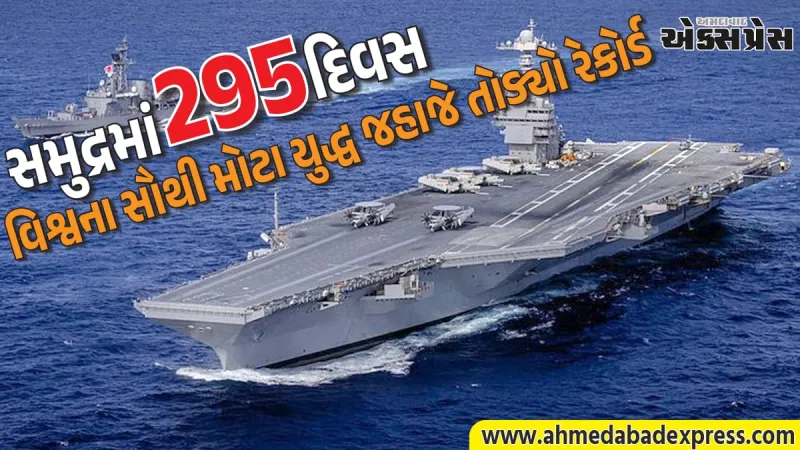
The world’s largest aircraft carrier, the USS Gerald R. Ford, has set a new record for the longest deployment in the last 50 years by spending 295 consecutive days at sea. This deployment, which began in June 2025, spanned military operations in Venezuela and the conflict with Iran. However, alongside this record, serious questions have been raised about the crew’s mental health, equipment wear and tear, and incidents like the fire that broke out in the laundry.
The world’s largest aircraft carrier, the USS Gerald R. Ford, broke the US record yesterday – Wednesday – for the longest deployment since the Vietnam War. The Ford’s deployment lasted nearly 10 months. During this deployment, it participated in both the military operation in Venezuela in February and the subsequent blockade against Iran. However, questions are also being raised about the ship’s extended deployment.
According to data compiled by the U.S. Naval Institute News, the ship’s 295th day at sea surpassed the previous record for the longest carrier deployment in the last 50 years. Previously, in 2020 – during the COVID-19 pandemic – the USS Abraham Lincoln was deployed for 294 days.
This massive warship’s prolonged deployment has raised questions about the impact on sailors being away from home for long periods, while also expressing concern about increased strain on the ship and its equipment. Notably, the ship has already experienced a fire incident, which necessitated a lengthy repair period.
First Venezuela, Then Iran
The Ford’s deployment began last June (2025), when it departed its homeport in Norfolk, Virginia, for the Mediterranean Sea. In October, the U.S. military redirected the ship toward the Caribbean Sea. This aircraft carrier recently participated in the military operation launched to capture Venezuela’s then-President Nicolas Maduro from his residence. Subsequently, it faced more combat; during operations against Iran, it was redeployed to the Middle East region. The ship participated in the initial stages of the conflict with Iran while positioned in the Mediterranean Sea; it then passed through the Suez Canal, entering the Red Sea in early March.
However, a fire breaking out in the ship’s laundry department forced it to return to the Mediterranean for repairs.
Senator Expresses Concern Over Long Deployment
During this time, it was stated that this long and record-breaking deployment has had a “serious impact” on the crew’s mental health and overall well-being. It was noted that, as a result of the fire incident, approximately 600 sailors were left without sleeping quarters for a period of time.
In a statement, a comment was made: “They should be home with their families, not sent around the world at the behest of a president who views the U.S. military as his private palace guard.”
USS Gerald R. Ford
The USS Gerald R. Ford (CVN-78) is the lead ship of the United States Navy’s newest class of nuclear-powered aircraft carriers, commissioned in 2017. It is named after the 38th U.S. President and incorporates advanced technologies, including electromagnetic aircraft launch systems, designed to increase efficiency and operational capability over previous Nimitz-class carriers.
Venezuela
Venezuela is a South American country known for its diverse landscapes, including the Andes Mountains, the Amazon rainforest, and Angel Falls, the world’s highest uninterrupted waterfall. Historically, it was a Spanish colony until the early 19th century, when it became a leading force in the independence movement led by Simón Bolívar. Its modern cultural identity is shaped by a mix of Indigenous, African, and Spanish influences, reflected in its music, art, and traditions.
Iran
Iran, historically known as Persia, is a country in Western Asia with one of the world’s oldest continuous major civilizations, dating back to the Elamite kingdoms of the 4th millennium BCE. It is home to numerous UNESCO World Heritage Sites, including the ancient ceremonial capital of Persepolis, founded in the 6th century BCE by the Achaemenid Empire. The nation’s rich cultural heritage is a complex tapestry of pre-Islamic Zoroastrian traditions and profound Islamic art, architecture, and scholarship that flourished after the 7th-century Arab conquest.
USS Abraham Lincoln
The USS Abraham Lincoln (CVN-72) is a Nimitz-class nuclear-powered aircraft carrier commissioned in 1989, named for the 16th U.S. president. It has been a key asset in numerous U.S. military operations, including the Gulf War and the 2003 invasion of Iraq, and famously served as the backdrop for President George W. Bush’s “Mission Accomplished” speech in 2003. The carrier remains an active part of the U.S. Pacific Fleet, undergoing multiple deployments and refueling overhauls throughout its service.
Norfolk, Virginia
Norfolk, Virginia, is a historic port city on the Chesapeake Bay, founded in 1682. It grew into a major naval and maritime hub, home to the world’s largest naval base, Naval Station Norfolk, established in 1917. The city’s history is deeply tied to American military, trade, and shipbuilding, with its waterfront playing a central role from the colonial era through today.
Mediterranean Sea
The Mediterranean Sea is a historically pivotal body of water that served as the cradle for numerous ancient civilizations, including the Egyptians, Phoenicians, Greeks, and Romans. Its role as a major trade and cultural exchange route for millennia has profoundly shaped the development of Europe, North Africa, and Western Asia. Today, it remains a vital corridor for global shipping, tourism, and geopolitical activity.
Caribbean Sea
The Caribbean Sea is a vast tropical body of water in the Western Hemisphere, bounded by the islands of the Caribbean, Central America, and northern South America. Historically, it was a central corridor for European exploration and colonization after Christopher Columbus’s 1492 voyage, becoming a major route for the transatlantic slave trade and colonial commerce. Today, it is renowned for its coral reefs, diverse marine life, and as a premier global tourist destination.
Suez Canal
The Suez Canal is a 120-mile artificial sea-level waterway in Egypt, connecting the Mediterranean Sea to the Red Sea. It was constructed between 1859 and 1869 under the direction of French diplomat Ferdinand de Lesseps, significantly shortening the maritime route between Europe and Asia by eliminating the need to sail around Africa. Today, it remains one of the world’s most critical and strategic shipping lanes, managed by Egypt’s Suez Canal Authority.