Successful Completion of Re-girdering Work on 113-Year-Old Railway Bridge Over the Mahisagar River
The Vadodara Division of Western Railway has successfully completed the re-girdering work of all 8 spans of Bridge No. 624 over the Mahisagar River on the Ahmedabad-Vadodara rail section. This is a historic achievement for Indian Railways, where a steel open web girder, 67.5 meters long and weighing approximately 320 tons, was replaced on a running railway line for the first time using road crawler cranes with capacities of 600 tons and 800 tons.
Regarding this historic achievement, the Divisional Railway Manager of Vadodara Division stated that the successful re-girdering of all 8 spans of this 113-year-old important railway bridge over the Mahisagar River is an excellent example of the engineering expertise, innovation, and team spirit of the Vadodara Division. It was mentioned that this work was completed under extremely challenging conditions, within the stipulated time frame, and with minimal blockages. Congratulations were extended to all officers and staff from the Bridge, TRD, P-Way, Operating, Electrical, and Mechanical departments involved in this remarkable success.
Water Flow Made the Work Challenging
Built in 1913 during British rule, this bridge is a vital railway structure over the Mahisagar River. Due to the year-round water flow in the river, the re-girdering work on this bridge was extremely challenging. Under the project, steel open web girders, 67.5 meters long and weighing approximately 320 tons each, were replaced. This ambitious project was completed in two phases. In the first phase, the girders of the 6 middle spans of the bridge were replaced, while in the second phase, the work on the remaining 2 end spans was successfully completed. The entire project was completed within a period of just one year, and a total of 8 mega blocks were taken, each lasting approximately five and a half hours.
Launching of Girders Using Cranes with Super Lift
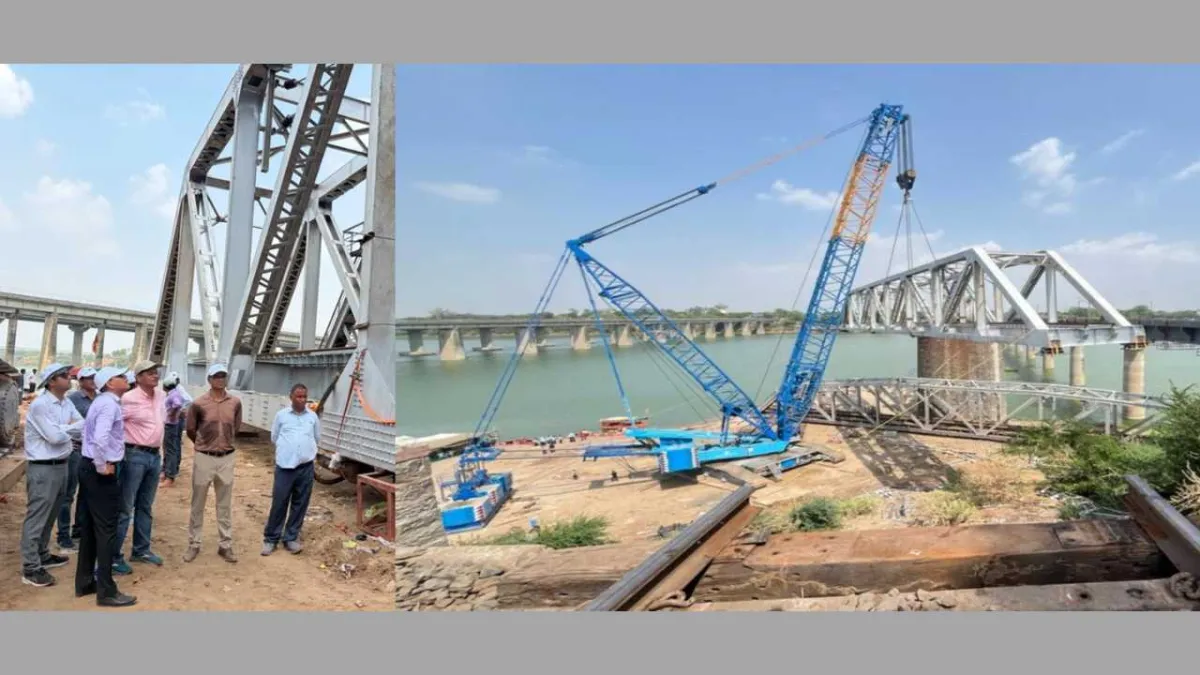
For the re-girdering work of the six middle spans, two crawler-type road cranes with a capacity of 600 tons each were used, each equipped with a 200-ton super-lift arrangement. To position the cranes within the river, a specially designed sand pump was installed on a large boat to prepare an artificial sand bed approximately 30 meters wide. The cranes were set up on this platform, and the girder replacement work was completed safely and successfully.
Due to space constraints at both end spans of the bridge, deploying two cranes was not possible. Addressing this challenge, engineers replaced the girders of the end spans using an 800-ton capacity crawler-type road crane fitted with a 300-ton super-lift arrangement. The use of this innovative technique resulted in significant savings in cost, traffic blocks, and power blocks. According to available records, re-girdering work of steel open web girders of such a large span using a road crane has not been done previously on any railway.
The successful completion of the re-girdering project of the Mahisagar River bridge is a significant milestone in the infrastructure upgrade program of Western Railway, which will further enhance safety, reliability, and operational efficiency on the Ahmedabad-Vadodara rail section.