With active neighborhood diplomacy, how is Benin’s new president reshaping his alliances?
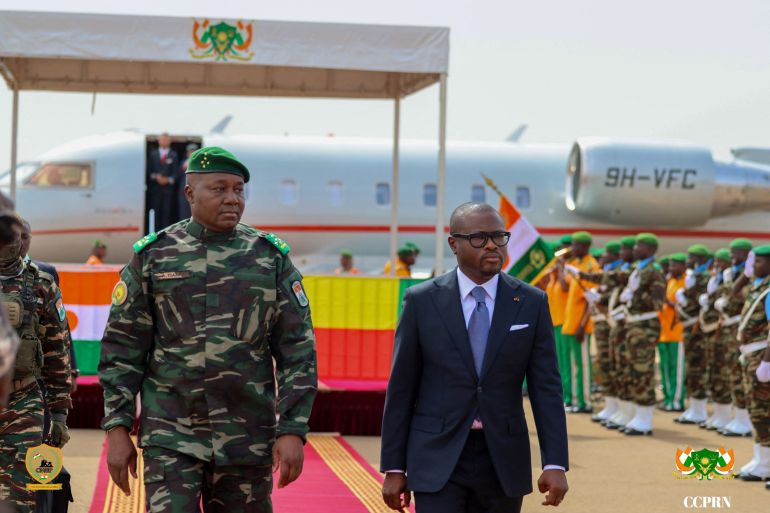
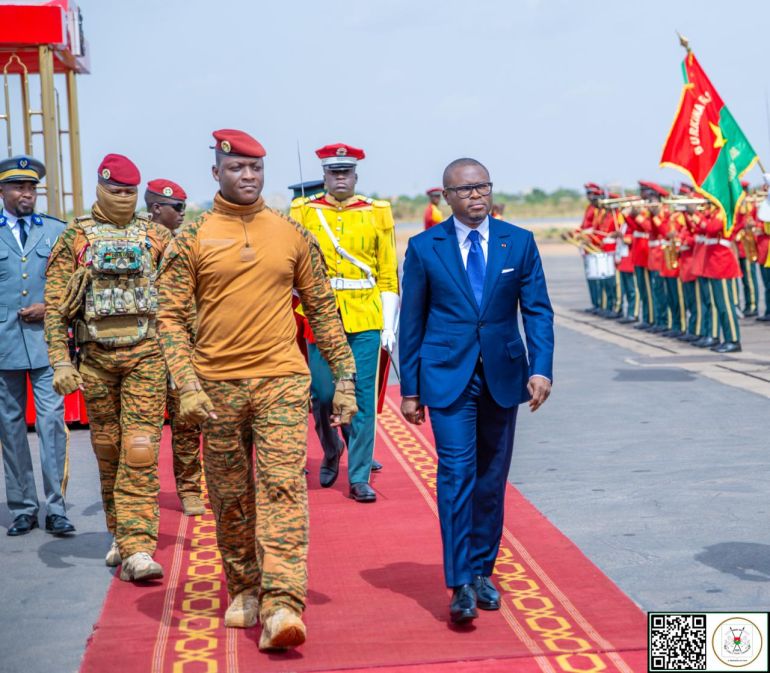
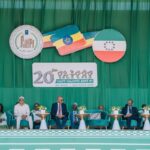
Benin’s new President Romuald Wadagni began his first foreign engagements with visits to Niger and Burkina Faso, just days after taking office on May 24. The Beninese presidency stated this was part of an “active neighborhood diplomacy” toward neighboring countries that the new president intends to pursue. His first stop was in Niger on Monday, before heading to Burkina Faso and then Ouagadougou the following day.
Niger: Committee to Remove Obstacles
According to a joint statement issued in Niamey, Wadagni’s visit to Niger was at the invitation of junta leader General Abdourahamane Tiani. The two presidents held a bilateral meeting followed by an expanded working session with delegations from both countries. The statement noted that the leaders discussed the terrorist threat in the Sahel and West Africa, reaffirming their commitment to “unite their forces to combat the scourge of terrorism and cut off the routes that have plagued the region for years.”
The statement added that the presidents agreed to increase exchanges in political, economic, scientific, and cultural fields, and expressed their commitment to working on “removing all obstacles to strengthening cooperation between the two countries, particularly reopening the border between Benin and Niger.” It also mentioned the formation of a committee of experts to identify and remove these obstacles, with a 15-day deadline to submit its report to the presidents.
Niger had closed its border with Benin after accusing it of harboring “French bases” aimed at destabilizing the country, part of a rift between Niamey authorities and France since the 2023 coup. The joint statement concluded with Wadagni inviting his Nigerien counterpart to visit Benin, and Tiani accepted the invitation, with the date to be set through diplomatic channels.
Burkina Faso: Cotonou Port and Security
In Ouagadougou, Wadagni held a working session at the “Kossyam” Palace with Burkina Faso’s President Captain Ibrahim Traoré. A joint statement, released by the Burkina Faso presidency, described the visit as “a decisive step in revitalizing bilateral relations,” affirming a “shared will to strengthen a partnership based on trust and solidarity.”
The statement noted that both sides emphasized the need to consolidate cooperation in combating terrorism, cross-border crime, and violent extremism. On the economic front, the presidents welcomed prospects for cooperation in trade, industry, vocational training, infrastructure, and logistics, highlighting “the strategic role of the Port of Cotonou in supplying Burkina Faso.” They agreed to expedite the convening of the fifth session of the Joint Grand Commission for Cooperation.
Niger and Burkina Faso, along with Mali, form the “Alliance of Sahel States,” after the three countries withdrew from the Economic Community of West African States (ECOWAS) in early 2024 and signed a confederation agreement in July of the same year, establishing this alliance.
Wadagni had pledged during his inauguration ceremony to confront rising security threats and work to translate economic growth into tangible improvements.
Diori Hamani International Airport
Diori Hamani International Airport is the main airport serving Niamey, the capital of Niger. It was named after Hamani Diori, the country’s first president, who led Niger to independence from France in 1960. The airport has been a key hub for international travel and cargo in the region since its opening.
Niamey
Niamey is the capital and largest city of Niger, located along the Niger River in the southwestern part of the country. Originally a small fishing village, it grew significantly during the French colonial period and became the capital when Niger gained independence in 1960. Today, Niamey serves as the nation’s political, economic, and cultural hub, known for landmarks like the Grand Mosque and the Niger National Museum.
Ouagadougou
Ouagadougou is the capital and largest city of Burkina Faso, serving as the country’s cultural, economic, and administrative center. Historically, it was founded as an important trading hub by the Mossi people in the 11th century and later became the capital of the Mossi Empire. Today, it is known for its vibrant markets, the biennial Panafrican Film and Television Festival (FESPACO), and the ongoing influence of traditional Mossi culture alongside modern development.
Kossyam Palace
Kossyam Palace, located in the suburbs of Ouagadougou, is the official residence of the President of Burkina Faso. Originally built in the 1970s under President Sangoulé Lamizana, the palace has been the site of significant political events, including a 2014 protest that led to the brief occupation and looting during the popular uprising that ousted President Blaise Compaoré. It remains a symbol of national power and political history.
Port of Cotonou
The Port of Cotonou is Benin’s largest seaport and a vital economic hub for the country and the wider West African region. Originally developed in the early 20th century during the French colonial period, it has since expanded to handle a significant portion of Benin’s international trade, including imports like rice and cement, and exports such as cotton and cashew nuts. Today, it remains a key gateway for landlocked neighboring countries like Niger and Burkina Faso.
Alliance of Sahel States
The Alliance of Sahel States (AES) is a mutual defense and economic pact formed in September 2023 by Burkina Faso, Mali, and Niger. Established in response to shared security challenges and a collective desire for greater sovereignty, the alliance was created after these nations experienced military coups and distanced themselves from Western-aligned regional blocs like ECOWAS. The AES represents a significant shift in West African geopolitics, aiming to coordinate efforts against jihadist insurgencies and foster regional cooperation outside traditional international frameworks.
Economic Community of West African States (ECOWAS)
The Economic Community of West African States (ECOWAS) is a regional political and economic union founded in 1975 through the Treaty of Lagos, aimed at promoting economic integration and cooperation among its 15 member countries. Its history includes efforts to create a common market and a single currency, as well as mediating conflicts in the region, such as in Liberia and Sierra Leone. Today, ECOWAS works to foster free trade, peace, and stability across West Africa.
Benin
Benin, a country in West Africa, was the heart of the powerful Kingdom of Dahomey from the 17th to the 19th centuries, known for its military strength and the famous Amazon warriors. It later became a French colony before gaining independence in 1960, and today it is recognized for its rich cultural heritage, including the historic Royal Palaces of Abomey and the vibrant Vodun traditions.