Who will have the last laugh? A cold war between France and Russia over Madagascar’s riches.
Although a visitor to Madagascar can see France’s influence everywhere—from architecture and cars to schools and businesses—this traditional scene is now facing fierce competition.
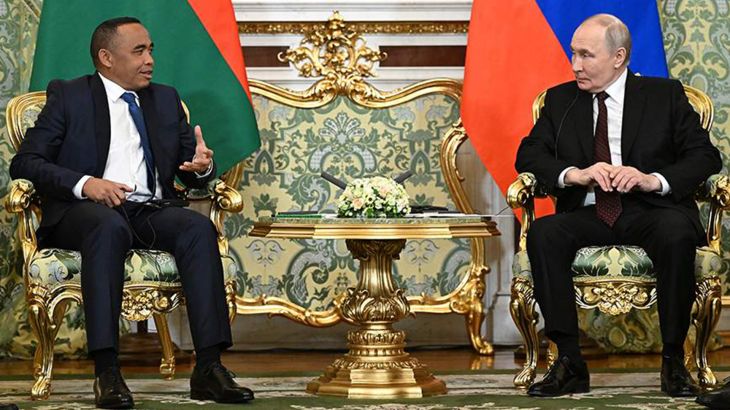
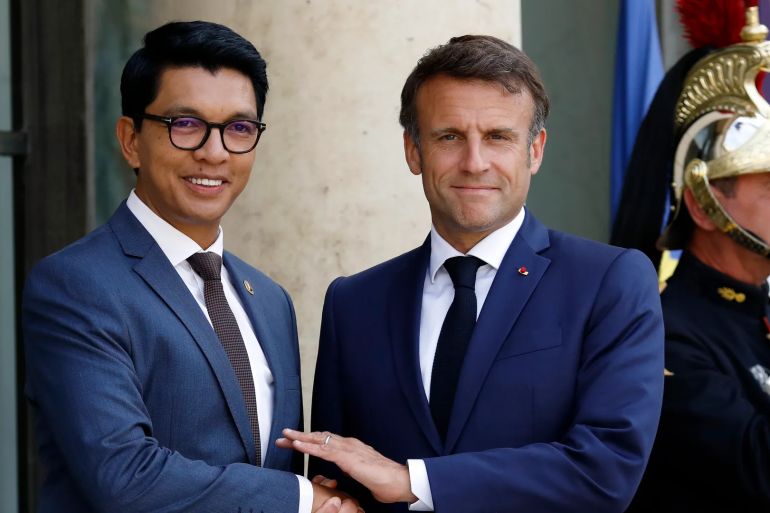
Since the ousting of the former president late last year in 2025, the new transitional authorities on the island have clearly begun leaning toward strengthening ties with Russia, causing significant concern in Paris.
In 2025, Madagascar experienced major political tensions and widespread protests led by the opposition against President Andry Rajoelina, especially after it was revealed that he had obtained French citizenship, sparking debate over the legitimacy of his rule and his candidacy for a new term.
The new authorities in Madagascar announced the revocation of the former president’s citizenship, a move described as a devastating blow to his political career, weeks after he was removed from office following popular protests led by the youth.
Russian presence has become tangible in the security sector, as a report revealed that senior officials in the transitional authority now rely on Russian guards from the Africa Corps forces (formerly known as Wagner).
In this context, the President of the National Assembly, Setini Ranjiana Soloniiko, who is seen as a strong ally of Moscow, spoke about the nature of the relationship with France, saying: “Our history with France has its ups and downs, but we are not governed by history.”
Soloniiko emphasized that his country aspires to a relationship built on mutual trust and the principle of “mutual benefit,” noting that the shift toward the global economic group does not mean excluding anyone, but rather an openness to all who wish to work with Madagascar.
Economic Transformation
Economically, France still leads with a trade volume double that of Russia, but Russia is setting its sights on the promising mining sector.
An economic journalist viewed these developments as a logical evolution of history, adding that it is expected for armed nations to expand their ambitions after every global geopolitical shift, describing them as “good wars” if managed well.
The journalist considered that the most important thing for Madagascar is not to close its doors, but to sign good and fair contracts that ensure the benefits from Malagasy resources and wealth return directly to the people.
An Open Arena for All
Despite the French-Russian rivalry (where trade with France amounts to $1.2 billion, double that with Russia), Madagascar remains an open arena for other international players: the United States controls 90% of textile exports, China 17.5% of basic materials, India dominates 70% of rice trade, and Japan holds 80% of the fishing sector.
Madagascar now finds itself with an opportunity to cement a policy of openness. While France tries to maintain its remaining influence, Russia seeks to exploit the island’s strategic location in the Indian Ocean to enhance its African presence, while the biggest challenge for local authorities remains putting the citizen’s interest above all else in this intense international competition.
Madagascar
Madagascar is a large island nation off the southeast coast of Africa, known for its unique biodiversity and distinct cultural heritage that blends African, Asian, and European influences. Historically, the island was unified under the Merina Kingdom in the 19th century before becoming a French colony in 1896, gaining independence in 1960. Today, it is celebrated for its iconic lemurs, baobab trees, and the Avenue of the Baobabs, a protected natural landmark.
France
France is a country in Western Europe known for its rich history, culture, and landmarks such as the Eiffel Tower and the Palace of Versailles. It was a major center of the French Revolution in the late 18th century, which shaped modern democratic ideals. Today, France is famous for its art, cuisine, and as a global leader in fashion and philosophy.
Russia
Russia, the largest country in the world by land area, has a rich and complex history spanning from the medieval state of Kievan Rus’ to the Russian Empire, the Soviet Union, and the modern Russian Federation. Its cultural sites, such as Moscow’s Kremlin and Red Square, St. Petersburg’s Hermitage Museum, and the historic churches of the Golden Ring, reflect a blend of Eastern Orthodox, imperial, and Soviet influences. Today, Russia is known for its vast landscapes, literary giants like Tolstoy and Dostoevsky, and iconic symbols like the Matryoshka dolls and the Trans-Siberian Railway.
Paris
Paris, the capital of France, is a global center for art, fashion, and culture, famously known as the “City of Light.” Its history stretches back over 2,000 years, evolving from a Celtic settlement called Lutetia into a medieval powerhouse and the epicenter of the French Revolution. Today, iconic landmarks like the Eiffel Tower, Notre-Dame Cathedral, and the Louvre Museum reflect its rich heritage and enduring influence.
Africa Corps
“Africa Corps” commonly refers to the German Afrika Korps, the expeditionary force deployed by Nazi Germany to North Africa during World War II. Formed in 1941 under the command of Field Marshal Erwin Rommel, the unit was tasked with aiding Italian forces and securing Axis control over the region. Despite early successes, the Afrika Korps ultimately faced defeat by Allied forces, leading to its surrender in 1943.
Indian Ocean
The Indian Ocean is the third-largest ocean in the world, covering about 20% of Earth’s water surface and bordered by Africa, Asia, Australia, and the Indian subcontinent. Historically, it has been a vital hub for ancient trade routes, connecting civilizations such as those in Mesopotamia, Egypt, India, and China through the exchange of spices, textiles, and ideas. Its strategic importance continues today, as it remains a key corridor for global maritime commerce and energy shipments.
National Assembly
The National Assembly is the legislative body of a country, often located in a prominent government building. Its history typically traces back to the establishment of a nation’s democratic or parliamentary system, serving as the venue where elected representatives debate and pass laws. For example, France’s National Assembly was formed during the French Revolution in 1789, symbolizing the shift from monarchy to popular sovereignty.
Moscow
Moscow, the capital of Russia, is a city of immense historical and cultural significance, first mentioned in chronicles in 1147. It grew from a small medieval settlement into the center of the Grand Duchy of Moscow, later becoming the capital of the Tsardom of Russia and the Soviet Union. Today, it is known for iconic landmarks like the Kremlin and Red Square, reflecting its rich and turbulent past.