New government in Central Africa: continuity or a redistribution of power?
President Faustin Archange Touadera announced the formation of a new government, about two months after his inauguration for a third term. According to African media following the matter, this step reflects continuity in the structure of the executive branch rather than a fundamental transformation.
The new government includes 29 ministers, only 10 of whom are new, while the remaining members of the previous team retained their positions. The dominance of the presidential party, “Movement of United Hearts” (Mouvement Cœurs Unis), remains a prevailing feature of this composition.
Among the most prominent new faces is Evariste Ngamana, who took over the portfolio of Communication and Media. He previously served as a spokesperson for President Touadera during his recent election campaigns.
The retention of Prime Minister Felix Moloua raised widespread questions. He had submitted his resignation on May 13, but President Touadera reappointed him two days later, before the government was formed. This process was described by Africa Press, which focuses on African affairs, as an “institutional shift under the sign of continuity.”
Final results for all seats in the second round of legislative elections have not yet been announced.
Controversial Timing
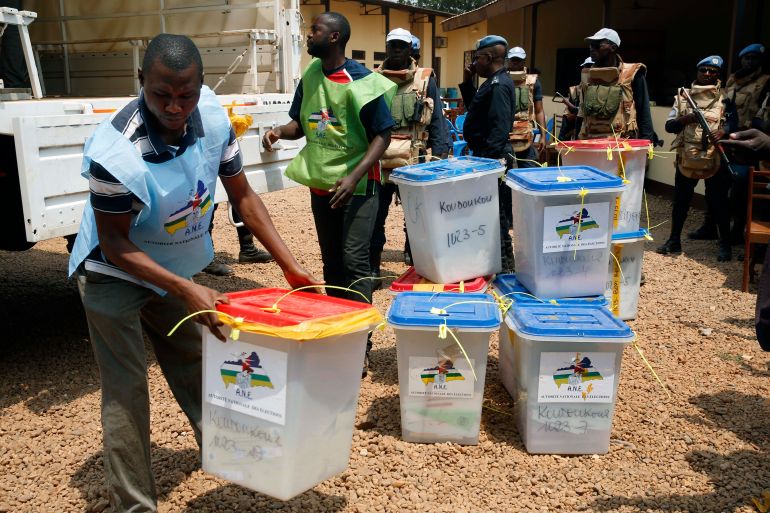
The timing of the announcement is as significant as the government’s composition. It came at a time when final results for all seats in the second round of legislative elections had not yet been announced. Only 90 out of 140 seats in the Central African Republic’s parliament have been confirmed.
The legislative elections were held amid a widespread absence of the opposition, which chose to withdraw from participating in both the presidential and parliamentary elections. According to Jeune Afrique, this contributed to fragmenting its ranks and weakening its ability to influence the political landscape.
President Touadera won a third term with 76.15 percent of the vote in the presidential election, ahead of his main rivals Anicet Georges Dologuele, who received 14.66 percent, and Henri Marie Dondra, with 3.19 percent, according to the official results. He was inaugurated on March 30, making the government formation a natural institutional step in strengthening the executive branch.
Some opposition parties had rejected the legitimacy of this third term, protesting what they described as a violation of constitutional limits on term numbers. According to Jeune Afrique, this position complicated their engagement in the entire electoral process.
U.N. Environment Assembly (UNEA)
The U.N. Environment Assembly (UNEA) is the world’s highest-level decision-making body on environmental issues, established in 2012 following the Rio+20 conference. It meets biennially in Nairobi, Kenya, bringing together all 193 UN member states to set priorities for global environmental policies and international environmental law. Through its resolutions, UNEA addresses critical challenges such as climate change, biodiversity loss, and pollution.
U.N. Environment Programme (UNEP)
The United Nations Environment Programme (UNEP) is a leading global environmental authority established in 1972 following the UN Conference on the Human Environment. Its mission is to coordinate environmental activities, assist developing countries in implementing environmentally sound policies, and promote sustainable development through science, advocacy, and partnerships. Headquartered in Nairobi, Kenya, UNEP addresses critical issues like climate change, pollution, and biodiversity loss.
Nairobi, Kenya
Nairobi, the capital and largest city of Kenya, was founded in 1899 as a railway depot on the Uganda Railway. It grew rapidly during the British colonial era, becoming the capital of the British East Africa Protectorate in 1907. Today, Nairobi is a major cultural and economic hub in Africa, known for its unique blend of urban life and wildlife, including Nairobi National Park.
Movement of United Hearts
The Movement of United Hearts refers to a spiritual and humanitarian initiative founded in Brazil by the visionary Mestre Irineu, later developed under the guidance of Padrinho Sebastião and others. Rooted in the Santo Daime tradition, it emphasizes healing, unity, and connection with nature through sacred rituals and music. The movement has grown internationally, fostering communities dedicated to spiritual growth and social service.
Central African Republic
The Central African Republic is a landlocked country in Central Africa known for its rich biodiversity, including national parks like Manovo-Gounda St. Floris. Historically, it was part of the French colonial empire as Ubangi-Shari before gaining independence in 1960. Since then, the nation has faced political instability and conflict, which have impacted its cultural heritage and development.
Bangui
Bangui is the capital and largest city of the Central African Republic, located on the banks of the Ubangi River. Founded by French colonists in 1889 as a military post, it grew into a major administrative and economic center. The city has endured periods of political instability and conflict, but remains the nation’s cultural and commercial heart.
Jeune Afrique
“Jeune Afrique” is a leading pan-African news magazine founded in 1960 by Béchir Ben Yahmed, originally based in Paris, France. It has played a significant role in covering African politics, economics, and culture, often providing an independent perspective during the post-colonial era. The publication has evolved over decades, maintaining influence as a key source of analysis on the continent’s affairs.
Africa Press
Africa Press is not a single cultural site or tourist destination, but rather a term that historically referred to various news organizations and printing presses across the African continent, particularly during the colonial and post-independence eras. These presses played a crucial role in disseminating information, promoting nationalist movements, and shaping public opinion. Today, the name may be associated with specific media outlets or publishing houses that continue to contribute to African journalism and cultural expression.