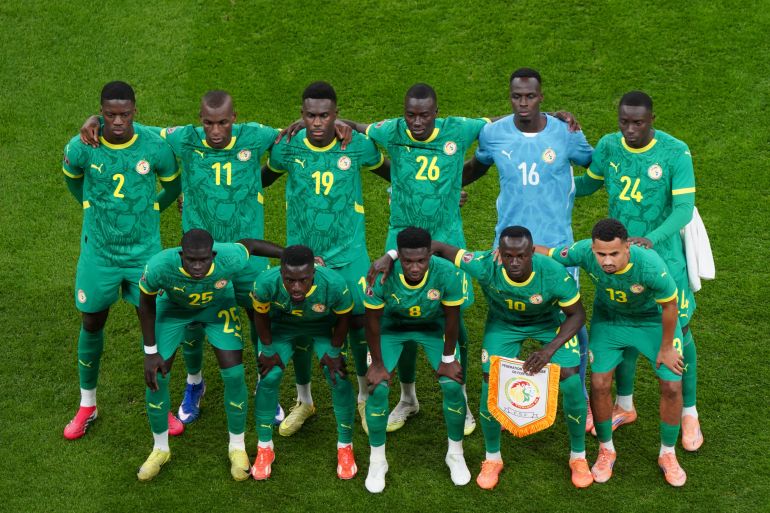
The Senegalese Football Federation announced the squad for the national team preparing to compete in the World Cup next month in the United States, Canada, and Mexico.
The squad notably excluded Lens player Malang Sarr, Lazio forward Boulaye Dia, Metz forward Habib Diallo, and Watford midfielder Nampalys Mendy, among the prominent players who have regularly appeared for Senegal in recent times.
Senegal’s 2026 World Cup Squad
The squad is led by the duo playing in the Saudi league: Sadio Mané (Al-Nassr) and Kalidou Koulibaly (Al-Hilal).
The squad, published on the official account of the Senegalese Federation on platform “X” via an image containing the players’ names, includes:
- Goalkeepers: Édouard Mendy – Mory Diaw – Ives Diouf.
- Defenders: Krépin Diatta – Anthony Mendy – Kalidou Koulibaly – El Hadj Malick Diouf – Mamadou Sarr – Moussa Niakhaté – Moustapha Mbow – Abdoulaye Seck – Ismail Jakobs – Ilay Camara.
- Midfielders: Idrissa Gana Gueye – Pape Gueye – Lamine Camara – Habib Diarra – Pathé Ciss – Pape Matar Sarr – Para Saboukou Ndiaye.
- Forwards: Sadio Mané – Ismaïla Sarr – Iliman Ndiaye – Assane Diao – Ibrahima Mbaye – Nicolas Jackson – Bamba Dieng – Chérif Ndiaye.
Senegal plays in the World Cup in Group Nine, which also includes France, the runner-up of the previous edition, as well as Iraq and Norway.
Prince Moulay Abdellah Stadium
Prince Moulay Abdellah Stadium is a multi-purpose sports venue located in Rabat, Morocco, named after the late Prince Moulay Abdellah, a brother of King Hassan II. Opened in 1983, it has a seating capacity of around 52,000 and has hosted major events, including matches for the African Cup of Nations and the 2018 African Nations Championship. The stadium serves as the home ground for the Moroccan national football team and several local clubs, reflecting its significance in Moroccan sports history.
United States
The United States is a large, diverse country in North America, originally colonized by European powers before declaring independence from Britain in 1776. Its history includes westward expansion, the Civil War over slavery, and its rise as a global industrial and political superpower in the 20th century. Today, it is known for its cultural influence, democratic institutions, and iconic landmarks like the Statue of Liberty and the Grand Canyon.
Canada
Canada is a vast North American country known for its natural beauty, multicultural society, and stable democracy. Its history includes Indigenous peoples living on the land for thousands of years, followed by French and British colonization, which shaped its bilingual and bicultural identity. Canada became a self-governing dominion in 1867 and gradually evolved into a fully independent nation, known today for its commitment to peacekeeping and diversity.
Mexico
Mexico is a country in North America with a rich history spanning thousands of years, from advanced pre-Columbian civilizations like the Aztecs and Mayans to Spanish colonization beginning in the 16th century. It gained independence in 1821 and has since developed a vibrant culture known for its art, cuisine, and traditions such as Día de los Muertos. Today, Mexico is a popular tourist destination with iconic sites like Chichen Itza, Mexico City, and its beautiful beaches.