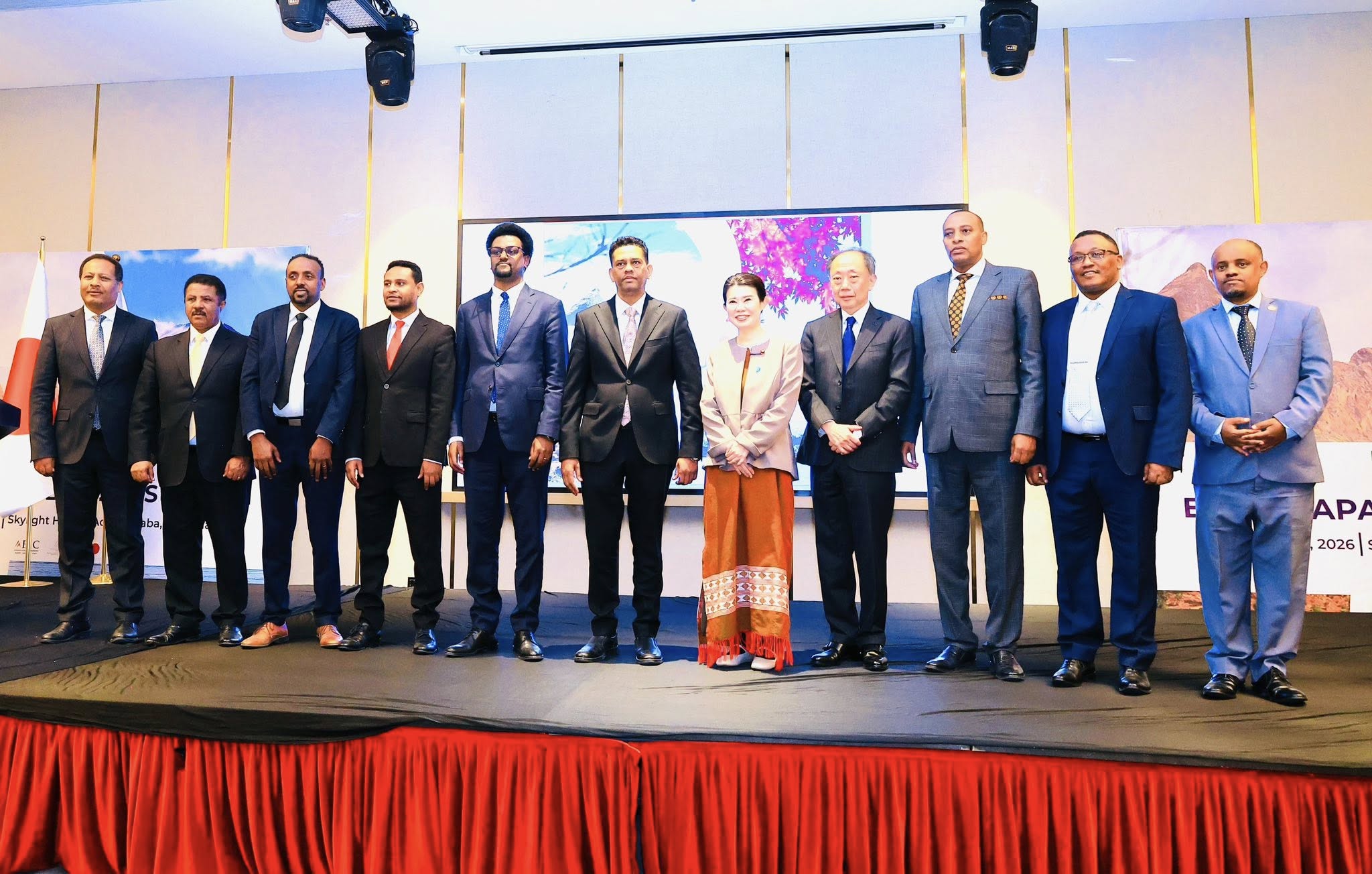
The Ethiopian-Japanese business forum has commenced with broad participation from businesspeople and officials from both countries, in a step aimed at enhancing economic cooperation and opening broader investment horizons.
The forum was attended by a high-level Japanese trade delegation comprising more than 50 businesspeople representing diverse sectors. On the Ethiopian side, the forum was attended by the Minister of Trade and Regional Integration, the Commissioner of the Investment Commission, and the Director-General of the Middle East, Asia, and Pacific Affairs Directorate.
The forum included presentations on investment, trade, and manufacturing opportunities in Ethiopia, with a detailed explanation of the laws and regulations governing finance and foreign currency for foreign investors, in addition to highlighting the promising potential of the Ethiopian market.
The forum aims to strengthen bilateral economic relations, increase the volume of direct investments, and strengthen cooperation ties between the private sectors of the two countries.
Participants’ Views at the Forum:
The First Export Promotion Expert at the Ministry of Trade and Regional Integration emphasized the continuity of trade relations between the two countries, pointing out that “economic reports show that the trade balance is currently in favor of Japan. The total volume of trade has seen a slight decline in recent years, with the majority of our exports to Japan concentrated in sectors such as coffee and textiles.” He added that “there are promising opportunities for Japanese companies in the fields of technology, mining, and logistics,” confirming the government’s efforts to enhance the supporting infrastructure for these sectors.
The First Advisor at the Ministry of Industry explained that “the current strategy focuses on creating a supportive environment for private investment through an ambitious economic reform agenda.” He clarified that “these reforms have led to attracting direct investments worth approximately $4 billion in 2024, most of which are in manufacturing and energy.” He also noted that “recent monetary reforms, including the liberalization of the exchange rate, aim to boost exports and attract more foreign investors.”
In his analysis of economic performance, the First Advisor at the Ministry of Finance stated: “Our economy has withstood successive global shocks thanks to prudent fiscal policies and structural reforms.” He added, explaining: “Our indicators are showing steady improvement, with exports jumping to about $8 billion, and we are achieving an expected GDP growth of 9.2% this year, with inflation dropping to single digits. This performance reflects the strength of the economic policies pursued by the country.”
In conclusion, the Director of the Statistics Directorate at the National Bank of Ethiopia reviewed the most prominent financial reforms, saying: “We have implemented a comprehensive package of reforms to improve the investment climate, where the exchange rate is now determined based on market mechanisms, and we have allowed the free opening of foreign currency accounts.” He affirmed that “these measures remove historical obstacles and confirm Ethiopia’s determination to build a transparent financial system attractive to global capital.”
This forum constitutes an important turning point in bilateral economic relations, as the official statements embody a strong political will from both sides to transform the partnership into tangible investment opportunities. With the bold reforms being implemented by Addis Ababa and the growing interest from Tokyo, the prospects look promising for writing a new chapter of fruitful cooperation between the two countries.
Ethiopian-Japanese business forum
The Ethiopian-Japanese Business Forum is a platform for fostering trade, investment, and economic cooperation between Ethiopia and Japan. While not a historical site, its modern history is tied to Japan’s growing development role in Africa and Ethiopia’s efforts to attract foreign investment, particularly in manufacturing and infrastructure, over recent decades. It serves as a key networking and dialogue event for government and private sector representatives from both nations.
Ministry of Trade and Regional Integration
The Ministry of Trade and Regional Integration is the Ethiopian government body responsible for formulating and implementing national trade policies and fostering economic integration within Africa. Historically, its functions evolved from earlier trade and industry ministries, with its current name and expanded regional focus reflecting Ethiopia’s strategic priority to enhance its role in continental trade blocs like the African Continental Free Trade Area (AfCFTA). It plays a central role in regulating domestic commerce, promoting exports, and negotiating trade agreements to drive economic growth.
Investment Commission
The Investment Commission is not a specific cultural site or historic landmark, but a government body or agency found in many countries. Its primary role is to promote and facilitate foreign and domestic investment, typically by streamlining regulations and offering incentives. Such commissions are generally modern institutions, established as part of national economic development strategies in the 20th and 21st centuries.
Middle East, Asia, and Pacific Affairs Directorate
The Middle East, Asia, and Pacific Affairs Directorate is a key bureau within the U.S. Department of State, responsible for managing diplomatic relations and foreign policy for a vast region stretching from North Africa to the Pacific Islands. Historically, its structure has evolved to address complex geopolitical shifts, including post-Cold War realignments and the growing strategic importance of the Indo-Pacific. It plays a central role in advancing U.S. interests on issues ranging from security and trade to human rights across dozens of countries.
Ministry of Industry
The Ministry of Industry is a governmental department responsible for overseeing and regulating a nation’s industrial and manufacturing sectors. Its history is tied to the rise of centralized economic planning and industrialization, with many countries establishing such ministries in the 19th or 20th centuries to drive national development, promote technological advancement, and ensure economic self-sufficiency.
Ministry of Finance
The Ministry of Finance is a key government department responsible for managing a nation’s revenue, budget, taxation, and economic policy. Its history is intertwined with the development of the modern state, often formalized in the 18th or 19th centuries to centralize fiscal administration and fund public services. For example, the United Kingdom’s Treasury traces its origins to the medieval Exchequer, while the U.S. Department of the Treasury was established in 1789 shortly after the country’s founding.
National Bank of Ethiopia
The National Bank of Ethiopia (NBE) is the country’s central bank, established in 1963 to replace the former State Bank of Ethiopia. It is responsible for issuing currency, managing monetary policy, and supervising the banking sector, playing a central role in the nation’s economic development since its founding.
Statistics Directorate
The Statistics Directorate is not a specific cultural site or historic landmark, but a common name for a government department responsible for collecting and analyzing national data. Historically, such offices were established in many countries during the 19th and 20th centuries to support evidence-based policy and economic planning. Today, they are fundamental institutions for public information, research, and governance.