Amazon enters the satellite internet race in South Africa.
Amazon has confirmed it is preparing to launch its satellite internet service in South Africa this year, a move expected to enhance connectivity options and expand network access in areas still suffering from poor infrastructure.
The announcement was made during hearings organized by South Africa’s Independent Communications Authority regarding the spectrum allocation plan. It was clarified that the service will be offered through licensed local partners, with availability expected to begin later this year.
Through this step, Amazon aims to integrate its services with fiber and mobile networks, particularly in areas where laying ground infrastructure is difficult or prohibitively expensive.
Intensifying Competition
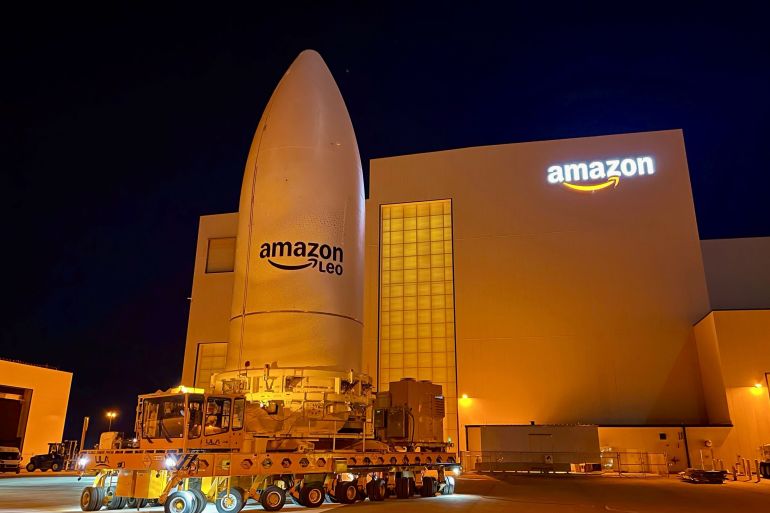
This move comes at a time when the satellite internet market is witnessing increasing competition. Amazon launched its first batches of operational satellites in 2025, putting it in direct competition with global providers like SpaceX’s Starlink, which faces regulatory hurdles in South Africa. Observers believe Amazon’s entry will add a strong competitor in the race to expand digital connectivity across the continent.
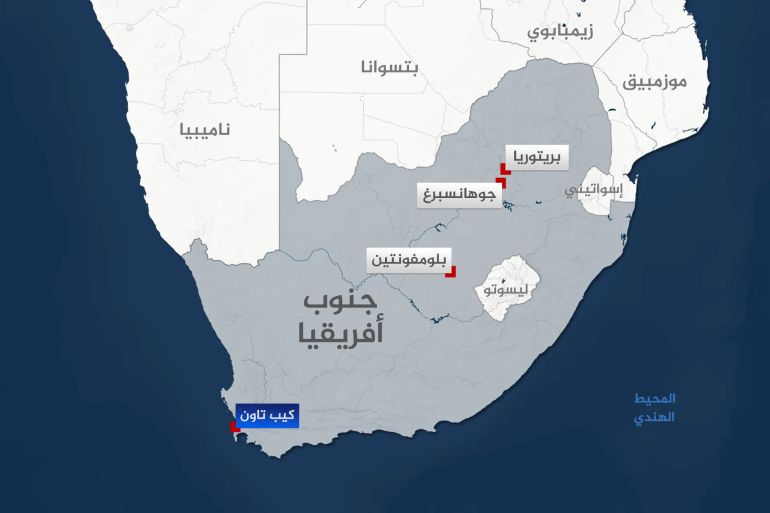
Amazon already has a significant presence in the country. In 2020, it launched its first cloud services region in Cape Town, allowing local businesses and institutions to store data and run applications without relying on external servers. The company also launched its local e-commerce website in 2024, opening the door for local sellers and consumers to engage with its commercial ecosystem.
Although South Africa is one of the continent’s most developed internet markets, vast areas still suffer from poor network access. Satellite internet could bridge this gap, especially in rural communities, schools, and farms, while also fostering competition among service providers to improve prices and quality.
South Africa
South Africa is a country located at the southern tip of the African continent, renowned for its diverse landscapes, wildlife, and multicultural society often described as the “Rainbow Nation.” Its modern history is profoundly shaped by colonialism and the institutionalized racial segregation of apartheid, which ended in 1994 with the establishment of a democratic government and the election of Nelson Mandela as president. The country is home to significant cultural and historical sites, including Robben Island, the Cradle of Humankind fossil sites, and numerous landmarks commemorating its struggle for freedom and reconciliation.
Independent Communications Authority
The Independent Communications Authority of South Africa (ICASA) is the national regulatory body for the broadcasting and telecommunications sectors in South Africa. It was established in 2000 by an act of parliament following the end of apartheid, succeeding previous regulators to promote fair competition, manage the frequency spectrum, and protect consumers in a newly open and democratic society. Its creation was a key part of the post-apartheid effort to transform the communications landscape and ensure universal access to information.
SpaceX’s Starlink
SpaceX’s Starlink is a satellite internet constellation being constructed by the private aerospace company SpaceX to provide high-speed, low-latency internet across the globe, especially in remote and underserved areas. The project, announced in 2015, began launching its first operational satellites in 2019 and represents a significant step in commercial space-based infrastructure, aiming to fund future Mars exploration.
Cape Town
Cape Town is a major coastal city in South Africa, historically founded as a supply station for the Dutch East India Company in 1652. It is renowned for its iconic Table Mountain and its complex history, including its role in the colonial era and the apartheid system, before becoming part of a democratic South Africa. Today, it is a vibrant cultural and economic hub known for its diverse heritage and stunning natural landscapes.