Does Russia’s rescue of two hostages in Mali reveal its expanding influence in the African Sahel?
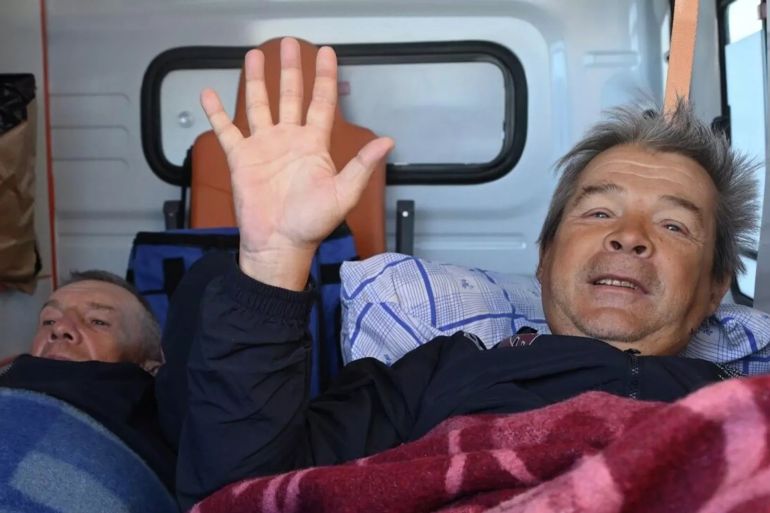
The Russian Defense Ministry announced the liberation of two citizens – one Russian and one Ukrainian – who had been held by the Group for Support of Islam and Muslims, affiliated with al-Qaeda, since July 2024. This followed a “special operation” carried out by Moscow’s forces inside Malian territory, a development adding further weight to Russia’s growing military presence in the region, amid the ongoing open war between Moscow and Kyiv.
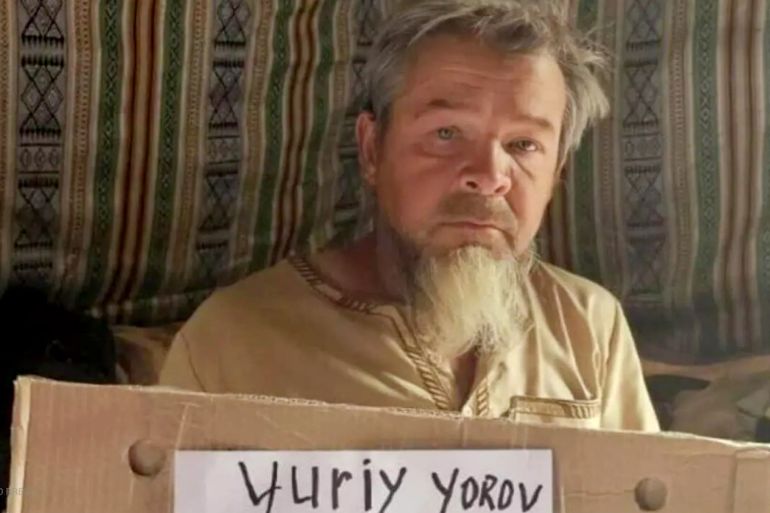
The ministry revealed in a statement on social media platforms that the freed individuals are Oleg Grita (a Russian born in 1962) and Yuri Yurov (a Ukrainian born in 1970). They worked as employees of a Russian geological exploration company and were abducted in the Mbanga area of the Tillabéri region in southwestern Niger, bordering both Mali and Burkina Faso, an area where gold mines are prevalent and armed groups are expanding.
The Russian news agency TASS quoted the ministry as saying that an initial medical examination conducted by Russian doctors at the African Legion hospital revealed the captives were suffering from multiple diseases and severe physical exhaustion, noting that they were transported to Moscow on a military aircraft for treatment and rehabilitation.
The Group for Support of Islam and Muslims had released a video recording in August 2024 showing the two men, claiming responsibility for their abduction.
Moscow did not disclose the operational nature of the mission, whether it was an armed assault or the result of a negotiated settlement. No official statement was issued by Bamako clarifying the extent of Malian forces’ involvement, despite existing security coordination between the two sides under the military cooperation agreement signed in 2019.
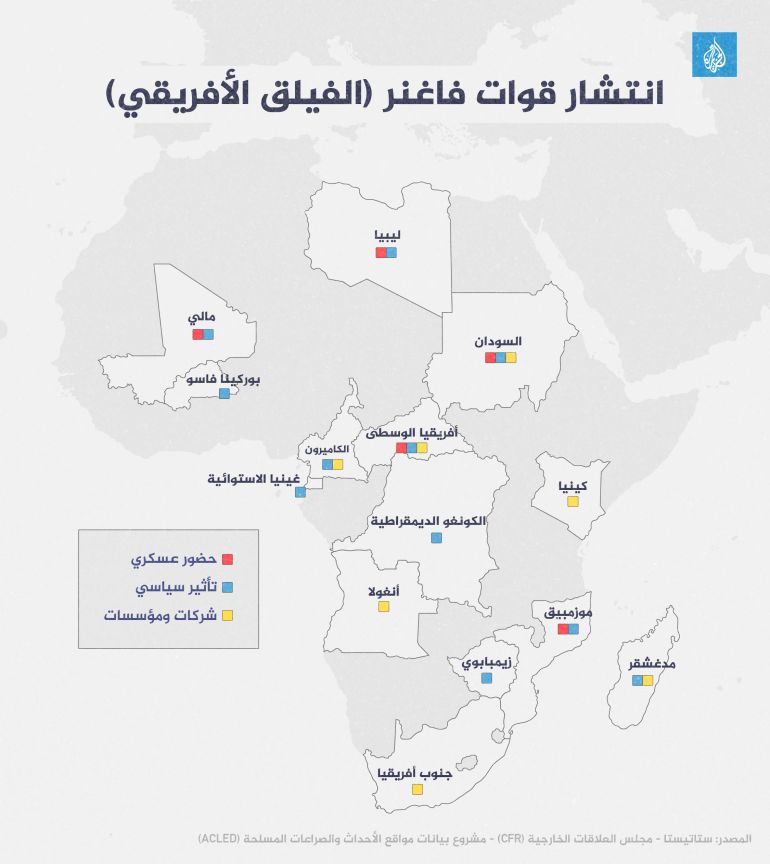
Map of African Legion deployment across the continent in early 2025
The African Legion: Heir to Wagner
The African Legion is the de facto successor to the Wagner paramilitary group in Africa, established by the Russian Defense Ministry in 2023 after the death of Wagner founder Yevgeny Prigozhin in a plane crash. The legion took over its continental operations under direct governmental authority. According to a recent report by a research service, around 2,500 Russian personnel were deployed in Mali in early 2026 to support combat operations against Islamist insurgents and separatists, making the Russian presence in Mali the largest of its kind in the Sahel.
However, the Carnegie Endowment for International Peace noted in a report published last February that armed violence has not decreased despite Russian support. Instead, the Group for Support of Islam and Muslims imposed a siege on Bamako starting in September 2025, targeting fuel convoys heading to the city.
Ukrainian Yuri Yurov during his detention in Mali
The Ukrainian Dimension and Kyiv’s Silence
The operation carries a notable symbolic dimension, as Moscow announced the rescue of a Ukrainian citizen amid the ongoing war between the two countries since February 2022. Yet Kyiv has remained silent so far. The absence of any confirmation from Kyiv regarding Yurov’s status reflects the depth of diplomatic rupture and ongoing tensions between the two nations, even when it involves rescuing citizens from shared regional conflicts.
The operation also comes at an intense political moment. Days earlier, President Vladimir Putin extended invitations to leaders for participation in the third Russia-Africa summit, while Russian Energy Minister Sergey Tsivilev held a meeting of the joint intergovernmental committee with Mali in Moscow, indicating the multifaceted nature of cooperation extending beyond security.
These steps have accumulated since a series of coups between 2020 and 2023, where military councils in Bamako, Ouagadougou, and Niamey overthrew pro-Western governments and turned to Moscow seeking an alternative security partner. Consequently, French forces gradually withdrew from the three countries, and over a thousand American soldiers left Niger in 2024 under pressure from the military council.
Conversely, observers note that the detention of the two men
Group for Support of Islam and Muslims
The “Group for Support of Islam and Muslims” (Jama’at Ansar al-Islam wa al-Muslimin) is a militant Islamist coalition formed in March 2017 in Mali, primarily active in the Sahel region. It emerged from the merger of several jihadist groups, including Ansar Dine, the Macina Liberation Front, and al-Qaeda in the Islamic Maghreb’s Saharan branch. The group aims to establish Islamic rule and has been involved in ongoing conflicts against regional governments and international forces.
al-Qaeda
Al-Qaeda is not a place or cultural site, but a militant Islamist extremist organization founded by Osama bin Laden in the late 1980s. It originated during the Soviet-Afghan War, aiming to support mujahideen fighters, and later evolved into a global terrorist network responsible for numerous attacks, including the September 11, 2001 attacks in the United States. The group’s ideology promotes violent jihad against perceived enemies of Islam, and it has been designated as a terrorist organization by many countries and international bodies.
African Legion
The African Legion, also known as the German East African Legion, was a military unit formed by German colonial forces during World War I in East Africa. It primarily consisted of African soldiers, known as *Askari*, who fought under German command against Allied forces in campaigns across modern-day Tanzania, Kenya, and Mozambique. The legion is notable for its resilience and guerrilla tactics, with many of its members continuing resistance even after Germany’s official surrender in 1918.
Wagner
Wagner refers primarily to the German composer Richard Wagner (1813–1883), a revolutionary figure in 19th-century classical music known for his epic operas like *The Ring Cycle* and *Tristan und Isolde*. His work broke traditional musical conventions and deeply influenced Western art, though his legacy is also complicated by his controversial anti-Semitic writings and later appropriation by the Nazi regime. The city of Bayreuth, home to the Bayreuth Festival Theatre he designed, remains a central site for his music and cultural influence.
Bamako
Bamako is the capital and largest city of Mali, located along the Niger River. Founded in the 17th century as a small trading village, it grew significantly under French colonial rule in the late 19th and early 20th centuries. Today, it serves as the country’s economic and cultural hub, home to landmarks like the National Museum of Mali and the iconic Grand Mosque.
Moscow
Moscow is the capital and largest city of Russia, with a history dating back to its founding in 1147 by Prince Yuri Dolgorukiy. It served as the center of the Grand Duchy of Moscow, later becoming the capital of the Tsardom of Russia, and eventually the Soviet Union, playing a pivotal role in major historical events such as the Napoleonic Wars and World War II. Today, Moscow is renowned for its iconic landmarks, including the Kremlin, Red Square, and St. Basil’s Cathedral, reflecting its rich cultural and political heritage.
Kyiv
Kyiv is the capital and largest city of Ukraine, with a history dating back over 1,400 years, making it one of the oldest cities in Eastern Europe. It was a major center of the medieval Kyivan Rus’ state and later became a key cultural and religious hub for Orthodox Christianity, home to iconic sites like the Kyiv Pechersk Lavra and Saint Sophia Cathedral. Today, Kyiv stands as a symbol of Ukrainian resilience and independence, especially in the face of modern conflicts.
Carnegie Endowment for International Peace
The Carnegie Endowment for International Peace is a nonpartisan think tank founded in 1910 by philanthropist Andrew Carnegie to promote global peace and diplomacy. It was established with a $10 million endowment and has since expanded to include research centers in Washington, D.C., Moscow, Beijing, and Beirut. The organization is known for its influential policy analysis and advocacy on issues such as nuclear nonproliferation, conflict resolution, and international governance.