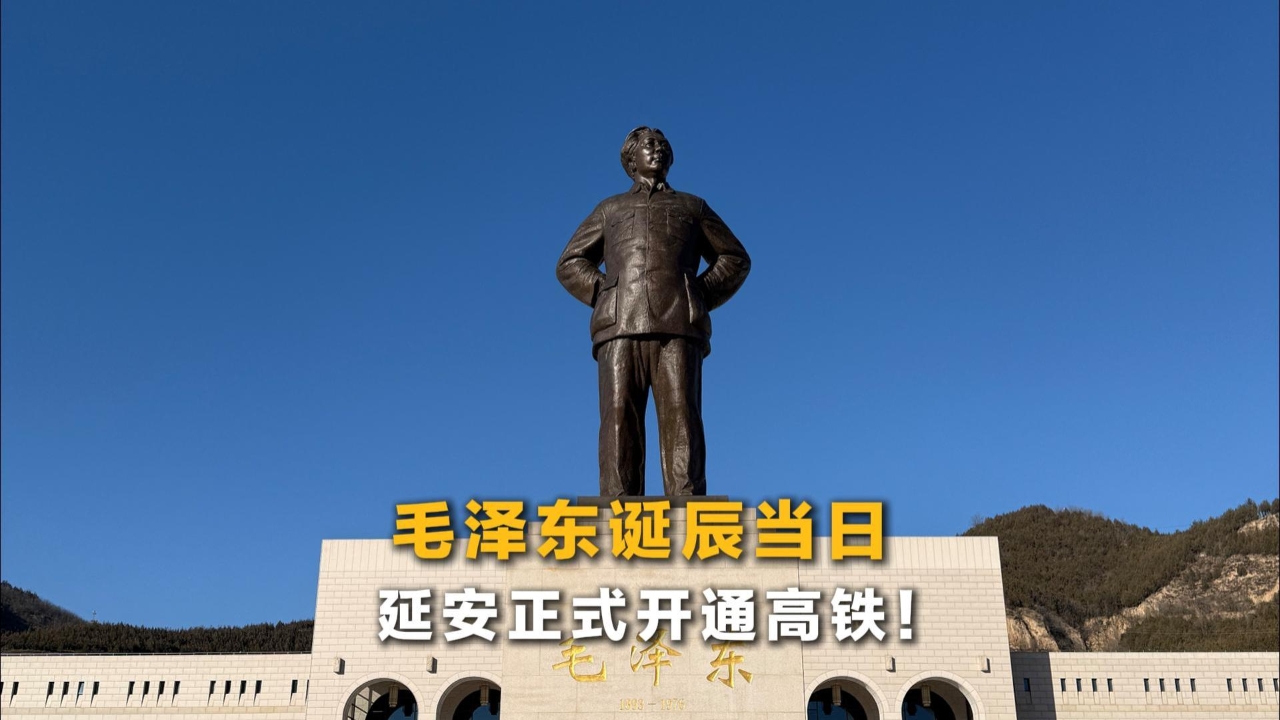
On Mao Zedong’s Birthday, High-Speed Rail Officially Launches in Yan’an.
On December 26th, coinciding with the 132nd anniversary of Comrade Mao Zedong’s birth, as the C9309 bullet train slowly departed from Yan’an Station, Yan’an officially entered the high-speed rail era.
As the first high-speed railway in the old revolutionary base area of northern Shaanxi and a core component of the national “Eight Vertical and Eight Horizontal” high-speed rail network’s Baotou-Yinchuan-Hainan corridor, the Xi’an-Yan’an high-speed rail has a main line length of 299.8 kilometers and a design speed of 350 km/h. After its opening, the fastest travel time between Xi’an and Yan’an will be shortened to about one hour.
On that day, with the opening of the Xi’an-Yan’an high-speed rail, China’s high-speed rail operating mileage exceeded 50,000 kilometers. From the grand vision for railway development in “The International Development of China” to the torrent of steel on the journey of Chinese modernization, the “Fuxing” bullet train has become a messenger traversing history, integrating Yan’an’s red annals into the powerful pulse of China’s development.
Yan’an Station
Yan’an Station is a major metro station in Shanghai, China, located at the intersection of Yan’an Road and Xizang Road. It is a key interchange on the Shanghai Metro network, connecting Lines 1, 2, and 8. The station is named after Yan’an, a city in Shaanxi province historically significant as the base of the Chinese Communist Party during the latter part of the Chinese Civil War.
Xi’an-Yan’an high-speed rail
The Xi’an-Yan’an high-speed railway is a key rail link in Shaanxi Province, China, which opened in December 2022. It significantly reduces travel time between the ancient capital of Xi’an and the revolutionary base of Yan’an, a city of major historical significance in modern Chinese history. The line facilitates economic development and tourism while connecting two important cultural and political centers.
Baotou-Yinchuan-Hainan corridor
The “Baotou-Yinchuan-Hainan corridor” is not a single, recognized historical or cultural site, but rather a modern conceptual term for a major economic and development belt in China. It broadly refers to a strategic corridor connecting the industrial city of Baotou in Inner Mongolia, through Yinchuan in Ningxia, and extending to Hainan Island in the south, aiming to enhance regional connectivity and growth. Its “history” is therefore contemporary, rooted in 21st-century national development plans rather than ancient cultural heritage.
Eight Vertical and Eight Horizontal
“Eight Vertical and Eight Horizontal” refers to the traditional street layout of the ancient city of Chang’an (modern-day Xi’an), the capital of China’s Tang Dynasty. This grid pattern, with eight main streets running north-south and eight running east-west, was meticulously planned during the Sui and Tang dynasties (7th-10th centuries) and symbolized imperial order and cosmic harmony. It served as a model for urban planning in East Asia and facilitated the city’s role as a prosperous eastern terminus of the Silk Road.
Fuxing bullet train
The Fuxing bullet train is China’s latest generation of high-speed rail service, launched in 2017. It represents a major achievement in domestic technological innovation, with trains designed and manufactured in China capable of operating at speeds up to 350 km/h (217 mph). The name “Fuxing,” meaning “rejuvenation,” symbolizes the country’s modern transportation advancement and broader national development goals.
The International Development of China
“The International Development of China” is not a specific place or cultural site, but rather a 1920 book and proposal by Sun Yat-sen, the founding father of the Republic of China. In it, he outlined a comprehensive, modern industrialization plan for China, seeking foreign investment and cooperation to build extensive railways, ports, and industries. While never fully implemented as a single project, its visionary ideas significantly influenced later economic planning and infrastructure development in 20th-century China.
Chinese modernization
“Chinese modernization” refers to the development path pursued by China under the Communist Party of China, aiming to build a modern socialist society by integrating advanced global practices with national conditions. It emphasizes comprehensive progress in economic, political, cultural, social, and ecological spheres, guided by Xi Jinping Thought on Socialism with Chinese Characteristics for a New Era. This approach has evolved since the reform and opening-up period, focusing on achieving national rejuvenation while maintaining socialist principles.
old revolutionary base area of northern Shaanxi
The old revolutionary base area of northern Shaanxi, centered around Yan’an, served as the headquarters of the Chinese Communist Party from 1935 to 1948 after the Long March. It was a crucial sanctuary where Mao Zedong and other leaders developed key political and military strategies, shaping the ideology that led to the founding of the People’s Republic of China. Today, it is preserved as a significant historical and patriotic education site.