Iran launches missiles into Israel for the first time during a ceasefire, oil prices rise 3%
Iran fires missiles at Israel for the first time during ceasefire
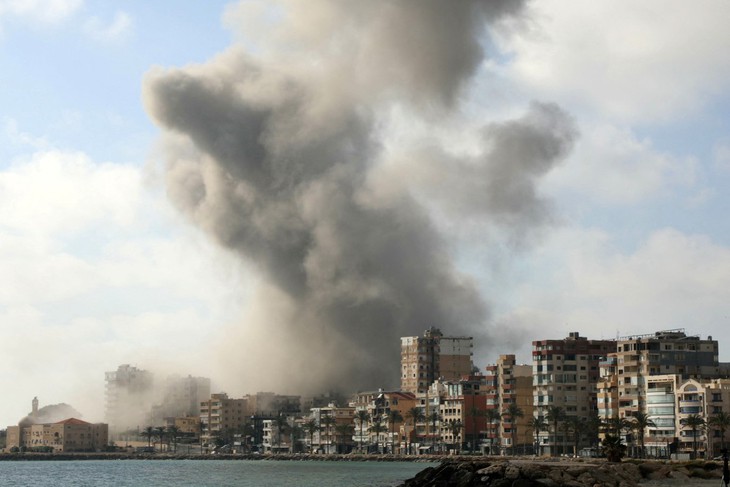
According to AFP, on June 7, Israel accused Tehran of making a “serious mistake” after reporting it had suffered its first missile attack from Iran since the ceasefire between Israel, the US, and Tehran was announced on April 8.
Air raid sirens sounded in several areas in the north and center of the country, including the cities of Haifa, Caesarea, and Hadera.
Following this, Israeli military Chief of Staff Eyal Zamir declared that the country’s forces would strike the enemy hard as soon as given the green light.
In a series of brief statements, the Israeli military said it had detected multiple missiles launched from Iran and that all of them were intercepted. A total of 11 missiles were launched from Iran.
Israel’s Magen David Adom rescue service reported no casualties from the missiles, but some people were injured while running to shelters.
Meanwhile, Iran argued that the missile launch was a “warning” following an Israeli airstrike on the southern suburbs of Beirut the same day, and warned that any further escalation would face a “broader” response targeting all US and Israeli targets in the region.
Israel said the airstrike targeted a command center of the armed group Hezbollah, a force backed by Iran, in the southern suburbs of Lebanon’s capital Beirut.
Oil prices rise 3% after the attack
Around 5:30 a.m. on June 8, AFP reported that oil prices rose more than 3% in trading today as markets reopened, reflecting new concerns after Iran’s first attack on Israel since the ceasefire was reached on April 8.
Brent crude oil prices rose 3.29% to $96.15 per barrel. US WTI crude oil prices rose 3.25% to $93.48 per barrel.
Iran suspends flights at Tehran international airport
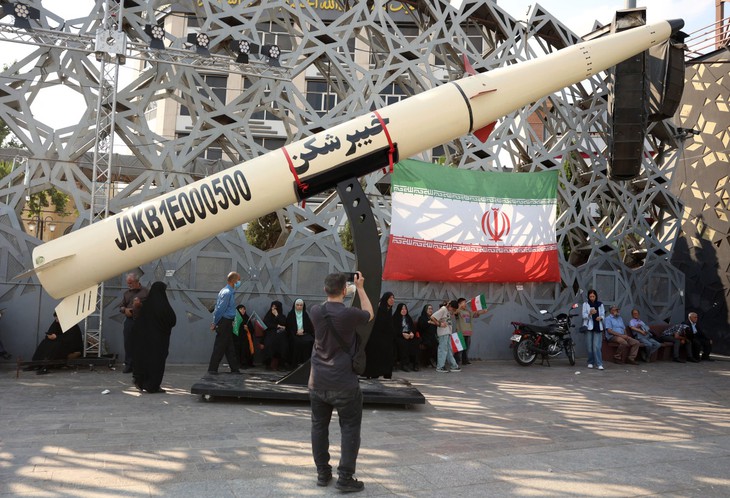
Iranians stand next to a model of the Kheibar missile during a rally showing support for Iran’s Supreme Leader Mojtaba Khamenei in Tehran on June 4.
On June 7, local media reported that Tehran’s international airport had suspended all arriving flights following Iran’s missile attack on Israel.
“The Civil Aviation Organization announced the suspension of all incoming flights to the airport until further notice,” Iran’s Mehr news agency reported.
This is the latest closure of Imam Khomeini International Airport, one of two airports serving the capital Tehran. The airport had only reopened in April after weeks of closure due to the impact of the war in the Middle East.
Iran threatens to retaliate against US and Israel after Beirut attack
On June 7, Mohammad Bagher Ghalibaf, Speaker of the Iranian Parliament and the country’s lead negotiator, warned that Israel’s attack in southern Beirut and the continued US blockade of Iranian ports would lead to retaliatory action, according to AFP.
In a post on platform X, Ghalibaf accused the US of giving Israel the “green light” to carry out attacks targeting two locations in Lebanon’s capital Beirut.
He stated that these attacks, along with the blockade, have made “US bases and assets as well as the Israeli regime in the region legitimate targets.” He emphasized that “our armed forces, as always, are free to act.”
Egypt, Qatar, and Jordan condemned Iran’s attacks on Kuwait and Bahrain; Israeli military attacks killed three Lebanese soldiers… are some notable news about the Middle East on the evening of June 6.
Tyre
Tyre is an ancient Phoenician city located in modern-day Lebanon, renowned for its rich maritime history and as the legendary birthplace of Europa and Dido. Founded around 2750 BCE, it became a powerful trading hub and colonized cities across the Mediterranean, including Carthage. The site features well-preserved Roman ruins, such as a hippodrome and a triumphal arch, and is a UNESCO World Heritage Site.
Haifa
Haifa is a major port city in northern Israel, with a history dating back to the 3rd century CE. It is best known for the stunning Baháʼí World Centre, including the terraced gardens and golden-domed shrine, a UNESCO World Heritage site. Today, Haifa is a symbol of coexistence, serving as a hub for diverse religious and ethnic communities.
Caesarea
Caesarea is an ancient city and archaeological site on Israel’s Mediterranean coast, originally built by Herod the Great between 22 and 10 BCE in honor of the Roman emperor Augustus Caesar. It served as a major Roman and Byzantine port and administrative center, and later became a Crusader stronghold. Today, its well-preserved ruins include a Roman aqueduct, theater, and harbor, making it a popular tourist destination.
Hadera
Hadera is a city in northern Israel, founded in 1891 by Jewish immigrants from Eastern Europe as part of the Zionist agricultural settlement movement. Its name derives from the Arabic word “al-Khadra,” meaning “the green,” referring to the area’s once-verdant swampland, which was drained by early settlers to combat malaria. Today, Hadera has grown into a thriving urban center known for its power plant, industrial zones, and diverse population.
Beirut
Beirut is the capital and largest city of Lebanon, with a history dating back over 5,000 years. It has been a major cultural, commercial, and intellectual hub in the Mediterranean, shaped by Phoenician, Roman, Ottoman, and French influences, though it was heavily devastated during the Lebanese Civil War (1975–1990). Today, Beirut is known for its resilient spirit, vibrant arts scene, and ongoing reconstruction that blends historic landmarks with modern life.
Imam Khomeini International Airport
Imam Khomeini International Airport, located southwest of Tehran, Iran, opened in 2004 to ease congestion at Mehrabad Airport. Named after the founder of the Islamic Republic, Ayatollah Ruhollah Khomeini, it serves as the country’s primary international gateway. The airport has undergone expansions and faced initial operational challenges, but today handles millions of passengers annually.
Tehran
Tehran, the capital of Iran, is a sprawling metropolis that rose to prominence in the late 18th century when it was chosen as the capital by the Qajar dynasty. The city underwent rapid modernization during the 20th century under the Pahlavi dynasty, transforming from a small village into a major political and cultural hub. Today, Tehran is known for its blend of ancient history, visible in sites like the Golestan Palace, and modern urban life, including museums, bustling bazaars, and the iconic Milad Tower.
Kheibar missile
The Kheibar missile is an Iranian short-range ballistic missile, named after the historic Battle of Khaybar, a 7th-century conflict between early Muslims and Jewish tribes. Introduced in 2022 by the Islamic Revolutionary Guard Corps, it is designed to target heavily fortified positions, with a reported range of up to 2,000 kilometers. The missile represents a significant advancement in Iran’s indigenous military capabilities, capable of evading missile defense systems.