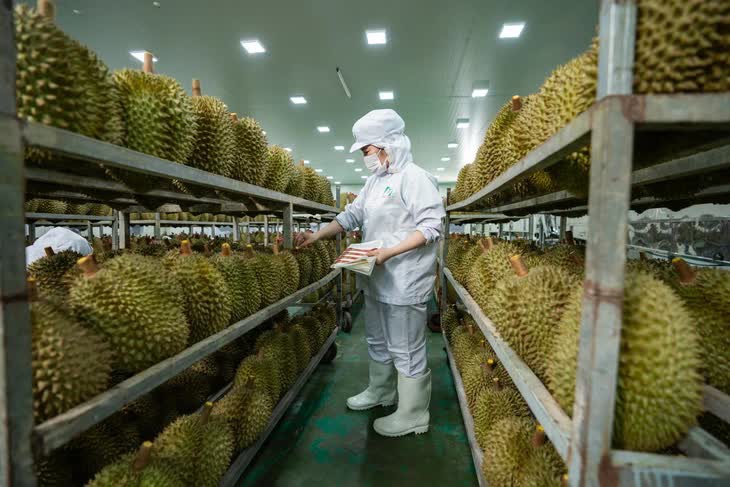
On April 27, an article was published analyzing the limitations of cold storage infrastructure in Vietnam’s fruit export industry.
The article attracted widespread interest from fruit and vegetable export businesses in Vietnam. However, less than a month later, Vietnam’s export industry faced a more serious crisis: durian prices suddenly and sharply dropped.
The farm-gate price of Ri6 durian fell to only 20,000 VND per kilogram, even lower than production costs, leaving many durian farmers in difficult circumstances.
On the surface, the direct cause was that customs authorities detected excessive residues of Chrysoidine G (a banned industrial yellow dye) and cadmium in Vietnamese durian, leading to strict controls and export restrictions. But behind this phenomenon lie deeper and more significant market logic changes.
A clear signal from the Chinese market: Chinese buyers are willing to pay higher prices for products that ensure quality, safety, and regulatory compliance.
Conversely, Vietnamese durian is repeatedly rejected at border checkpoints due to failing inspection standards, causing farm-gate prices to continue falling. This contrast shows that China’s agricultural import rules are fundamentally changing.
Food safety, traceability, quality standard compliance, and green certification are gradually replacing the mindset of only chasing low prices, becoming important thresholds for entering the Chinese market.
With nearly 20 years living and working in Vietnam, it is clearly seen that many Vietnamese fruit export businesses still hold a mistaken mindset: believing that Chinese consumers only care about low prices and accept average quality as long as the price is reasonable.
Frankly speaking, some Chinese traders also think similarly: that Vietnamese agricultural products belong to the low-price segment, so standards do not need to be too high.
For a long time, these two mindsets formed a tacit compromise: Vietnam relaxed standards, and China lowered requirements to accept. The 2026 durian price crisis completely shattered this compromise.
That old business mindset needs updating. The Chinese market is increasingly upgrading, and consumers are more concerned about product origin, safety, and quality. Price remains important but is no longer the sole factor determining transactions.
It cannot be denied that Vietnam’s durian industry has grown very rapidly: the cultivation area exceeds 200,000 hectares, output is nearly 2 million tons, and export turnover has increased sharply. But alongside this expansion, some individuals and businesses have taken unsustainable paths.
Recently, there have been continuous discoveries of forged growing area codes, packaging facility permits, and phytosanitary certificates; some cases even involve selling fake export document packages.
Forging documents can only temporarily evade inspections, not withstand long-term market rules. When exposed, the entire export chain suffers, and farmers bear the heaviest losses.
Based on years of experience monitoring Vietnam-China trade, three recommendations are offered:
First, treat standard compliance capability as the industry’s core competitiveness. Cold storage is hard infrastructure, testing and traceability systems are soft infrastructure, and customs clearance procedures are the connecting channel. All three need systematic investment and improvement.
Second, adjust investment direction. Stop forging documents and instead build testing laboratories recognized by China, and establish a full-chain traceability system from farm to border. In the short term, accelerate certification recognition; in the medium term, improve traceability; in the long term, align with international green standards.
Third, seize the timing. The Chinese market waits for no one. The EU’s anti-deforestation regulation officially takes effect at the end of 2026, requiring stricter traceability for imported agricultural products. Countries and businesses that upgrade early will gain competitive advantages for years to come.
The development and quality improvement of Vietnamese fruit have been witnessed over a long period, and it is hoped these issues can be overcome and not become obstacles.
The threshold of Chinese market standards will not lower to accommodate anyone. Only those who proactively upgrade and adapt will achieve sustainable success.
Deputy Prime Minister Ho Quoc Dung requested the Ministry of Public