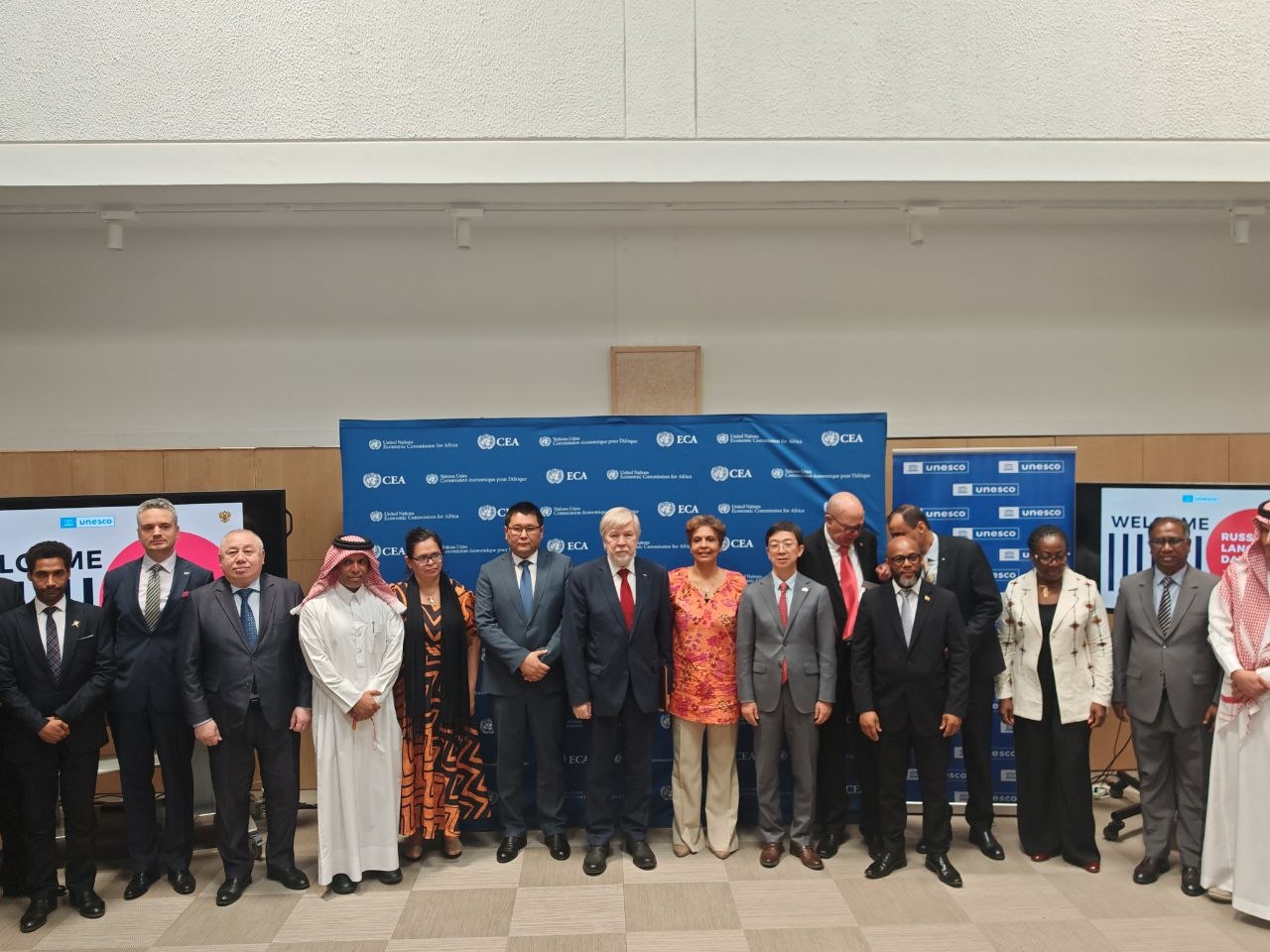
Addis Ababa, June 5, 2026 – The Ambassador of Russia to Ethiopia, Evgeny Terekhin, confirmed that celebrating Russian Language Day in Addis Ababa would significantly contribute to strengthening relations between peoples, cultural exchange, and knowledge transfer between Russia and Africa.
During his speech at the event, the Russian Ambassador explained that hosting this event at the headquarters of the United Nations Economic Commission for Africa not only represents a celebration of a rich culture but also reflects the strength of a partnership based on trust, deep historical ties, and mutual respect between the two sides.
He noted that Russian universities, even during the Soviet era, trained tens of thousands of highly qualified specialists, as African students who studied in Russian received a solid academic education in various fields including medicine, engineering, public administration, and other disciplines.
He added that about 35,000 students from different African countries are currently pursuing higher education in Russian universities, while thousands of them study on scholarships provided by the Russian government.
Ambassador Terekhin expressed confidence that such events would contribute to strengthening cultural ties and expanding mutual interest in the languages and traditions of different peoples.
For her part, the Director of the Joint Liaison Office between UNESCO, the African Union, and the United Nations Economic Commission for Africa, Rita Bisonath, affirmed that language is not only a means of communication but also an essential part of human identity.
She stressed that the disappearance of any language means humanity loses an irreplaceable source of knowledge and creativity, noting that the Russian language holds a distinguished place within human cultural heritage as a language of literature, science, philosophy, diplomacy, and artistic creativity.
The Russian Language Day events included a variety of cultural activities, featuring traditional dance performances, music, songs, poetry recitals, along with other cultural events.
Russian Language Day is celebrated globally on June 6 each year, coinciding with the birthday of the Russian poet and writer Alexander Pushkin, who is regarded as one of the most prominent figures who laid the foundations of modern Russian literature.