A marathon between two continents: What is Kenya’s president looking for?
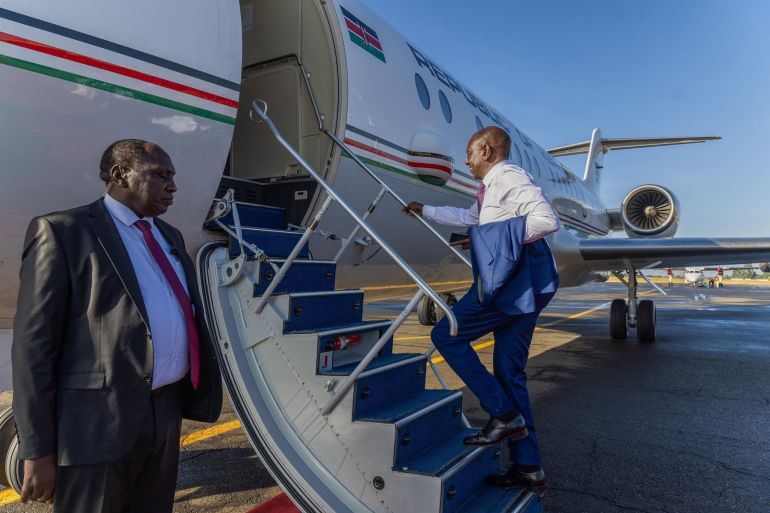
Kenyan President William Ruto is undertaking a series of foreign visits this month, spanning Africa and Europe, with four stops: South Africa, Belgium, Finland, and France. This reflects Nairobi’s efforts to expand its economic and diplomatic partnerships. According to reports, these moves highlight Kenya’s growing diplomatic activity aimed at deepening relations with partners on both continents.
South Africa Stop
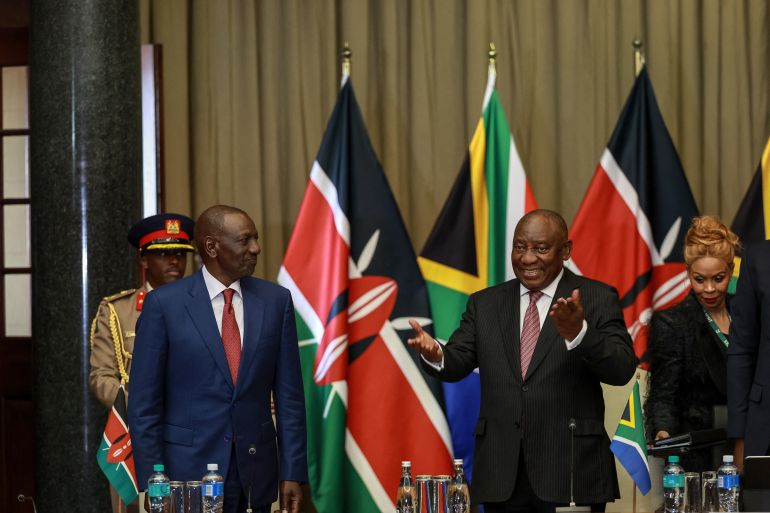
Ruto began his tour with a state visit to South Africa from June 3 to 5, at the invitation of President Cyril Ramaphosa. According to a statement from the South African presidency, Ramaphosa received his Kenyan counterpart in Pretoria last Thursday, where the two leaders held bilateral talks and signed six trade and investment agreements. The statement noted that relations between the two countries were re-established in 1994, and that South Africa considers Kenya a strategic partner in East Africa.
The visit included a business forum in Midrand near Johannesburg, aimed at boosting trade and investment exchange.
South African President Cyril Ramaphosa (right) welcomes Kenyan President William Ruto.
Belgium Stop
From South Africa, Ruto is expected to travel to Belgium for talks with King Philippe at the Royal Palace on Monday, as part of efforts to deepen bilateral cooperation between Nairobi and Brussels. Details of the program between the African and European stops are still being arranged.
Finland Stop
The tour then moves to Finland for a state visit on June 10 and 11, at the invitation of Finnish President Alexander Stubb. This is Ruto’s first visit to the Nordic country, following a state visit by Stubb to Kenya in 2024. It is also the first state visit by a Kenyan president to Finland since former President Daniel arap Moi’s visit in 1987.
According to a statement from the Finnish presidency, the visit focuses on deepening bilateral relations, expanding trade and investment, as well as reforming multilateral institutions, international mediation, and regional issues in Africa and Europe. The program includes an official welcome ceremony at the Presidential Palace in Helsinki on June 10, bilateral talks, a joint press conference, a discussion session titled “The Promise of Peace” on international mediation, and a business forum at the Nokia Executive Center in Espoo on June 11.
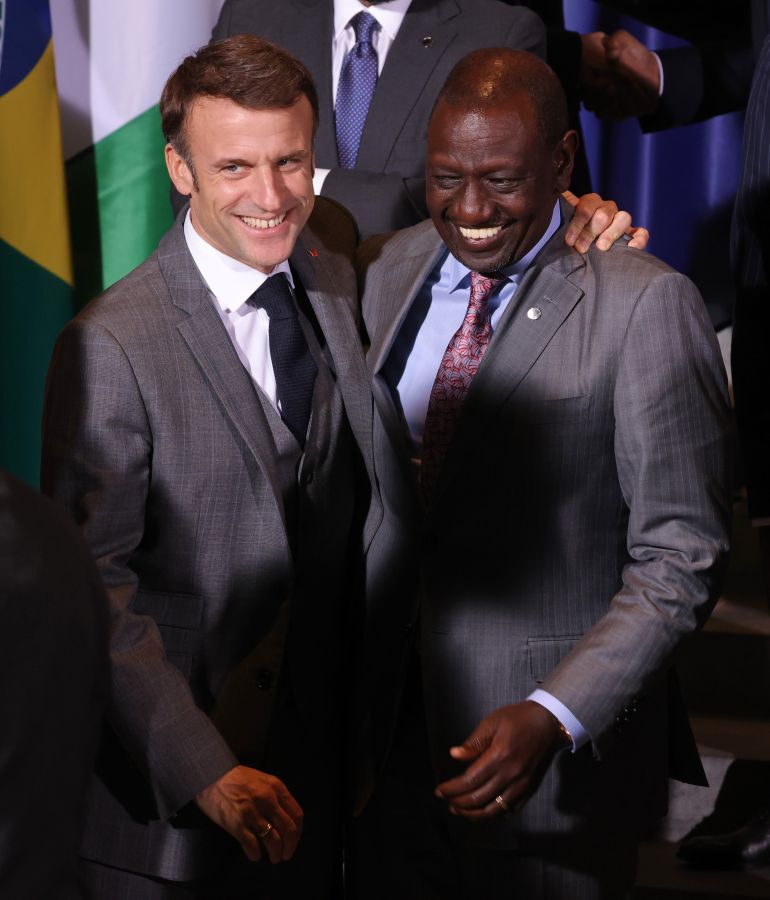
Ruto (right) concludes his tour with a visit to France at the invitation of French President Macron (left) to participate in the G7 summit.
France Stop and G7 Summit
The tour concludes with Ruto heading to France to participate in the G7 summit. The summit will be held from June 15 to 17 in Évian-les-Bains, where world leaders will discuss economic, security, and geopolitical challenges, as well as climate issues and international finance.
Kenya was invited to attend the summit alongside other invited countries including Brazil and India. According to a Kenyan official, the country plans to propose ideas reflecting the priorities of developing economies in areas such as financing, climate resilience, and inclusive growth.
These moves are part of Kenya’s increasing diplomatic activity toward European markets. Nairobi aims to position itself as a gateway for attracting investments in technology, energy, and manufacturing sectors, and as a voice for Africa and Global South countries in international forums.
Pretoria
Pretoria, the administrative capital of South Africa, was founded in 1855 by Marthinus Pretorius, a Voortrekker leader, and named after his father, Andries Pretorius. It played a central role in the country’s history, serving as the capital of the South African Republic (Transvaal) and later becoming a key site for the apartheid government’s administrative functions. Today, it is known for its jacaranda-lined streets, historic buildings like the Union Buildings, and its role as a diplomatic and political hub.
Union Buildings
The Union Buildings in Pretoria, South Africa, serve as the official seat of the country’s national government and house the offices of the President. Designed by architect Sir Herbert Baker, the sandstone structure was completed in 1913 and symbolizes the union of formerly divided British colonies and Boer republics after the Anglo-Boer War. It is also a significant historical site where Nelson Mandela was inaugurated as South Africa’s first democratically elected president in 1994.
Royal Palace
The Royal Palace, often located in capital cities such as Stockholm or Madrid, serves as the official residence of a monarch and a center for state ceremonies. Historically, these palaces evolved from medieval fortresses into grand Baroque or Neoclassical structures, symbolizing royal power and national heritage. Many are now open to the public, showcasing opulent interiors, art collections, and centuries of political and cultural history.
Presidential Palace
The Presidential Palace is the official residence and workplace of the head of state in many countries, often serving as a symbol of national government and history. Depending on the location, these palaces may have origins as royal residences, colonial administrative buildings, or purpose-built modern structures. For example, the Presidential Palace in Helsinki, Finland, was originally built as a private residence in the 1820s before becoming the official seat of the President.
Helsinki
Helsinki, the capital of Finland, was founded in 1550 by King Gustav I of Sweden as a trading port but remained a small town for centuries. It grew significantly after being made the capital of the Grand Duchy of Finland under Russian rule in 1812, with a neoclassical city center designed by Carl Ludvig Engel. Today, Helsinki is a vibrant cultural hub known for its blend of modern architecture, design, and historic landmarks like the Suomenlinna sea fortress.
Nokia Executive Center
The Nokia Executive Center is a historic venue located in Espoo, Finland, originally built in the 1990s as part of Nokia’s global headquarters. It served as a key hub for the company’s leadership and high-level business meetings during Nokia’s peak as a mobile phone giant. Following Nokia’s decline, the building was sold and later repurposed, marking a shift in the region’s corporate landscape.
Espoo
Espoo is a city in Finland, part of the Greater Helsinki region, known for its blend of urban and natural landscapes. Historically a rural municipality, it rapidly developed after World War II, becoming a major hub for technology and education, notably hosting the headquarters of Nokia and Aalto University. Today, Espoo is celebrated for its modern architecture, extensive green spaces, and cultural sites like the Espoo Cathedral.
Évian-les-Bains
Évian-les-Bains is a French spa town on the shores of Lake Geneva, renowned for its natural mineral water, Evian. Its history as a health resort dates back to the 19th century when the therapeutic properties of its springs were discovered, attracting wealthy visitors and leading to the development of elegant Belle Époque architecture. The town is also historically notable as the site of the 1962 Évian Accords, which ended the Algerian War.