Prime Minister Modi visited Surat L&T Hazira plant, inspected indigenous defense projects.
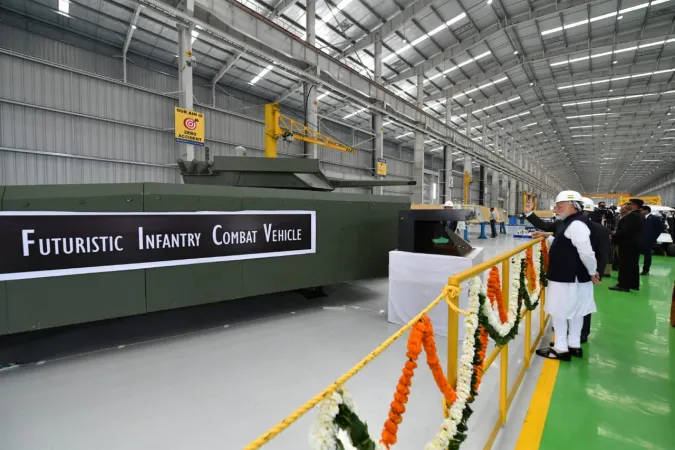
Prime Minister Narendra Modi visited the Larsen & Toubro (L&T) plant in Hazira, near Surat, on Friday. This visit highlights the strategic role of this complex in strengthening India’s indigenous defense production capabilities. It was his first visit in nearly seven years since his previous visit in 2019.
This state-of-the-art industrial complex in Hazira, near Surat, has become a major hub for defense production and heavy engineering. During the visit, Modi reviewed the plant’s operations and inspected various indigenous defense systems being developed and manufactured there. Currently, the Hazira plant is the largest private sector manufacturer of tracked armored vehicles in the country.
The plant is known for producing K-9 Vajra self-propelled artillery systems for the Indian Army. L&T has already supplied 100 K-9 Vajra guns to the army, many of which have been deployed in high-altitude areas along the Line of Actual Control (LAC) in eastern Ladakh. The central government has since approved an order for an additional 100 units of this artillery platform.
Hazira has also gained national recognition with the construction of the first prototype of the indigenous Zorawar light tank at the A.M. Naik Heavy Engineering Complex. Developed in just 19 months, this tank is specifically designed for operations in mountainous and high-altitude regions and is currently undergoing field trials.
Additionally, this plant is a key part of L&T’s efforts to secure the Indian Army’s Futuristic Infantry Combat Vehicle (FICV) program, which aims to replace the aging BMP-2 fleet. During his previous visit to the plant in 2019, the Prime Minister was briefed on prototypes developed under this program.
Other senior leaders have also visited the Hazira complex, including the Defense Minister, who visited the plant in January 2020 to review indigenous defense platforms like the K-9 Vajra.
Industry observers believe that with potential future orders for the Zorawar light tank and possible success in the FICV program, the Hazira plant could become one of India’s most important defense production hubs, further advancing the country’s goal of achieving self-reliance in defense manufacturing.
Surat L&T Hazira plant
The L&T Hazira plant, located in Surat, Gujarat, is a major manufacturing and engineering complex operated by Larsen & Toubro (L&T). Established in the early 2000s, it has become one of the company’s largest and most advanced facilities, specializing in heavy engineering, shipbuilding, and the production of critical equipment for sectors like oil and gas, power, and defense. Its strategic coastal location allows for easy access to global markets, contributing significantly to India’s industrial and export capabilities.
Hazira
Hazira is an industrial and port area near Surat, Gujarat, India, best known for the Hazira Port and the Hazira Maqbara, a 17th-century mausoleum built during the Mughal era. The site’s name is derived from “Hazira,” meaning “presence” or “tomb” in Gujarati, and it holds historical significance as a burial place for a Sufi saint. Today, Hazira is a major hub for heavy industries, including liquefied natural gas and steel plants, contrasting its historic past with modern development.
Surat
Surat is a historic port city in the Indian state of Gujarat, renowned for its significant role in trade during the Mughal era. It was a major hub for textile exports, particularly silk and cotton, and attracted merchants from across the world, including the British and Dutch. The city’s rich history is reflected in landmarks like the Surat Castle and the Dutch and Armenian cemeteries, which highlight its multicultural past.
Line of Actual Control (LAC)
The Line of Actual Control (LAC) is a disputed border between India and China, separating Indian-controlled territory from Chinese-controlled territory in the Himalayan region. It emerged after the 1962 Sino-Indian War, but has never been formally demarcated, leading to ongoing tensions and occasional military standoffs. The LAC is not a legally recognized international boundary, and both countries maintain differing perceptions of its exact alignment.
eastern Ladakh
Eastern Ladakh is a high-altitude desert region in northern India, known for its stark, moon-like landscapes and ancient Buddhist monasteries. Historically, it was a key stop on the Silk Road trade route, linking Central Asia with the Indian subcontinent. The area also holds strategic importance and has been shaped by both Tibetan Buddhist culture and, more recently, border tensions between India and China.
A.M. Naik Heavy Engineering Complex
The A.M. Naik Heavy Engineering Complex is a major manufacturing facility located in Hazira, Surat, India, operated by Larsen & Toubro (L&T). Named after L&T’s former chairman, A.M. Naik, it serves as a key hub for producing critical equipment for sectors like nuclear power, defense, and oil & gas. The complex has played a vital role in India’s industrial growth, particularly in heavy engineering and infrastructure development.
Hazira complex
The Hazira complex, located in Surat, Gujarat, India, is a historic Mughal-era site known for its architectural and religious significance. It houses the tombs of two revered Sufi saints, Syed Muhammad al-Hussaini (known as Hazrat Qutb-e-Alam) and his son Syed Muhammad al-Hussaini (Hazrat Burhan-ud-Din), built in the 15th and 16th centuries. The complex features intricately carved stone structures and a mosque, reflecting a blend of Islamic and local architectural styles.