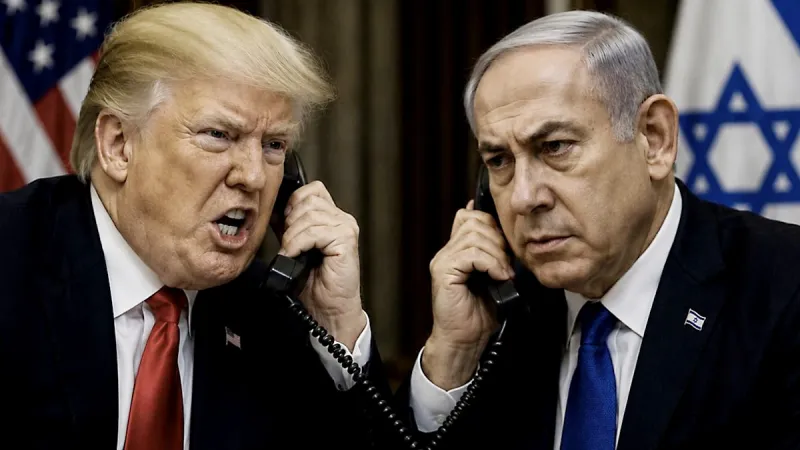
Donald Trump and Netanyahu in Heated Dispute Over Lebanon War.
A heated phone call took place between Donald Trump and Israeli PM Netanyahu regarding the military operation in Lebanon. Tensions have escalated significantly in West Asia. Click for more details.
Fierce dispute between Donald Trump and Netanyahu, major explosion over Lebanon war
Extremely shocking reports have emerged from Washington. A major dispute has occurred between US President Donald Trump and Israeli Prime Minister Benjamin Netanyahu over the military operation in Lebanon. This official revelation was made during a podcast interview. The incident has caused a huge uproar at the diplomatic level. Government sources have confirmed this intense conversation.
Fierce shouting match between Benjamin Netanyahu and Trump on the phone
The US President acknowledged this during a program with the New York Post. He used extremely harsh words for the Israeli PM. In fact, the military operation in Lebanon had jeopardized US peace negotiations. Iran has suspended nuclear talks with the US in protest of the attack. According to sources, Donald Trump was very unhappy with this global situation.
He directly warned Netanyahu over the phone. The President stated that Israel’s actions were causing major diplomatic damage on a global scale.
This incident comes at a time when the war situation in West Asia is worsening. Israel has intensified military operations against Hezbollah positions in the southern areas of Beirut. Severe violence has also been seen in this region in the past. Benjamin Netanyahu remains firm on his military stance.
The US has long been trying to broker a ceasefire in the region. However, instead of stopping the attacks, Israel has expanded its ground military operation.
Rising tensions in West Asia and Iran’s missile attack on Kuwait
This dispute has had a direct impact on the security of Gulf states. Iran recently launched a major attack on Kuwait using drones and missiles. The infrastructure of the international airport was severely damaged in the attack. According to government sources, one person has died. The growing tension in West Asia is now engulfing other countries as well.
US forces have retaliated by launching a military operation in southern Iran. Specifically, near the Strait of Hormuz, the US has bombed Iranian missile launch sites. The military operation in Lebanon is believed to be the main cause of this entire situation. Crude oil prices in the global market are also rising rapidly due to this.
Iran missile attack and US Navy retaliatory action
There are fears that military conflict in the region may intensify further in the coming times. The US Central Command has announced it will continue its defensive military operations in southern Iran. The President has indicated that the US will not allow Iran to build nuclear weapons. A high alert has been declared in Gulf states to prevent an Iranian missile attack. Global leaders may now raise this issue at the United Nations.
It is noteworthy that Israel has decided to continue its military operation in southern Lebanon. Netanyahu has made it clear that options for an attack on Beirut remain open.
This internal dispute between the US and Israel over the military operation in Lebanon has now come to the surface. New flames of war have erupted due to Iran’s aggressive stance and the US forces’ retaliatory action in the Gulf. Will the US succeed in preventing a full-scale war in West Asia?
Tags:
Related News
Lebanon
Lebanon is a country in the Middle East with a rich history dating back thousands of years, home to ancient civilizations like the Phoenicians. It features iconic cultural sites such as the Roman ruins of Baalbek and the historic city of Byblos, one of the oldest continuously inhabited cities in the world. Despite periods of conflict, Lebanon remains known for its diverse cultural heritage, vibrant cuisine, and resilient people.
West Asia
West Asia, often referred to as the Middle East, is a historically rich region that served as the cradle of ancient civilizations such as Mesopotamia, the Persian Empire, and the birthplace of major religions like Judaism, Christianity, and Islam. Its cultural sites include the ancient city of Persepolis in Iran, the historic Petra in Jordan, and the sacred city of Mecca in Saudi Arabia. Over centuries, the region has been a crossroads of trade, conquest, and cultural exchange, shaping its diverse heritage and modern geopolitical significance.
New York Post
The New York Post is a prominent American daily newspaper founded in 1801 by Alexander Hamilton, making it the oldest continuously published newspaper in the United States. Originally established as a Federalist-leaning broadsheet, it has evolved through various ownerships and formats, transitioning to a tabloid style in the 20th century under Rupert Murdoch’s News Corp. Today, it is known for its sensationalist headlines and conservative editorial stance, covering New York City news, politics, and entertainment.
Beirut
Beirut, the capital of Lebanon, is one of the oldest continuously inhabited cities in the world, with a history dating back over 5,000 years. It flourished as a major center of trade and culture under the Phoenicians, Romans, and Ottomans, but was heavily devastated during the Lebanese Civil War (1975–1990). Today, the city is known for its resilient spirit, blending ancient ruins with modern reconstruction, vibrant arts, and a diverse cultural scene.
Kuwait
Kuwait is a small, oil-rich country located in the Arabian Gulf, with a history dating back to the 18th century when it was founded as a fishing and trading port. It gained independence from British protection in 1961 and experienced rapid modernization following the discovery of oil. The nation is known for its iconic Kuwait Towers, a symbol of its post-oil prosperity, and its resilient recovery after the 1990 Iraqi invasion.
Strait of Hormuz
The Strait of Hormuz is a narrow, strategically vital waterway connecting the Persian Gulf to the Gulf of Oman and the Arabian Sea. Historically, it has been a crucial trade route for centuries, particularly for the transport of oil and natural gas from the Middle East to global markets. Due to its geopolitical importance, it has often been a focal point for international tensions and conflicts, especially involving Iran and neighboring nations.
United Nations
The United Nations is an intergovernmental organization founded in 1945 after World War II, with the primary goal of promoting international peace, security, and cooperation. Its headquarters are located in New York City, and it was established to replace the ineffective League of Nations, with founding members including 51 countries. Today, it comprises 193 member states and addresses global issues such as human rights, climate change, and conflict resolution.
Gulf
The Persian Gulf is a vital body of water in Western Asia, historically significant as a center of ancient trade routes linking Mesopotamia, the Indus Valley, and Arabia. For centuries, its shores have been home to powerful empires and trading ports, while in modern times, the region has become globally important due to its vast oil and natural gas reserves. Today, the Gulf’s cultural and economic influence remains profound, with nations like Saudi Arabia, Iran, and the UAE shaping its geopolitics.