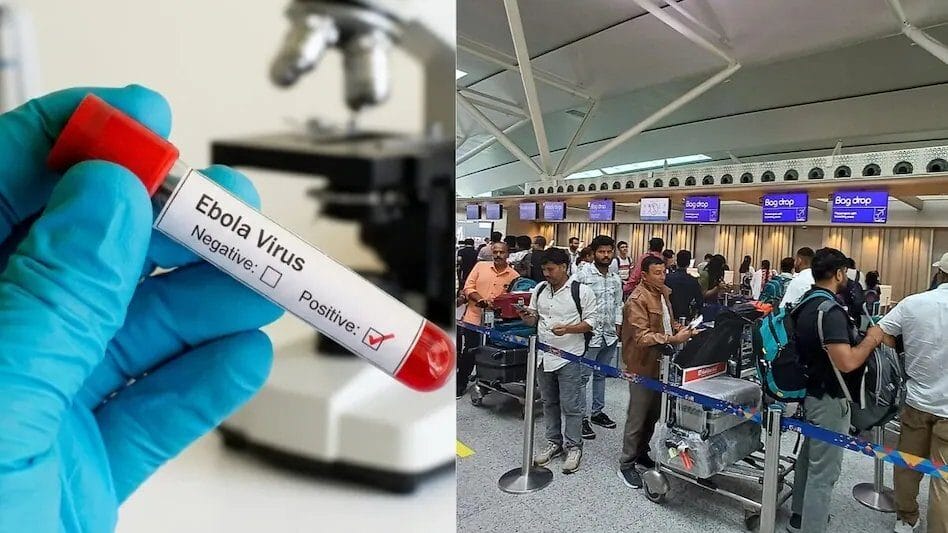
Ebola suspected case at Hyderabad Airport: Health alert issued, isolation underway.
Hyderabad, A health alert was issued at Rajiv Gandhi International Airport (RGIA) in Shamshabad, Hyderabad, on Thursday, June 4, due to a suspected case of Ebola. The situation arose when a passenger arriving from Ethiopia was flagged during routine thermal screening due to symptoms of fever. Given the passenger’s recent travel history through Uganda and South Sudan, precautionary protocols were immediately implemented due to the potential risk of Ebola infection.
Officials stated that the passenger was promptly isolated and sent to Gandhi Hospital for further examination. According to initial information, the passenger had been experiencing fever for the past few days, prompting the airport health team to act in accordance with standard protocols.
Samples sent to NIV Pune, monitoring of contacted passengers ongoing
To confirm the case, samples from the passenger were collected and sent to the National Institute of Virology (NIV) in Pune. Authorities are currently awaiting test results, which will determine whether the infection is confirmed or ruled out.
As a precaution, information about other passengers on the flight has been gathered, and monitoring of them has begun. Although it is reported that the flight was nearly empty, all individuals who came into contact are being tracked. According to health officials, the case remains in the suspected category, and all necessary safety measures are being taken.
Rajiv Gandhi International Airport
Rajiv Gandhi International Airport, located in Hyderabad, India, opened in 2008 to replace the older Begumpet Airport. It is named after former Prime Minister Rajiv Gandhi and was developed as a modern, state-of-the-art facility to handle the city’s growing air traffic. The airport has since become a major hub for both domestic and international flights, contributing significantly to the region’s economy.
Gandhi Hospital
Gandhi Hospital, located in Hyderabad, India, is a major public healthcare institution with a history dating back to the early 20th century, originally established as a small dispensary. It was later renamed in honor of Mahatma Gandhi and has since grown into a 1,200-bed tertiary care teaching hospital affiliated with Gandhi Medical College. The hospital has played a significant role in providing affordable medical services and training healthcare professionals in the region.
National Institute of Virology (NIV) in Pune
The National Institute of Virology (NIV) in Pune, India, is a premier research institute established in 1952, originally as the Virus Research Centre under the Indian Council of Medical Research (ICMR). It has played a critical role in studying and controlling major viral outbreaks, including the Nipah virus and COVID-19, and is known for isolating the SARS-CoV-2 virus in India. The institute also houses a high-containment Biosafety Level 4 (BSL-4) laboratory, one of the few in the country.