50 African Ministers in Seoul: What Is South Korea Looking for in the Black Continent?
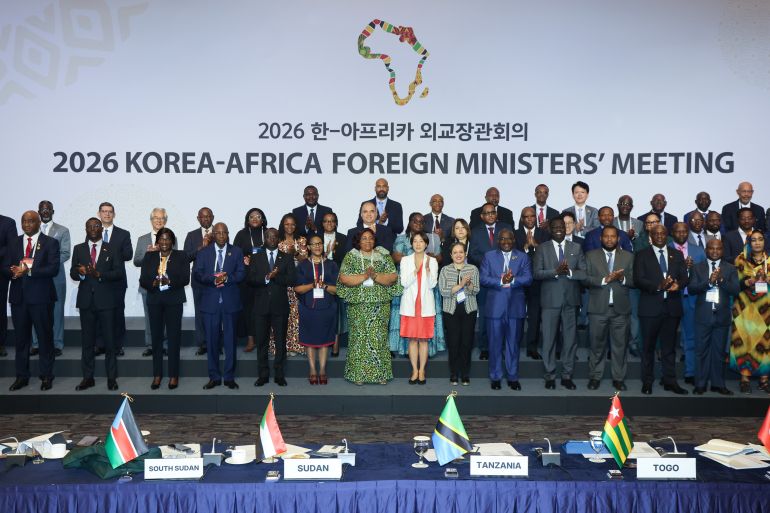
South Korea hosted its first joint ministerial meeting with African continent countries on Monday and Tuesday, with foreign ministers and heads of delegations from 50 of the 54 African member states attending, along with representatives from four regional organizations, including the African Union, the African Development Bank, and the African Continental Free Trade Area.
The meeting was held under the theme “Partnership for a joint response to global challenges in an era of transformation” and was opened by South Korean Foreign Minister Cho Hyun, who emphasized the rapid changes in the world, particularly supply chain disruptions and growing concerns over security and energy.
Cho Hyun stated, “The ongoing instability in the Middle East and the surrounding uncertainty make the geopolitical and economic importance of Africa clearer than ever,” adding that close cooperation between Seoul and African countries has become an urgent necessity.
The Korean minister described Africa as the continent of the future, citing three factors: its demographic strength represented by its youth, its strategic location at the maritime crossroads between the Atlantic and Indian Oceans, and its vast reserves of critical minerals.
The meeting prioritized the issue of critical minerals used in data centers, electric vehicle manufacturing, and batteries. Participants agreed to enhance the stability of supply chains for these minerals while ensuring increased local added value in African countries, adhering to environmental and labor standards.
It was announced that consultations would continue on holding the “Second Korea-Africa Critical Minerals Dialogue,” a step reflecting a notable strategic shift in Seoul’s approach to the continent, moving from a development aid model to a mutual economic partnership model.
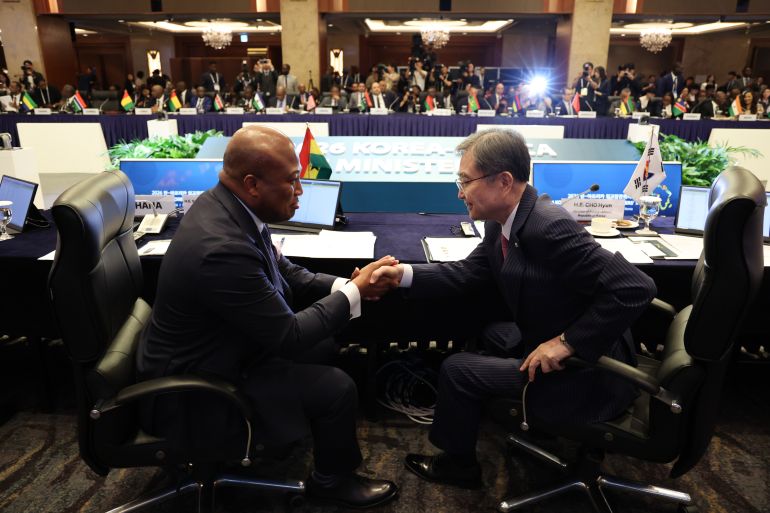
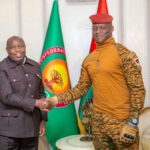
South Korean Foreign Minister Cho Hyun (right) in conversation with his Ghanaian counterpart Samuel Okudzeto Ablakwa
What was built at the first summit
This meeting follows the Korea-Africa Summit held in 2024, where Seoul pledged $14 billion in funding to support Korean companies investing in the continent and increased its official development assistance contributions to $10 billion by 2030. It also signed agreements to enhance trade and investment with eight African countries, as well as deals on strategic minerals with Tanzania.
On the sidelines of the ministerial meeting, Ghana’s Foreign Minister Samuel Okudzeto Ablakwa, acting Vice President of the African Union, highlighted the need to elevate Korea-Africa relations beyond traditional development cooperation toward a deeper economic partnership.
Second summit on the horizon
South Korean President Lee Jae-myung expressed his desire to organize the second Korea-Africa Summit by 2029, reflecting a trend toward establishing a regular framework for cooperation with the continent, similar to models established by other powers such as China. The Korean president met with more than twenty African ministerial delegations on the sidelines of the meeting.
Participants in the Korea-Africa Business Forum, which included government officials, business leaders, and experts, stressed the need to translate diplomatic momentum into tangible trade and investment partnerships, amid growing international interest in the continent, by leveraging its expanding consumer markets and stock of strategic minerals.
African Union
The African Union (AU) is a continental union founded in 2002 in Addis Ababa, Ethiopia, succeeding the Organisation of African Unity (OAU), which was established in 1963 to promote decolonization and unity. It aims to drive Africa’s integration, development, and peace, with key initiatives like Agenda 2063 for a prosperous and united continent. The AU’s headquarters, the African Union Conference Center, symbolizes this ongoing effort toward political and economic cooperation among its 55 member states.
African Development Bank
The African Development Bank (AfDB) is a multilateral development finance institution established in 1964 to promote economic and social progress across the African continent. Headquartered in Abidjan, Côte d’Ivoire, it provides loans, grants, and technical assistance to member countries for projects in infrastructure, agriculture, and other key sectors. Over its history, the bank has played a crucial role in mobilizing resources and fostering regional integration to reduce poverty and improve living standards in Africa.
African Continental Free Trade Area
The African Continental Free Trade Area (AfCFTA) is a landmark agreement among 54 of the 55 African Union nations, aimed at creating a single continental market for goods and services. Officially launched in January 2021 after years of negotiations, it seeks to boost intra-African trade by reducing tariffs and non-tariff barriers. The AfCFTA represents a major step toward economic integration, with the potential to lift millions out of poverty and accelerate industrialization across Africa.
Atlantic Ocean
The Atlantic Ocean is the second-largest ocean on Earth, separating the Americas from Europe and Africa. Its name derives from Greek mythology, referencing the “Sea of Atlas,” and it has been a crucial route for exploration, trade, and migration since the Age of Discovery. Historically, it played a central role in the transatlantic slave trade and later became a key theater in both World Wars.
Indian Ocean
The Indian Ocean is the third-largest of the world’s oceans, covering about 20% of the Earth’s water surface and bordered by Africa, Asia, Australia, and the Indian subcontinent. Historically, it served as a vital trade route for ancient civilizations, connecting the Roman Empire, Persia, India, and China through the monsoon-driven spice and silk trades. Its significance continued into the colonial era, with European powers establishing key ports and sea lanes that shaped global commerce and cultural exchange.
Seoul
Seoul, the capital of South Korea, is a dynamic metropolis that blends ancient history with cutting-edge modernity. Founded over 2,000 years ago, it served as the capital of the Joseon Dynasty, with landmarks like Gyeongbokgung Palace and the historic Jongmyo Shrine still standing today. Now a global hub for technology and pop culture, Seoul offers a unique mix of traditional markets, futuristic skyscrapers, and vibrant neighborhoods like Myeongdong and Gangnam.
South Korea
South Korea is a vibrant East Asian nation known for its dynamic blend of ancient traditions and cutting-edge modernity. Its history spans millennia, from the ancient kingdoms of Gojoseon and the Three Kingdoms period to the Joseon Dynasty, followed by Japanese colonization and the Korean War, which led to its division. Today, South Korea is celebrated for its technological innovation, K-pop culture, and well-preserved heritage sites like Gyeongbokgung Palace and the historic city of Gyeongju.
Tanzania
Tanzania, located in East Africa, is renowned for its rich cultural heritage and stunning natural landscapes, including Mount Kilimanjaro, Africa’s highest peak, and the Serengeti National Park. Its history is shaped by ancient trade routes, colonial rule under Germany and later Britain, and the unification of Tanganyika and Zanzibar in 1964 to form the modern nation. Today, Tanzania is celebrated for its diverse ethnic groups, Swahili culture, and commitment to wildlife conservation.