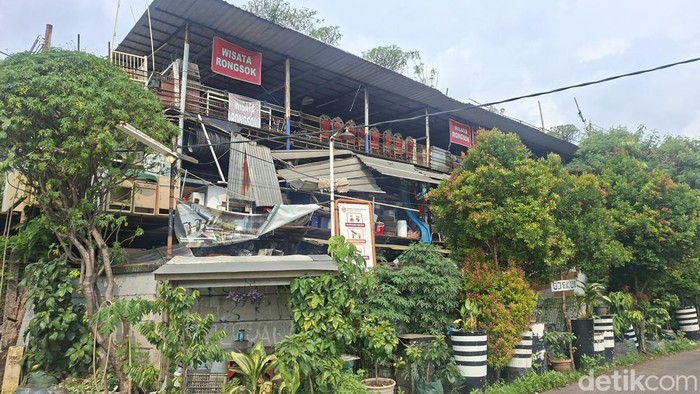
Depok –
For travelers who love vintage items or have a sharp eye for antiques, the name Mall Rongsok is likely familiar.
Unlike modern, luxurious shopping centers, this place offers an extraordinary sense of exploration for those who enjoy the thrill of finding unique and rare treasures.
Upon entering, a vast array of items stretches out before you, packed tightly together as far as the eye can see. Every corner of the space is filled with an eclectic mix of old monitors and vintage electronics, along with decorative trinkets that evoke memories of the past.
There is an interesting story behind the operation of Mall Rongsok, shared by Aditya (30), the successor to this unique family business.
If travelers think this place only sells ordinary scrap metal, they are mistaken. Here, almost anything can end up on the shelves and be available for purchase, as long as the price is right. The concept they follow is very flexible: get whatever you can find.
Aditya revealed that throughout the store’s history, they have often come across very unusual and truly astonishing items.
“Strangely, we once got a coffin. We once got a rowboat. They came in here, but luckily they were sold,” recalled Aditya at Wisata Rongsok, on Jl. Kukusan Raya, Beji, Depok City, West Java.
What’s more, Mall Rongsok has even brought in parts of air transportation. “Helicopters, airplanes—airplane doors or helicopter doors—we’ve bought those too,” he added.
The price range here is very striking. The cheapest items available include straws and used DVDs, with prices ranging from Rp 5,000 to Rp 15,000. Surprisingly, the most expensive item they have ever sold turned out to be a used car.
The Touching Story of the Owner’s Struggle
Behind its current fame, Mall Rongsok holds a touching story of perseverance. This business was started by Aditya’s father, Nurholis, from scratch, or more precisely, from a deficit.
Aditya recounted that his family once faced financial difficulties, often having to borrow money from various sources to gather the initial capital they needed. His father started by exploring Pasar Senen to find used goods that could be resold.
“All the capital was debt. Honestly, if you asked, my dad wasn’t a rich person. Really, if you asked the neighbors, my dad’s family was once considered poor. They used to live in a chicken coop when they were starting out, yes. On the riverbank,” Aditya revealed.
Thanks to incredible consistency, courage, and hard work, the physical store was eventually established, forming the strong brand it is today. Remarkably, the father still maintains a strict work ethic to oversee the business and its network of partners. “Even now, if you count his sleep hours, my dad only sleeps about 4 hours a day,” said Aditya.
That long struggle has now paid off. If they once had to exhaust themselves looking for items, now it is job seekers, offices, restaurants, and individuals who come to offer their goods.
One of the most astonishing things about Mall Rongsok is its pricing system. Amid the onslaught of digital scanners and barcodes, this place remains faithful to a system of decades-old memory.
Aditya admitted they once tried using manual price tags, but that method turned out to be ineffective and prone to cheating by dishonest buyers.
“First, it took too much time because there are so many items, and second, sometimes people would move them. They’d pull them off and switch them to a cheaper price,” he joked.
As a result, a strong memory and extensive experience are their main tools. Uniquely, the owner, Nurholis, always remembers the price of every item that comes in. They determine prices not just by guessing, but based on a deep understanding of brand quality, material durability, and original functional value compared to the cheap items available on online platforms today.
For travelers curious to experience the thrill of hunting for hidden treasures, Mall Rongsok is more than just a place to buy and sell used goods. This place is a living museum of items that refuse to be forgotten by time. It is open every day from