Trending Photos
-
Since the operation to expel Bangladeshi infiltrators from Bengal began, the frustration of extremists in Dhaka has been steadily increasing. The infiltrators, who have been looting local resources by creating fake Indian Aadhaar cards, PAN cards, health cards, and ration cards, are now lining up at the border. As the line grows longer, so does the level of threats from extremists.
Religious extremists based in Bangladesh are threatening to turn West Bengal into Gaza. They are warning of creating a ruthless terrorist organization like Hamas in Bengal. These radicals are linking the return of infiltrators to oppression of Muslims and are threatening India. They claim to be preparing for Ghazwat-ul-Hind in West Bengal. Not only that, they say they will destroy 10 temples for every mosque. However, you must understand that this issue is not about oppression of Muslims, nor is any mosque in Bengal at risk. So what is the real motive of this extremist threatening India from Dhaka? What is the agenda? You should understand this through the timing of the threat.
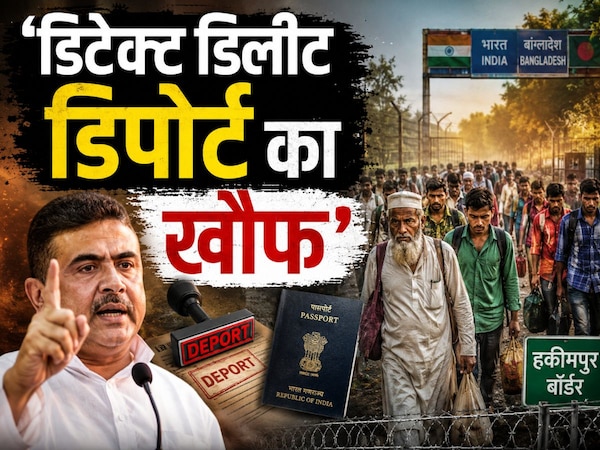
This threat from Bangladesh came on May 25, that is, the day before yesterday. It came when Bangladeshi infiltrators began gathering at the Hakimpur border in West Bengal. It came when infiltrators, fearing detention centers, started assembling at the Bangladesh border on their own.
This frustration of the extremists is actually the despair of a failed major ‘project’ of theirs. What was this project? What were its stages, and how did it fail? You should understand this.
Phase 1 of this project was demographic invasion. Extremists conspired for decades to change Bengal’s demographics. Their goal was not just employment, but to seize land and resources. Now, with the return of infiltrators, their ‘occupation model’ is collapsing.
Phase 2 of the extremists’ project was the funding syndicate. The multi-crore black market of fake currency, cattle smuggling, and drugs that operated across the border relied on these infiltrators, who are now forced to leave India.
The final phase of the extremists’ project was sleeper cells and terror modules. Extremist organizations used the crowd of illegal infiltrators to hide and prepare sleeper cells. An investigation into the riots in Murshidabad revealed that sleeper cells of Hizb ut-Tahrir and other terrorist organizations based in Bangladesh were active there. Infiltrators from Bangladesh joined the crowd and incited violence. However, after the change of power in West Bengal, fencing work at the border has accelerated on one hand, and on the other, infiltrators present in Bengal are being sent back to Bangladesh. This action has permanently shut down the extremists’ operation. That is why they are making hollow threats to turn Bengal into the Gaza Strip.
Another major reason for the frustration of extremists in Bengal is that after the formation of the new government, the shop of appeasement, where infiltrators used to get fake identity cards, has been shut down. Extremists are upset that the political umbrella their pawns once had has been blown away by the storm of regime change. This is why frustrated extremists are threatening to turn West Bengal into Gaza. But you must understand: where did the mention of Hamas come from?
A conference of extremists was held in Dhaka, the capital of Bangladesh, on October 7, 2024. It was organized by the extremist organization Al-Markazul. This conference took place exactly one year after Hamas’s attack on Israel. Hamas spokesman Khaled Qaddoumi and Hamas Diaspora chairman Khaled Mashal attended. Pakistani extremist leader Maulana Fazlur Rehman and several Taliban terrorists also participated.
Bangladeshi extremists, relying on this international terror connection, are threatening to establish Hamas in Bengal. But these threats are not a sign of their strength; they are a sign of their fear. Fear because the network of infiltration that extremists had woven in Bengal for generations is being systematically dismantled. What is the effect of this action? You will understand by knowing the situation at the Hakimpur border. You will understand how infiltrators gained the right to
West Bengal
West Bengal is a culturally rich state in eastern India, known for its vibrant festivals, literature, and arts, with Kolkata as its capital. Historically, it was the center of British colonial administration in India until 1911 and played a key role in the Indian independence movement. The region is also famous for the Sundarbans mangrove forest and its distinct Bengali heritage, including cuisine and music.Gaza
Gaza is a densely populated Palestinian city on the eastern coast of the Mediterranean Sea, with a history spanning over 4,000 years. It was a major trade hub for the ancient Philistines and later ruled by various empires, including the Romans, Byzantines, and Ottomans. Today, it is the administrative center of the Gaza Strip, known for its rich cultural heritage but also for the challenges of ongoing conflict and blockade.Hamas
“Hamas is a Palestinian Islamist political organization and militant group, founded in 1987 during the First Intifada against Israeli occupation. It has controlled the Gaza Strip since 2007, following a conflict with the rival Fatah party, and is designated as a terrorist organization by several countries. The group’s history is marked by its opposition to Israel, periodic armed conflicts, and its role in Palestinian governance and social services.”Hakimpur border
Hakimpur border is a land port located in the Dinajpur district of Bangladesh, serving as a key trade and transit point with the Indian state of West Bengal. Historically, the area has been significant for cross-border commerce and movement between the two countries, particularly after the establishment of the official land port in the early 2000s to facilitate bilateral trade. It remains an important gateway for the exchange of goods like agricultural products and industrial materials.Murshidabad
Murshidabad, located in the Indian state of West Bengal, was the capital of Bengal under the Nawabs in the 18th century, most notably during the reign of Murshid Quli Khan, who renamed the city after himself. It served as a major political and economic center until the British East India Company’s victory at the Battle of Plassey in 1757, which marked the beginning of British colonial rule in India. Today, the city is known for its historical landmarks, including the Hazarduari Palace and the Katra Mosque.Dhaka
Dhaka, the capital of Bangladesh, is a densely populated megacity with a rich history dating back to the 7th century, when it was part of the ancient Buddhist kingdom of Kamarupa. It rose to prominence as the Mughal capital of Bengal in the 17th century, becoming a major center for trade in fine muslin textiles. Today, it is a vibrant cultural hub, known for its bustling streets, historic mosques, and the legacy of the Bengali Renaissance.Hizb ut-Tahrir
Hizb ut-Tahrir (the Party of Liberation) is a pan-Islamist political organization founded in 1953 in Jerusalem by Taqiuddin al-Nabhani, a judge and Islamic scholar. The group advocates for the re-establishment of a unified Islamic caliphate through non-violent, political means, and it operates clandestinely in many countries where it is banned. Despite its global presence, it remains a controversial and often illegal organization, particularly in Central Asia and the Middle East, due to its opposition to secular governments and its radical ideology.Al-Markazul
Al-Markazul is likely a reference to **Al-Markaz al-Islami** (Islamic Center) or a similar cultural/religious hub, though the name is often used generically for community centers in Muslim-majority regions. Without a specific location, it generally denotes a place for Islamic worship, education, and cultural gatherings, often serving as a bridge for preserving heritage and fostering community ties. Historically, such centers have been established worldwide to provide spiritual guidance and social services, reflecting the diaspora and expansion of Islamic culture.