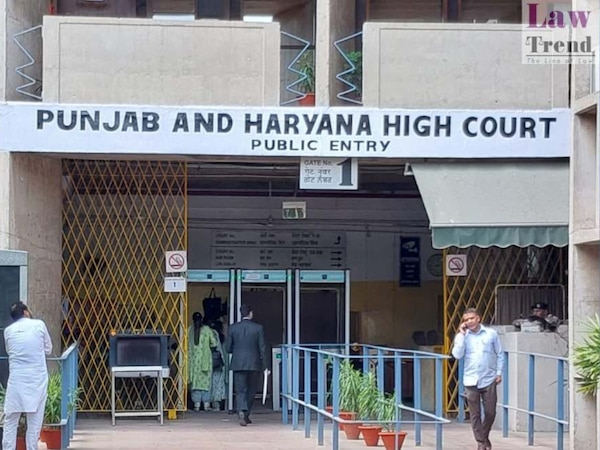
High Court News: A case came before the Punjab and Haryana High Court that surprised everyone. During the hearing, the High Court clarified that a woman meeting her ex (former lover) once after marriage cannot prove adultery. The court also stated that if a woman had a relationship with someone before marriage, it cannot be considered wrong after marriage.
The case involves a divorce between a soldier serving in the Indian Navy and his wife. The couple got married five years ago in November 2021. They have no children so far. The husband alleged that his wife had relationships with several men after marriage, including one person with whom she reportedly had a relationship before marriage.
Allegations Made by the Husband
The husband accused his wife of being quarrelsome and staying out late at night. Additionally, she refused to sleep in the same bed and would talk to strangers for long periods. The husband claimed that on January 11, 2013, he found his wife in a compromising situation with a man at their home. After this, he sent his wife to her parental home. However, the wife denied all allegations and accused her husband and in-laws of dowry harassment. She also alleged that her father-in-law had inappropriate intentions toward her.
Divorce in Family Court
Regarding the wife’s allegations, the Family Court stated that if the father-in-law had bad intentions, why would she go anywhere with him. The Family Court described the wife’s accusations as careless, irresponsible, and false, and deemed such baseless character attacks as cruelty toward the husband.
The woman then approached the High Court. The High Court ruled that making serious allegations against the husband and his family without concrete evidence falls entirely under mental cruelty. The court also noted that the basis for divorce between the two is not adultery, but the cruel behavior exhibited by the wife. Consequently, the High Court upheld the Family Court’s decision.
Also read:
Punjab and Haryana High Court
The Punjab and Haryana High Court, located in Chandigarh, is the common high court for the Indian states of Punjab and Haryana and the Union Territory of Chandigarh. It was established on November 1, 1966, following the reorganization of Punjab, when the former Punjab High Court was split to create separate high courts for the new states. The court building, designed by architect Le Corbusier, is a notable example of modernist architecture and reflects the city’s unique urban planning.
Indian Navy
The Indian Navy is the naval branch of India’s armed forces, with origins tracing back to the British East India Company’s marine forces established in the 17th century. It played a crucial role in maritime security and trade protection during the colonial era, and after India’s independence in 1947, it evolved into a modern blue-water navy. Today, it safeguards India’s maritime interests, conducts humanitarian missions, and maintains a significant presence in the Indian Ocean region.
Punjab and Haryana High Court
The Punjab and Haryana High Court is the highest judicial body for the Indian states of Punjab and Haryana, and the Union Territory of Chandigarh. Established in 1975 following the reorganization of the former Punjab High Court, it is located in Chandigarh. The court’s iconic building, designed by Le Corbusier, reflects the modernist architecture of the city and serves as a key institution for justice in the region.
Chandigarh
Chandigarh is a planned city in northern India, designed by the renowned architect Le Corbusier after India’s partition in 1947. It serves as the capital of both Punjab and Haryana, symbolizing post-independence modernity with its distinctive grid layout, geometric buildings, and the iconic Open Hand Monument. The city was built to replace Lahore as Punjab’s capital, and its design reflects a blend of modernist architecture and urban planning principles.
Indian Navy
The Indian Navy is the naval branch of the Indian Armed Forces, with its origins tracing back to the establishment of the East India Company’s marine forces in the 17th century. It played a key role in both World Wars and was officially renamed the Indian Navy after India became a republic in 1950. Today, it is a blue-water navy focused on safeguarding India’s maritime interests, projecting power across the Indian Ocean, and conducting humanitarian missions.
Family Court
The Family Court is a specialized judicial system that handles legal matters related to family relationships, such as divorce, child custody, adoption, and domestic violence. Its modern history began in the early 20th century, with the first dedicated family court established in the United States in 1914, aiming to provide a less adversarial and more rehabilitative approach to resolving family disputes. Today, family courts exist worldwide, evolving to prioritize the best interests of children and the well-being of families through mediation and specialized legal processes.
Indian Ocean
The Indian Ocean is the third-largest ocean in the world, covering about 20% of Earth’s water surface and bordered by Africa, Asia, Australia, and the Indian subcontinent. Historically, it served as a major maritime trade route for centuries, connecting ancient civilizations such as the Indus Valley, Mesopotamia, and Rome, and later facilitating the spice trade and European colonial expansion. Its strategic importance continues today as a vital corridor for global commerce and energy shipments.