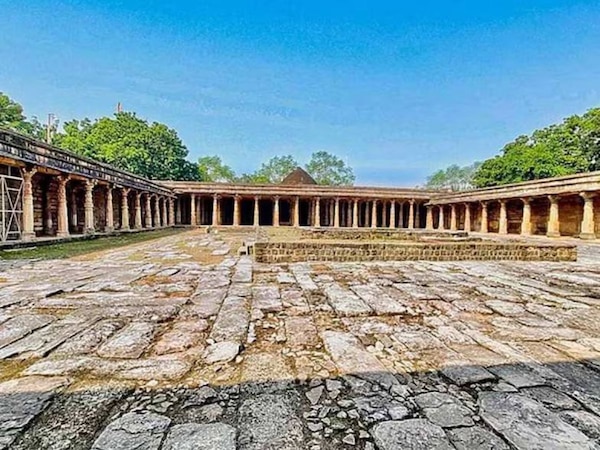
In Madhya Pradesh, after the historic High Court verdict on May 15 in the Dhar Bhojshala case, the ASI has issued a new order. The ASI has clarified in its order that the Hindu community will now have full freedom to come and go to Bhojshala. They will be able to study and worship Saraswati there according to the old tradition.

Temple of Goddess Saraswati and Center of Sanskrit Education

The ASI has stated in its order that the Madhya Pradesh High Court has recognized Bhojshala as a research center for the Sanskrit language, grammar, and literature, and as a temple of Goddess Vagdevi. In light of this, the Hindu community will now have full permission to come and go and worship there.

ASI and District Administration Will Decide the Arrangements Together

The ASI has stated in its order that Bhojshala will remain a protected monument under the AMASR Act of 1958. Therefore, the visiting hours for tourists and Hindu devotees will be determined by the Superintending Archaeologist in consultation with the district administration. What the Hindu community will be allowed to do for study and worship will also be decided by the Superintending Archaeologist in coordination with the district administration, so that the security and preservation of the monument can be ensured.

What Was the Madhya Pradesh High Court’s Decision

The Indore bench of the Madhya Pradesh High Court delivered a historic verdict on Friday regarding the long-standing dispute over Bhojshala. The court said that the original religious character of the disputed site is Bhojshala and that there was a temple of Goddess Saraswati there.

The court set aside the 2003 ASI order, which allowed Hindus to worship only on Tuesdays and on the occasion of Basant Panchami. Meanwhile, the 2003 order had allowed the Muslim community to offer namaz on Fridays. The court said that the Government of India and the ASI will decide how Bhojshala will be operated and managed. The ASI will continue to oversee the entire complex.

Considering the long-standing claim of the Muslim community, the court said that if the Muslim community wishes, they can request land for a mosque at another location in Dhar district. The government can consider that application according to the law.

Bhojshala

Bhojshala is a historic site in Dhar, Madhya Pradesh, India, traditionally associated with the 11th-century Paramara king Bhoja, who was a renowned scholar and patron of learning. It is believed to have served as a university or a center for Sanskrit education, where scholars gathered to study various disciplines. The site is also notable for its architectural remains, including inscriptions and a large stone slab, and it holds religious significance for both Hindus and Muslims, with a mosque later built on the premises.

Temple of Goddess Saraswati

The Temple of Goddess Saraswati is a sacred Hindu site dedicated to the goddess of knowledge, music, arts, and wisdom. While specific historical origins vary by location, many such temples in India, such as the one in Koothanur, Tamil Nadu, date back centuries and are revered as centers of learning and culture. The temple often attracts students and artists who seek the goddess’s blessings for intellectual and creative pursuits.

Madhya Pradesh High Court

The Madhya Pradesh High Court is the highest judicial body in the Indian state of Madhya Pradesh

Bhojshala

Bhojshala, located in Dhar, Madhya Pradesh, is a historic site believed to have been a university and cultural center established by the legendary Paramara king Raja Bhoja in the 11th century. It is famously associated with the Sanskrit scholar and poet, and features a unique blend of Hindu and Islamic architectural elements, including a mosque built later by Dilawar Khan. Today, the site is a protected monument and a subject of debate, as both Hindu and Muslim communities claim it for religious worship.

Temple of Goddess Saraswati

The Temple of Goddess Saraswati, often located within larger Hindu temple complexes or as standalone shrines, is dedicated to the Hindu goddess of knowledge, music, arts, and learning. Historically, such temples have served as centers for education and cultural activities, particularly in regions like Bali, Indonesia, and parts of India. The goddess is typically depicted holding a veena (a musical instrument) and a book, symbolizing the pursuit of wisdom and creative expression.

Madhya Pradesh High Court

The Madhya Pradesh High Court, located in Jabalpur, is the principal judicial body for the Indian state of Madhya Pradesh. Established on January 1, 1936, under the Government of India Act 1935, it was originally known as the High Court of Judicature at Nagpur for the Central Provinces and Berar. Following the reorganization of states in 1956, it was renamed and relocated to Jabalpur, serving as a key institution in the state’s legal and constitutional history.

Saraswati

Saraswati is the Hindu goddess of knowledge, music, arts, wisdom, and learning, often depicted playing a veena (a stringed instrument) and seated on a white lotus. She is also associated with the ancient, now-extinct Saraswati River mentioned in the Rigveda, which is believed to have flowed through present-day northwest India. Revered as the divine source of creativity and intellect, she is widely worshipped during the festival of Vasant Panchami, marking the arrival of spring.

Basant Panchami

Basant Panchami is a vibrant Hindu festival marking the arrival of spring, celebrated primarily in India and Nepal. Historically, it is dedicated to the goddess Saraswati, the deity of knowledge, music, and arts, and is observed on the fifth day of the Hindu month of Magha. The festival is known for its bright yellow attire, kite flying, and the initiation of educational activities, symbolizing renewal and wisdom.

Dhar district

Dhar district, located in the Malwa region of Madhya Pradesh, India, has a rich historical legacy as the capital of the Paramara dynasty from the 9th to 13th centuries. It later came under the control of the Delhi Sultanate, the Mughals, and the Marathas, with the city of Dhar serving as a key cultural and political center. Notable landmarks include the ancient Bhojshala temple and the Dhar Fort, reflecting its diverse architectural and historical influences.

Indore bench

The “Indore bench” is not a specific cultural site, but rather a term that historically refers to a type of low wooden bench or seating furniture popularized in colonial India, often associated with the princely state of Indore. These benches were commonly used in public spaces, railway stations, and homes during the British Raj, known for their simple, utilitarian design. While not a landmark, they represent a practical piece of everyday Indian material culture from the 19th and early 20th centuries.

mosque

A mosque is a place of worship for followers of Islam, serving as a center for prayer, community gatherings, and education. The first mosque was the Prophet’s Mosque in Medina, built by the Prophet Muhammad in the 7th century, establishing key architectural features like the minaret and prayer hall. Over centuries, mosques have evolved in design, from the simple early structures to grand, ornate buildings like the Great Mosque of Mecca, reflecting diverse cultural influences while maintaining their spiritual significance.