North Korea feels like a mysterious country trapped under pressure, sparking endless curiosity. It is said that under the state’s watchful eye, life is so harsh that people feel they can only survive by escaping. But the country is like a prison, with no way out! Yet, where there’s a will, there’s a way, and it requires patience. One family from that country has shared how, after a decade of planning, they managed to flee. The operation took just a couple of hours.

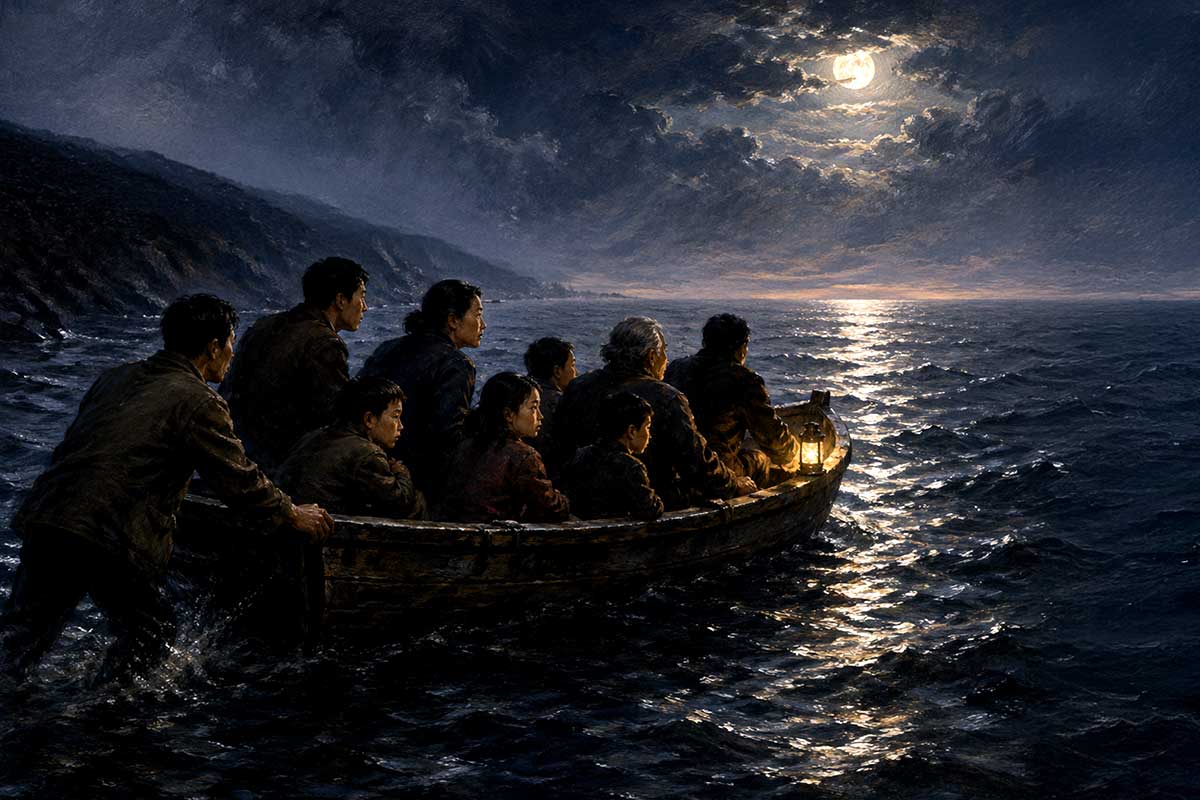
On May 6, 2023, that family of nine crossed the country’s waters in a small fishing boat. The task was incredibly difficult. Any small mistake could have led to capture, and everyone knows the severe punishment that would have awaited them.

Read more:

It is known that the person who devised this plan could not physically leave North Korea, as he had already died. Yet, the two brothers, Kim Il-hyok and Kim E-hyok, kept their father’s ashes on the boat. The plan was meticulous, crafted over a decade. Kim E-hyok frequently visited the coast, learned to fish, and then bought his own boat. The goal was to make the guards in the waters see him only as a fisherman. Later, the brothers went fishing together at sea, observing patrol patterns and the activities of soldiers in the waters. Only then did they finalize their escape plan.

The night of the escape was also chosen carefully. That night, a storm was so fierce that the radar was not working. Patrols also became irregular. Only a night watchman was present, and he was bribed. The group included Kim E-hyok’s wife, who was five months pregnant. She walked alone across a minefield in that condition, as planned. Everyone had previously explored the area and memorized the route. The youngest members of the group, aged four and six, were carried in sandbags. Then, everyone boarded the boat together. Kim E-hyok said his heart pounded throughout the journey. He now works as a cook in South Korea, sharing their escape story with everyone, which has spread across the world. This single incident makes clear how desperate people are in North Korea.

North Korea

North Korea, officially the Democratic People’s Republic of Korea (DPRK), was established in 1948 following the division of the Korean Peninsula after World War II. It has since been ruled by the Kim dynasty, with a focus on Juche ideology, isolationism, and a heavily militarized state. The country is known for its secretive nature, nuclear ambitions, and stark contrast to its southern neighbor, South Korea.

South Korea

South Korea, officially the Republic of Korea, is a vibrant East Asian nation known for its dynamic blend of ancient traditions and cutting-edge technology. Its history stretches back thousands of years, from the early Gojoseon kingdom through the Three Kingdoms period and the Joseon Dynasty, before experiencing Japanese colonization and the devastating Korean War. Today, it has emerged as a global cultural and economic powerhouse, famous for its K-pop, cuisine, and historic sites like Gyeongbokgung Palace.

North Korea

North Korea, officially the Democratic People’s Republic of Korea, is a country in East Asia that has been ruled by the Kim family since its founding in 1948, following the end of Japanese colonial rule. It was established as a socialist state under Kim Il-sung, and the Korean War (1950–1953)<

North Korea

North Korea, officially the Democratic People’s Republic of Korea (DPRK), is a highly isolated and authoritarian state on the Korean Peninsula, established in 1948 after the division of Korea following World War II. Its history is marked by the devastating Korean War (1950-1953), the rise of the Kim dynasty under a cult of personality, and a state-controlled economy that has led to severe poverty and international sanctions due to its nuclear weapons program. Today, the country remains one of the world’s most secretive nations, with limited outside contact and a heavily militarized border with South Korea.

South Korea

South Korea is a dynamic East Asian nation with a rich history spanning thousands of years, from ancient kingdoms like Goguryeo and Joseon to its modern division after the Korean War (1950–1953). Today, it is known for its blend of traditional culture—such as Buddhist temples, Hanok villages, and the UNESCO-listed Changdeokgung Palace—with cutting-edge technology, K-pop, and global cuisine like kimchi. The country has transformed from a war-torn state into a thriving democracy and economic powerhouse, often called the “Miracle on the Han River.”

Gyeongbokgung Palace

Gyeongbokgung Palace, built in 1395, is the largest and most iconic of the Five Grand Palaces in Seoul, South Korea, serving as the main royal palace of the Joseon Dynasty. It was destroyed during the Japanese invasions in the late 16th century and later rebuilt, but suffered further damage under Japanese colonial rule in the early 20th century. Today, it stands as a beautifully restored symbol of Korean heritage, featuring the Geunjeongjeon throne hall and the scenic Gyeonghoeru Pavilion.

Korean Peninsula

The Korean Peninsula, located in East Asia, is a historically significant region divided into two sovereign states: North Korea and South Korea. Its history spans thousands of years, marked by ancient kingdoms like Gojoseon, the Joseon Dynasty, and Japanese colonization from 1910 to 1945, followed by the Korean War (1950-1953) which solidified the division. Today, the peninsula is known for its rich cultural heritage, including traditional arts, cuisine, and the global influence of K-pop and Korean cinema.

East Asia

East Asia is a culturally rich and historically significant region comprising countries such as China, Japan, South Korea, North Korea, Mongolia, and Taiwan. Its history spans thousands of years, with ancient civilizations like the Shang and Zhou dynasties in China, the development of Confucianism and Buddhism, and influential empires such as the Mongol Empire. Today, East Asia is known for its blend of traditional heritage and modern innovation, including landmarks like the Great Wall of China, Kyoto’s temples, and Seoul’s palaces.

Gojoseon kingdom

Gojoseon was the first recorded Korean kingdom, traditionally founded by the legendary figure Dangun in 2333 BCE. It emerged in the basins of the Liao and Taedong Rivers, blending Bronze Age culture with early state formation, and is considered the foundation of Korean civilization. The kingdom eventually fell to the Chinese Han dynasty in 108 BCE, but its legacy continues to shape Korean national identity.

Three Kingdoms period

The Three Kingdoms period (220–280 CE) was a turbulent era in Chinese history following the fall of the Han dynasty, marked by the division of China into three rival states: Wei, Shu, and Wu. This era is famed for its epic battles, political intrigue, and legendary figures like Cao Cao, Liu Bei, and Zhuge Liang, which have been immortalized in the classic novel *Romance of the Three Kingdoms*. Its legacy profoundly influenced Chinese culture, art, and military strategy for centuries.

Joseon Dynasty

The Joseon Dynasty was a Korean dynastic kingdom that lasted for approximately five centuries, from 1392 to 1910. Founded by General Yi Seong-gye, it succeeded the Goryeo Dynasty and established Seoul as its capital, with Confucianism as its core state ideology. This period saw major cultural and scientific advancements, including the creation of the Korean alphabet, Hangul, and it was the last dynasty of Korea before the Japanese annexation.