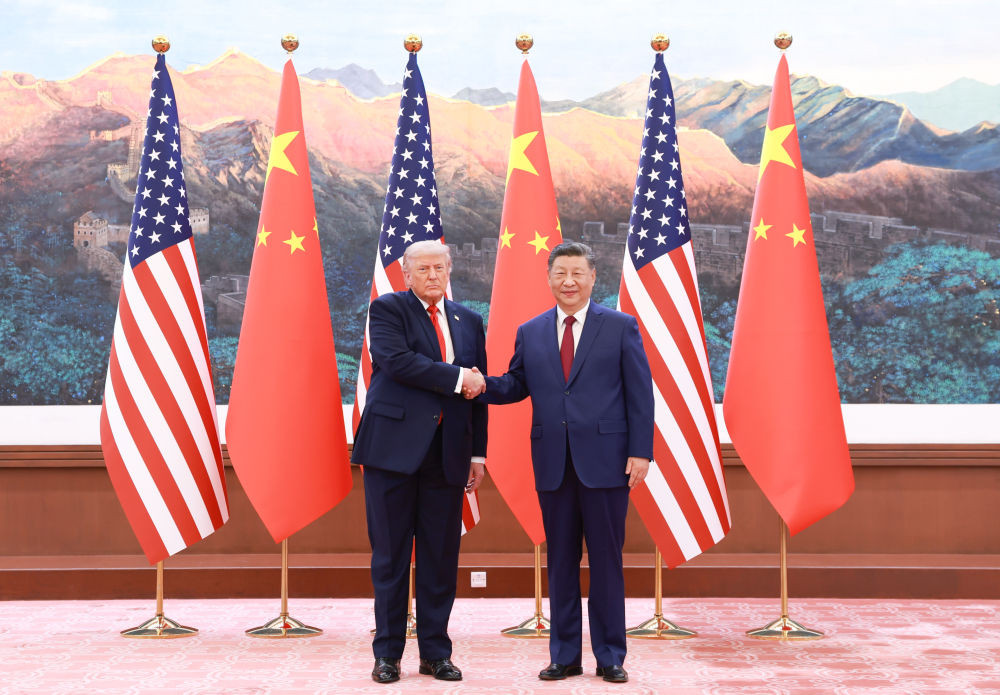
In the Hebei Hall of the Great Hall of the People, in front of the large painting “Jinshanling Morning Light,” flags of China and the United States were arranged. President Xi Jinping and President Trump smiled as they entered the hall, stood side by side, shook hands, and posed for a photo, with flashes lighting up and shutters clicking frequently.
Behind them, the Great Wall wound through the mountains, and the morning light painted the splendid landscape a bright golden yellow.
On the morning of May 14, President Xi Jinping held talks with U.S. President Trump, who was on a state visit to China, at the Great Hall of the People in Beijing.
This was the first visit by a U.S. president to China in nine years and the first face-to-face meeting between the two heads of state since their meeting in Busan in October last year. Another “handshake across the Pacific” captured the world’s attention.
“Our meeting can now be said to be the focus of global attention.” “In the United States, almost everyone is talking about this meeting.” Bearing the well-being of over 1.7 billion people in both countries and affecting the interests of more than 8 billion people worldwide, both sides deeply understood the weight of the “handshake” between the world’s two largest economies.
The formal talks were held in the East Hall, adjacent to the Hebei Hall. As the guests took their seats, President Xi Jinping opened the discussion with profound concern, posing three deep questions:
“In the current era of rapid transformation and increasing international turmoil, the world has reached a new crossroads. Can China and the United States avoid the ‘Thucydides Trap’ and create a new paradigm for major-country relations? Can we join hands to address global challenges and inject more stability into the world? Can we, focusing on the well-being of our peoples and the future of humanity, jointly create a bright future for bilateral relations?”
“These are questions of history, of the world, and of the people, and they are also the answers of the era that leaders of major countries must write together,” he said earnestly and firmly. “I am willing to work with President Trump to steer the great ship of China-U.S. relations well, making 2026 a historic and landmark year that builds on the past and opens up the future.”
The metaphor of the “great ship” proposed by President Xi Jinping during the Busan meeting left a deep impression. As the “helmsman,” the strategic guidance of head-of-state diplomacy plays an increasingly prominent role as the “anchor” in major-country relations.
At this moment, facing President Xi Jinping, President Trump again stated: “We will have a bright future together. I have great respect for China and for your achievements as a leader. I say this to everyone: you are an outstanding leader, and I stand by this assessment because it is the truth.”
How can the “great ship” of China-U.S. relations sail steadily and far?
After over two hours of in-depth talks, an important statement quickly dominated headlines worldwide: both sides agreed to establish “China-U.S. constructive strategic stability” as the new positioning for bilateral relations, providing strategic guidance for the next three years and beyond.
What is “constructive strategic stability”?
“It should be a positive stability based on cooperation, a healthy stability with measured competition, a normal stability where differences are manageable, and a lasting stability where peace is achievable.”
Seeking harmony without uniformity and common ground while reserving differences, this new positioning for major-country relations is full of wisdom and responsibility.
It was noted that executives from over 10 well-known U.S. companies accompanied the president on the visit, including Apple, Nvidia, Tesla, and Boeing, covering cutting-edge fields such as the internet, technology, and aviation. They demonstrated rational and pragmatic choices