Young masters and misses showcase their skills and go viral! The new generation of intangible cultural heritage inheritors has arrived.
Young masters and sisters are gaining popularity with their skills! A new generation of “intangible cultural heritage inheritors” has emerged.
Recently
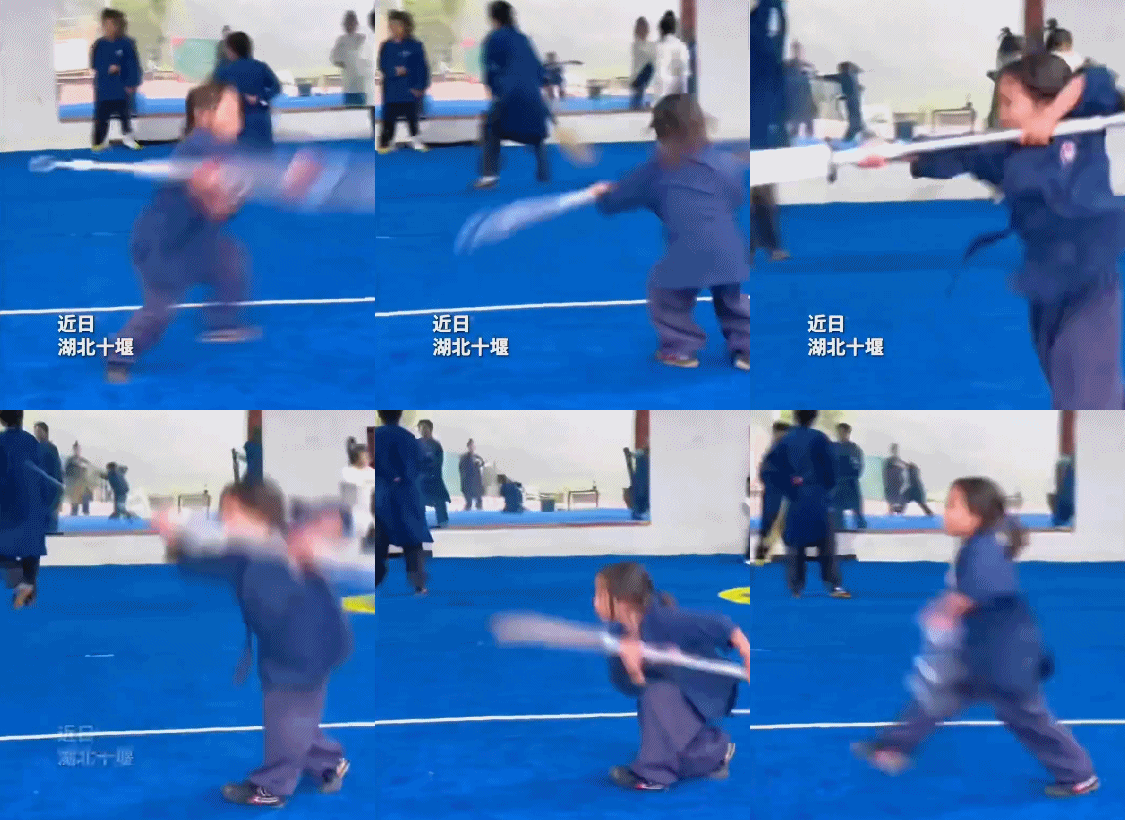
A video of a 5-year-old girl practicing
Guangdong provincial intangible cultural heritage
Maonan Hongquan Crane Style boxing went viral
In the video
She stands firmly in horse stance, with clear bright eyes
With each movement of her small fists
She displays the demeanor of a “martial arts master”
Netizens praised the little girl in comments:
Besides this 5-year-old girl
There are many other young masters and sisters
Who have mastered amazing
“intangible cultural heritage skills”
In every movement and posture
They carry forward and inherit traditional culture
Full of confidence!
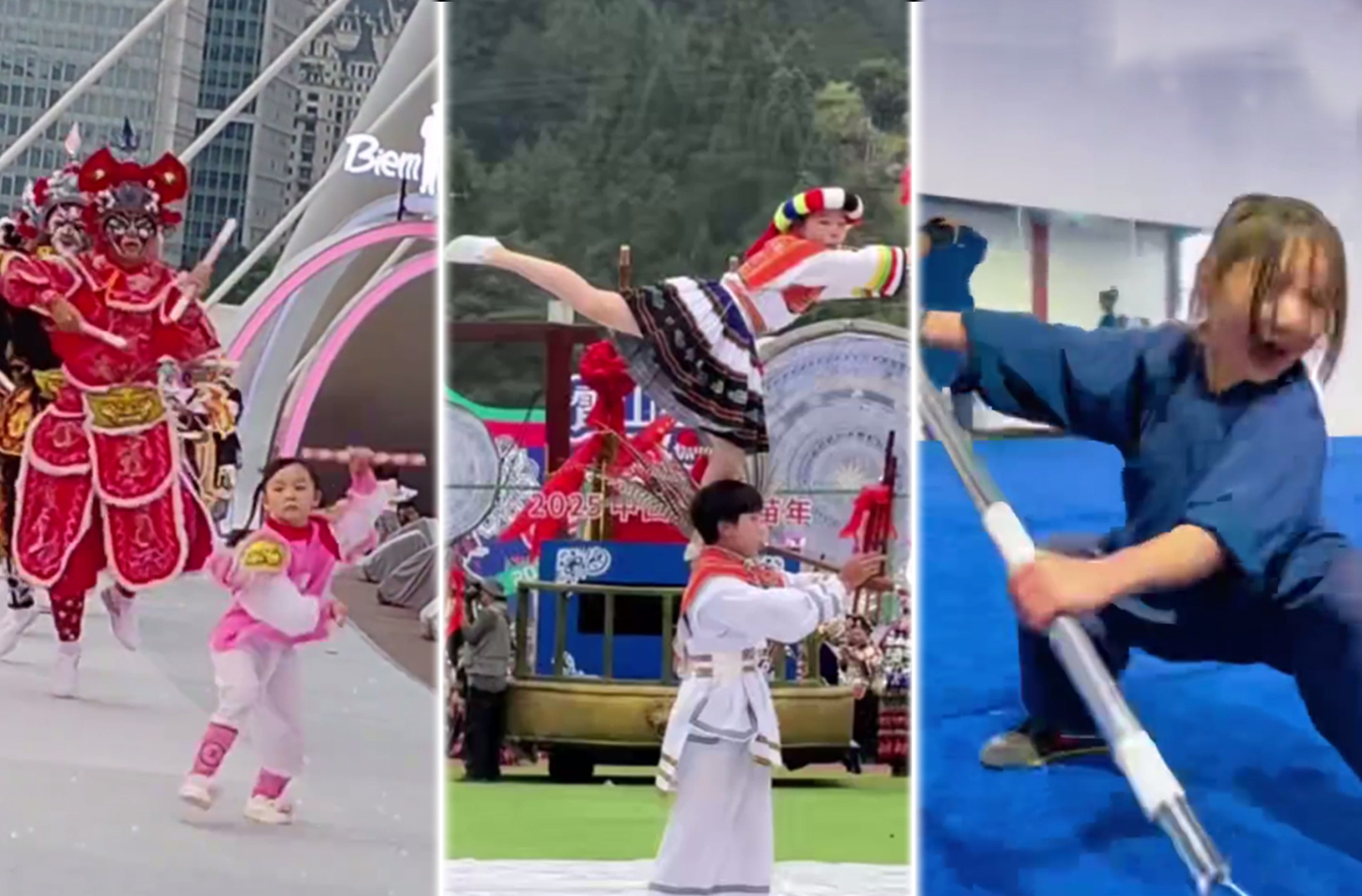
Little Enqi dances Yingge dance with great self-assurance
Last year Zhuang Enqi went viral online with a segment of
Yingge dance
Before the opening of the 15th National Games
Zhuang Enqi and a performance team composed of university students
Appeared on Guangzhou streets
With flying drumsticks and powerful steps
The entire performance team
Perfectly demonstrated the strength and beauty of Yingge dance
Accompanied by drum beats
Little Enqi waved her mini Yingge drumsticks
Jumping, spinning, striking drumsticks under her legs
Her small body bursting with tremendous energy
Extremely impressive!
7-year-old “little brother” from Wudang wields the Spring and Autumn Broadsword
A 7-year-old “little brother” from Wudang
Holding a Spring and Autumn Broadsword longer than his height
On the competition field, every movement
Flows smoothly and with magnificent momentum
This Spring and Autumn Broadsword carrying historical significance
As a national intangible cultural heritage
Representative weapon of Wudang martial arts
Shows renewed vitality in the hands of this young master
In movements combining hardness and softness
The “little brother” wielding the Spring and Autumn Broadsword
Has already won championships in two major competitions
In him
We see both the profound heritage of traditional martial arts
And the vitality of young children
Amazing! A group of children
Brings Miao ethnic Lusheng dance “Rolling Mountain Pearl” to life
With the sound of Lusheng
Maonan Hongquan Crane Style boxing
Maonan Hongquan Crane Style boxing is a traditional Chinese martial art originating from the Maonan ethnic minority in Guangxi. It is a southern-style boxing system that imitates the movements of the crane, emphasizing agility, precision, and the use of open-hand techniques. Historically, it has been practiced for both self-defense and the preservation of Maonan cultural identity.
Yingge dance
Yingge dance is a traditional Chinese folk performance known for its vibrant, energetic movements often involving drums and dancers wielding wooden sticks. Originating from the Song Dynasty, it is believed to have evolved from historical celebrations and rituals. Today, it remains a popular cultural display during festivals, especially in Guangdong and other southern Chinese regions.
Spring and Autumn Broadsword
“Spring and Autumn Broadsword” is not a physical place or cultural site, but rather a famous and influential Chinese martial arts novel written in the 1930s by Huanzhulouzhu. The story is set in the wuxia (martial heroes) genre and follows the adventures of its heroes, reflecting the social values and literary trends of early 20th-century China. It remains a classic work in the wuxia canon and has influenced subsequent martial arts fiction and media.
Wudang martial arts
Wudang martial arts are a Chinese martial arts tradition originating from the Wudang Mountains in Hubei province, a UNESCO World Heritage Site and a central hub of Taoism. Historically, they are attributed to the legendary Taoist monk Zhang Sanfeng, who is said to have developed them in the 12th-14th centuries, emphasizing internal strength, flexibility, and the cultivation of “qi” (life energy). Unlike the external, hard styles of Shaolin, Wudang practices are characterized by soft, flowing movements and are deeply connected with Taoist philosophy, meditation, and health preservation.
Lusheng dance
The Lusheng dance is a traditional folk dance of the Miao, Dong, and other ethnic minorities in southwestern China, particularly in Guizhou and Guangxi provinces. Historically performed during festivals, celebrations, and courtship rituals, the dance involves synchronized movements to the music of the *lusheng*, a reed-pipe wind instrument. It serves as a vital expression of cultural identity, community unity, and the preservation of ancient customs.
Rolling Mountain Pearl
Rolling Mountain Pearl is a unique folk art environment located in Nevada, created by artist Frank Van Zant. Beginning in the 1960s, he constructed a sprawling complex of concrete sculptures, shrines, and monuments, often embedded with thousands of glass bottles and found objects. The site reflects his personal spiritual journey and stands as a testament to outsider art and perseverance.
Miao ethnic
The Miao ethnic group is one of China’s 56 officially recognized ethnic groups, with a significant population in the mountainous regions of Guizhou, Hunan, Yunnan, and other parts of Southeast Asia. Historically, they are descendants of the ancient “San Miao” tribe and have a rich cultural heritage known for intricate silver jewelry, vibrant embroidery, and festivals like the Lusheng. Their history includes migrations and the establishment of unique social structures, with their culture being preserved through oral traditions, music, and distinctive stilted wooden architecture.