)
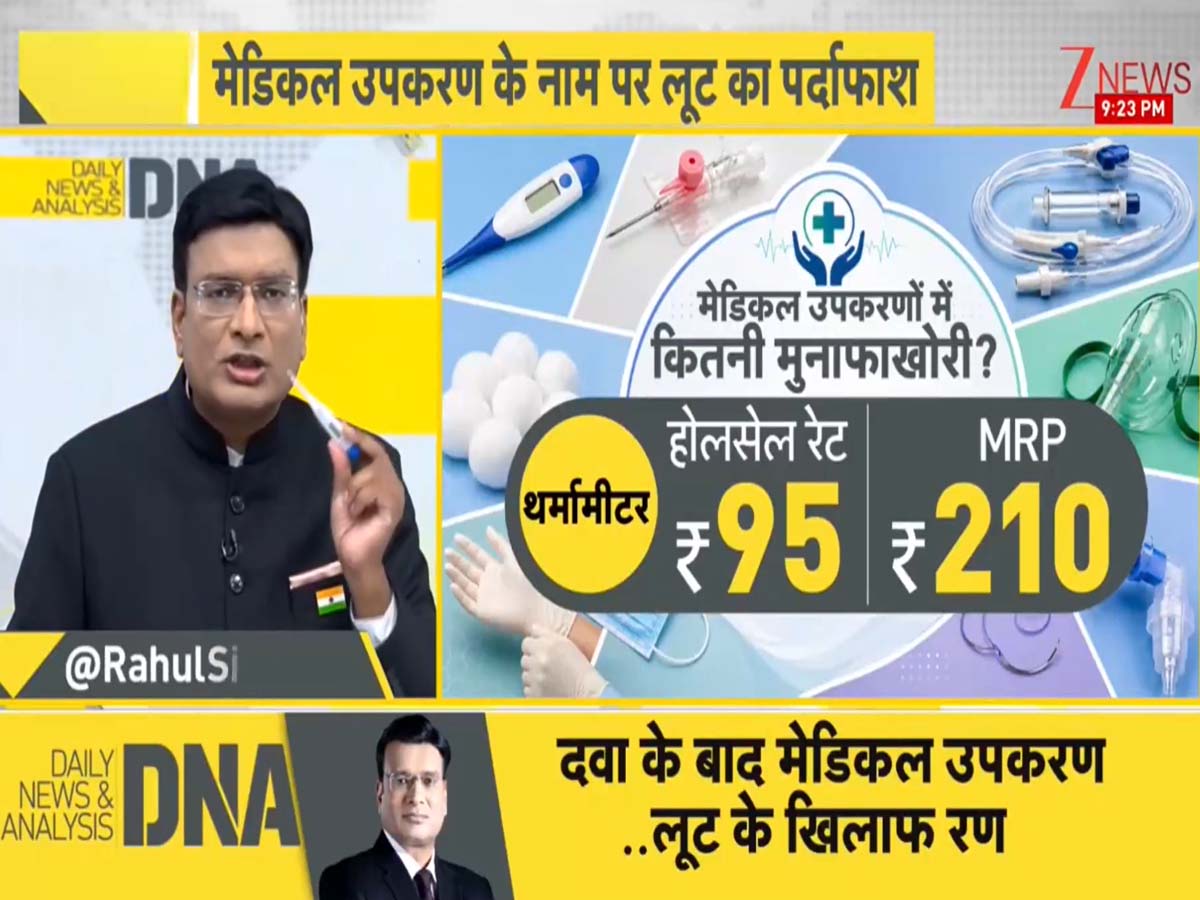
DNA Analysis Medical Loot: Today, we will expose the black hole of the country’s healthcare system, where an ordinary person’s entire savings disappear. Today, we are going to expose those profiteers who are looting you in the name of medical equipment including thermometers, glucometers, and BP machines. They are making profits of over 3000 percent. You might be stunned reading this, but it is true. The medical mafia is making more than 3,000 percent profit from all of us. On top of that, they are dumping low-quality items in your homes. Medicines are being sold in the market at prices 100 to 500 times higher.
Widespread Looting in Medical Supplies
A campaign is being run continuously against medical mafias. And we are constantly receiving your cooperation in this. We want you to join this campaign today as well. Come to the social media page with the hashtag #LootKaMedicalSamaan. Through this, you can give your opinion. You can also send your messages to the mobile number 9310497453.
You must have seen that in hospitals, a device called a cannula is placed in patients’ hands for administering drips. This cannula is being sold in the market for 200 to 250 rupees. You will be shocked to know its actual price. The thread used for stitching costs patients thousands of rupees. You won’t believe its real price. What kind of looting is happening with medical equipment? Today, we will also decode this through three bills. You will also find out why this discussion about the prices of medical equipment is happening today.
This question is related to the common man. It is related to every home, so we conducted an all-India investigation. We spoke to everyone from wholesalers of medical equipment to end users. We checked bills from retailers to hospitals. The truth that came out will make the ground slip from under your feet.
Cannula costing 7 rupees sold for 210
First, in Patna, a reporter met a wholesaler of medical equipment. They found out the difference between the MRP and wholesale rate of medicines. The most common medical equipment is a thermometer. You probably have a thermometer at home too. If you check now, you might find at least two or three thermometers at home.
A Hicks thermometer, which sells in the market for 210 rupees, is bought by shopkeepers for 95 rupees. That is, at half the MRP. Cannula, the device placed in the hand for administering glucose or medicine to a patient, is being sold in the market for 210 rupees. But it is sold by the wholesaler for 7 rupees. That is, it is being sold at a price 3000% higher.
The cannula and the pipe going to the glucose bottle are called an IV set. A shopkeeper or hospital buys it from the wholesaler for 12 rupees. The MRP on its box is 216 rupees. That means a profit of 1700% is made on it.
22 masks being sold for 584 rupees
The wholesale rate of a bundle of cotton is 75 rupees. It is being sold in the market for 241 rupees. Ramsons company makes nebulizer masks for children. The MRP on its box is 584 rupees. But actually, any shopkeeper gets it for 22 rupees. That is a margin of 2500%.
| New revelation in ‘Medical Mafia’ on DNA.. Thermometer-BP machine.. Instruments of profiteering! ‘Looting’ is going on in the name of medical equipment…
DNA test of the ‘black hole’ of the healthcare system
Surgical gloves, which doctors wear during operations, are available wholesale for 13 rupees. In the hospital bill, you are charged 80 rupees for this.
You will understand how big this game of profiteering is after reading the rate of the next equipment. The thread used for stitching has a