
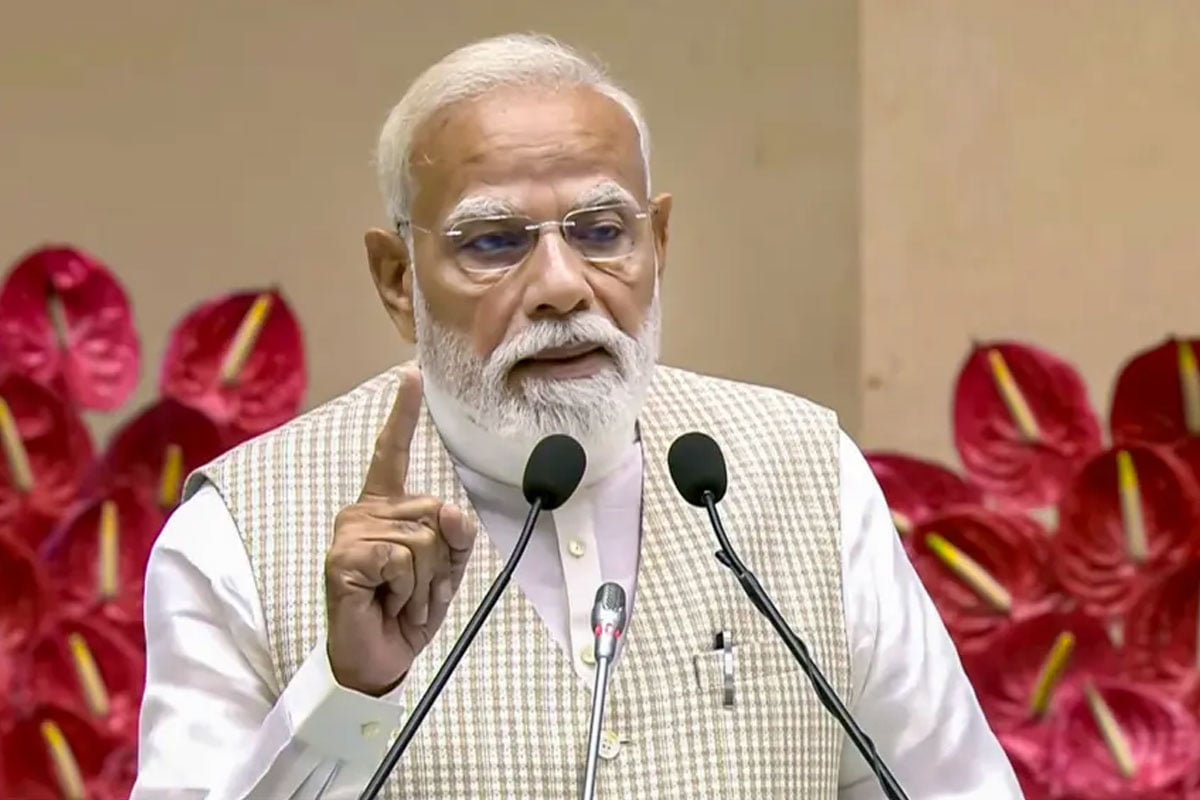
‘Made a mistake, will have to face the consequences’, Modi blames opposition after women’s reservation bill fails
zoom
Modi blames the opposition after the women’s reservation bill fails.

Despite convening a special session and two days of discussion and appeals, the government could not secure the opposition’s support. The women’s reservation bill did not pass in the Lok Sabha as it failed to get a two-thirds majority. Following this incident, the Prime Minister blamed the opposition camp. It is reported that in the cabinet meeting, the Prime Minister targeted the opposition, effectively calling them misogynistic, and said, “The opposition made a mistake, they will have to face the consequences.”

It is reported that due to the bill not passing in parliament, the Prime Minister expressed his anger against the opposition in Friday’s cabinet meeting. He stated, “The opposition made a mistake. They will have to bear the consequences. They will have to answer to the women of the country.” Not only that, targeting the opposition’s actions as an anti-women step, he said, “They have dashed the hopes of the country’s women. Their misdeed must be communicated to every village, to every person in the country. So that the nation knows their true nature.”

The Prime Minister said, “They have dashed the hopes of the country’s women. Their misdeed must be communicated to every village, to every person in the country. So that the nation knows their true nature.”

The government had been working hard to pass three bills in the three-day special session. The first of these was to reserve one-third of seats in the Lok Sabha and state assemblies for women. This bill was named the ‘Nari Shakti Vandan Act’. The second was the Lok Sabha seat delimitation bill. And the third was the Union Territories law amendment bill. However, the opposition alleged that under the guise of women’s reservation, the government was trying to change India’s electoral map. The opposition camp united in opposing the bill. During the voting, while 298 votes were cast in favor of the bill, 230 were cast against. 528 MPs participated in the vote. To pass, the bill required a two-thirds majority, i.e., 352 votes. As this was not achieved, the bill ultimately could not be passed.

It is noteworthy that the ‘Nari Shakti Vandan Act’ bill was passed in parliament in 2023. The bill stated that 33 percent of seats would be reserved for women. It was also stated that seat delimitation would occur after the census. Then, 33 percent of those seats would be reserved for women. But now the center is not waiting for the census. The government’s goal was to delimit seats based on the 2011 census. Based on that delimitation, seats would be reserved for women. Simultaneously, the opposition alleges that the government wants to delimit Lok Sabha seats under the cover of women’s reservation. The INDIA bloc united in opposing this. Not only that, the opposition camp is set to write to the Prime Minister demanding the immediate implementation of the bill that was passed in 2023.

Lok Sabha

The Lok Sabha is the lower house of India’s bicameral Parliament, located in New Delhi. Established by the Constitution of India in 1952, it is the primary legislative body where members are directly elected by the public. Its history is tied to India’s post-independence democratic framework, succeeding the Constituent Assembly and operating from the iconic Sansad Bhavan (Parliament House).

Nari Shakti Vandan Act

The “Nari Shakti Vandan Act” is not a physical place or cultural site, but a landmark Indian legislation. Formally known as the Constitution (One Hundred and Sixth Amendment) Act, 2023, it mandates reserving one-third of seats for women in the Lok Sabha (India’s lower house of Parliament) and state

Lok Sabha

The Lok Sabha is the lower house of India’s bicameral Parliament, located in New Delhi. Established by the Constitution of India in 1952, it is the primary legislative body where members are directly elected by the people. It holds significant power, including overseeing the government and approving the national budget.

Sansad Bhavan

Sansad Bhavan, also known as the Parliament House of India, is the seat of the country’s bicameral legislature in New Delhi. It was designed by British architects Sir Edwin Lutyens and Sir Herbert Baker and opened in 1927 as the home of the Imperial Legislative Council. Following India’s independence in 1947, it became the central forum for the nation’s parliamentary democracy.

Parliament House

Parliament House is the meeting place of the Australian Parliament in Canberra, opened in 1988 to replace the provisional Parliament House. Its modern design, topped by a large flag mast, symbolizes democratic government, and it was built to mark the bicentenary of European settlement in Australia. The site sits atop Capital Hill, reflecting the architect’s vision of the people being above their government.

New Delhi

New Delhi is the capital city of India, officially inaugurated in 1931 as the new seat of the British Indian government, replacing Calcutta. It was designed by British architects Edwin Lutyens and Herbert Baker, featuring wide boulevards and grand colonial-era buildings like the Rashtrapati Bhavan and India Gate. Today, it serves as the political and administrative heart of the country, housing key government institutions and historical monuments from both the colonial and Mughal eras.

Constitution of India

The Constitution of India is the supreme legal document that established the framework for the world’s largest democracy, coming into effect on January 26, 1950. It was drafted by a Constituent Assembly led by Dr. B. R. Ambedkar, drawing from various global constitutions and India’s own historical needs following independence from British rule in 1947. It defines the structure, powers, and duties of government institutions and sets out the fundamental rights and duties of its citizens.

Constituent Assembly

The Constituent Assembly refers to a legislative body convened to draft or adopt a new constitution for a nation. Historically, notable examples include the French National Assembly of 1789, which was central to the French Revolution, and the Russian Constituent Assembly of 1918, which was dissolved by the Bolsheviks after a single session. Such assemblies are pivotal in moments of regime change or founding, embodying the principle of popular sovereignty.

Nari Shakti Vandan Act

The “Nari Shakti Vandan Act” is not a physical place or cultural site, but a landmark Indian legislation. Officially the Constitution (One Hundred and Sixth Amendment) Act, 2023, it mandates reserving one-third of seats for women in the Lok Sabha (India’s lower house of Parliament) and state legislative assemblies. This historic act, passed after decades of advocacy, aims to significantly enhance women’s political representation in India’s democracy.

Constitution (One Hundred and Sixth Amendment) Act, 2023

The Constitution (One Hundred and Sixth Amendment) Act, 2023 is a landmark Indian legislation that reserves one-third of all seats for women in the Lok Sabha (the lower house of Parliament) and state legislative assemblies. Its history is rooted in decades of advocacy and legislative attempts, finally achieving passage to promote gender equality in India’s political representation.