On April 24, Shanghai was abloom with spring as the 2026 Shanghai International Flower Festival took place. The city transformed into a sea of flowers, with the main urban venue and various sub-venues each showcasing their own beauty.
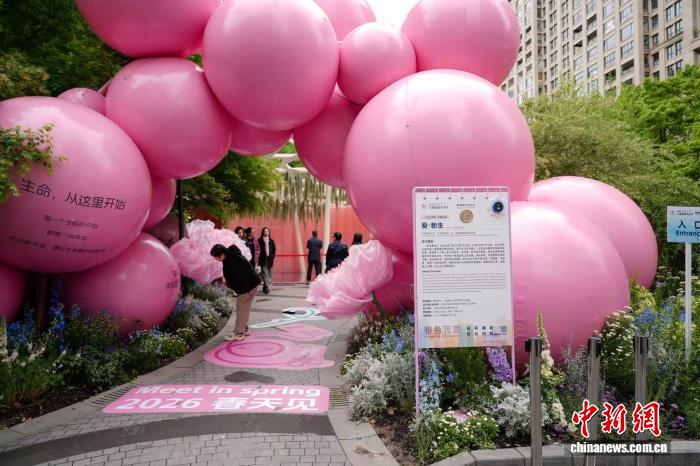
At the Huangpu main urban venue of the 2026 Shanghai International Flower Festival, a garden named “Love · New Life,” centered on the theme “Praise of Life · Source of First Intentions,” integrated medical humanistic care into the urban public space, attracting many passersby to stop and admire.
The “Love · New Life” garden, jointly created by the Huangpu District Greenery and City Appearance Administration Bureau and the Obstetrics and Gynecology Hospital affiliated with Fudan University, was visited. The garden uses flowers to link five themes: Departure, Birth, New Life, Breaking the Cocoon, and Blooming, forming a complete narrative of life growth. The hospital’s director explained that the garden’s design uses floral art to visualize the process of life gestation, allowing people to appreciate the wonder and preciousness of life while enjoying the flowers.
Life begins with a tiny cell. At the garden’s entrance, pink bubbles floating among the flowers visualize the initial throbbing and enveloping sensation of life. New life “departs” from here. As visitors stroll through the “Birth” area, a space of graceful hanging plants, a private corner surrounded by rose walls contains a kaleidoscope-like seed installation, symbolizing the starting point of life. In the “New Life” section, a wall of children’s paintings titled “Children Have Something to Say” casts a colorful world of childlike innocence under light and shadow. These creative artworks were inspired by children who, after listening to the hospital’s themed science lectures, learned about the wonderful process of maternal gestation and the story of life’s beginning, then used their imagination to create them. In the “Breaking the Cocoon” area, a sound installation captures a baby’s first cry, the first call of “Mom,” and the powerful sound of a fetal heartbeat. In the “Blooming” area, a giant opening and closing flower art installation slowly opens and closes its petals, depicting the process of life from gestation to free growth.
Inside the garden, seed papers are occasionally distributed to visitors, embedded with sunflower seeds. Sunflowers symbolize sunshine and hope, representing new life and growth toward the light. The garden exhibition will continue until May 10. After that, some exhibits will be moved to the hospital to continue spreading beauty and warmth.
As one of the sub-venues of the 2026 Shanghai International Flower Festival, the Shanghai Chenshan Botanical Garden features various orchids in bloom. An orchid diversity exhibition themed “Maritime · Orchid Charm” gathers rare orchid resources from around the world, offering a feast for orchid enthusiasts. The exhibition showcases about 60 genera and 260 species (including varieties) of orchids, totaling about 17,000 plants, covering rare resources from Asia, America, Africa, and Oceania. Over 20 species of nationally first-class protected and CITES Appendix I endangered orchids, such as Cypripedium flavum, Cypripedium candidum, and Cypripedium wenshanense, along with over 80 species of nationally second-class protected orchids, are on display simultaneously, providing a visual feast.
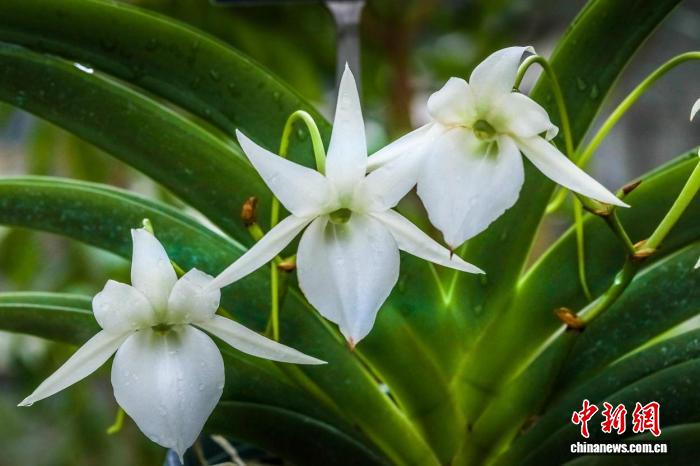
In the Southeast Asian orchid charm exhibition area, Asian tropical epiphytic orchids are the core, combined with Southeast Asian styles to present unique landscapes: Songkran Orchid Ode, Vanda Future, and Rainforest Orchid Language. The Songkran Orchid Ode landscape mainly features Vanda and Mokara orchids, integrating Thai Songkran festival culture to showcase life’s resilience. The Vanda Future landscape tells the story of the birth of the Vanda ‘Miss Joaquim’ using the mother plant of Singapore’s national flower, blending technology to depict urban ecology. The Rainforest Orchid Language landscape restores the Indonesian rainforest ecosystem, displaying native orchids and species diversity while conveying conservation awareness.
The Yangpu Fux