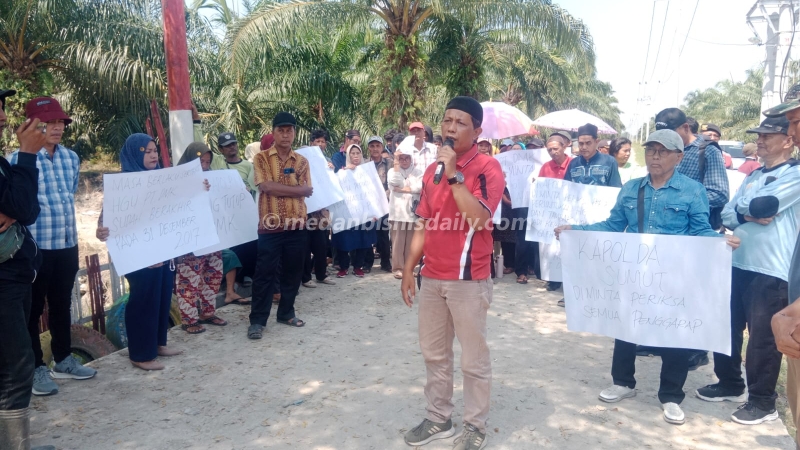
Sergai. Dozens of men and women from Group 80 Plasma Tambak Inti Rakyat (TIR) held another protest at the office or land now used as an oil palm plantation owned by PT Deli Mina Tirta Karya (PT DMK). The protest took place in Dusun II, Bagan Kuala Village and Tebing Tinggi Village, Tanjung Beringin District, Serdang Bedagai Regency (Sergai), North Sumatra, on Thursday (April 23, 2026).
The protesters carried banners listing various demands, including requesting the North Sumatra Police Chief to investigate all cultivation activities, value-added tax (VAT), income tax, and alleged changes in the use of HGU (Hak Guna Usaha or land use rights) and shrimp ponds into oil palm plantations by PT DMK.
They also asked the Minister of ATR/BPN (Agrarian Affairs and Spatial Planning/National Land Agency) not to issue certificates for HGU changes and demanded that the company’s activities be stopped and the land be returned to the plasma group covering 289 hectares. Additionally, the crowd stated that PT DMK’s HGU expired on December 31, 2017.
The peaceful protest was escorted by personnel from the Sergai Police, led by the Head of Operations, Commissioner David Sinaga, the Head of Intelligence, Inspector Sukma Atmaja, and the Tanjung Beringin Police Chief, Commissioner Sawaluddin.
The head of the Land Settlement Team for Group 80 (Plasma), Zuhari, stated in his speech that the protest was conducted in accordance with the law. He emphasized that the community demands justice for the land they have long fought for.
According to him, based on HGU Certificate Number 1 of 1992, PT DMK’s operational permit for a land area of 499.2 hectares expired on December 31, 2017. However, on the ground, the company is still operating and has even changed the land use from shrimp ponds to oil palm plantations without clear permits.
He also considered this action a violation of the law, as according to Law Number 39 of 2014 on Plantations, every plantation business must have a permit. Cultivating oil palm on land originally permitted for shrimp ponds is considered an administrative and criminal violation.
In their demands, the crowd presented several points, including:
- Stop all activities of PT DMK on land where the HGU has expired.
- Redistribute approximately 320 hectares of land to the shrimp farmers of Group 80.
- Close the company’s operations until the farmers’ rights are fulfilled.
Additionally, the crowd requested law enforcement to investigate alleged violations of plantation business permits, as well as alleged violations of income tax and VAT by the company.
Zuhari stated that the protests would continue until the demands are met. He also said that if there is no action from the government, the community will reclaim the land they claim as their right.
Responding to the protest, PT DMK Manager, Indra Pohan, stated that this issue can be resolved through the sub-district government to ensure the rightful parties to the land based on the meeting results with the police.
During the protest, tension arose when company security restricted access for journalists who wanted to cover the event. This triggered a verbal dispute as it was considered to hinder journalistic duties in accordance with Law Number 40 of 1999 on the Press. The situation eased after the company apologized.
The crowd stated they would hold another protest with a larger number if their demands are not met.