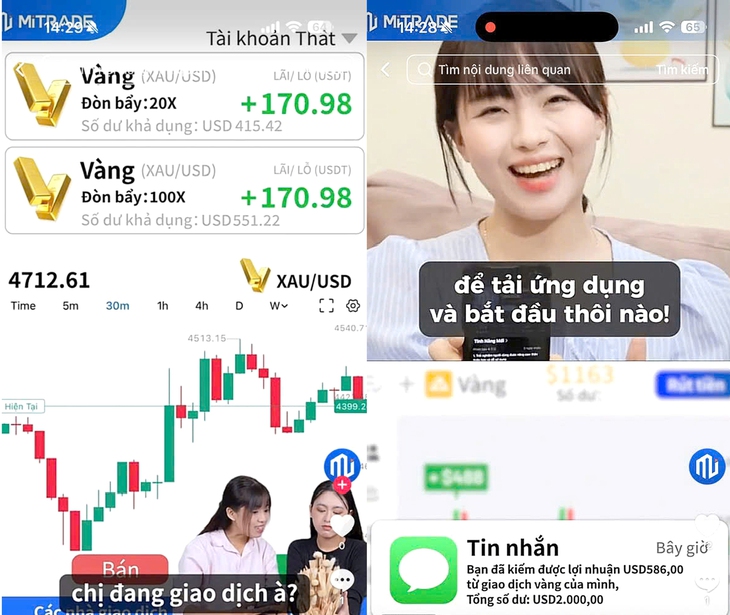
Although not licensed by the State Bank of Vietnam or the State Securities Commission, many international gold, forex, and stock trading platforms still attract large numbers of Vietnamese participants with the “dream” of huge profits.
According to records, just on Facebook alone, a series of discussion groups about these investment channels have emerged, each attracting between 500,000 and 1 million followers. Not only that, related apps are heavily advertised on TikTok, enticing users to download and participate in investing to receive bonuses.
Approaching a reporter, an account named Tran Kien tried to lure them into a Zalo group called “(forex)” with an attractive ad: if you join, you will: “Always have a team to support and grasp market trends.” The win rate is 85%, with profits over 20% per month, 1-on-1 support, free negative balance recovery, and order balancing when investments are ineffective. Notably, transaction fees are low, orders are placed quickly, and profits are easy to make.
Notably, many brokers from other platforms advertise even more attractively, continuously offering profit rates of 15-30% after just a few hours of trading each day. “We always strive to provide safe trading strategies, constantly improving to deliver the best quality for customers and investors,” a broker named Hoang shared.
Not only approaching victims under the guise of “investment experts,” many scammers also set emotional traps to lure others into pouring money into fake platforms. Ms. T.H. (Ho Chi Minh City), a university lecturer, said she once got to know a “boyfriend” on social media. After more than two months of chatting, even though they had never met in person, she placed great trust in him.
From emotional stories, she was gradually led to participate in investing in gold and international stocks on a platform he introduced. Initially, she deposited only a small amount, saw profits, and was able to withdraw money, so she became more trusting. Later, she continued to invest nearly 2 billion VND.
When her account suddenly “crashed,” losing all the invested money, the “boyfriend” also disappeared. “Now I don’t know how to get the money back,” Ms. T.H. said, adding that she never expected to fall into such a situation.
According to records, many people also reported losing from several hundred million to tens of billions of VND after participating in international gold and stock investment platforms not licensed in Vietnam. Some had their accounts suddenly “crashed,” while others could not withdraw money because the platform continuously gave various reasons.
Among these were cases where people transferred money via QR codes provided by the platform but were told the transaction was invalid and their money was “frozen” indefinitely. In panic, many people fell for a second trap by seeking out self-proclaimed “experts” and “lawyers” online. These people promised to help recover the money if the victim paid additional fees.
Beware of increasingly sophisticated scams
Recently, the State Securities Commission has issued warnings about many apps and websites raising capital under the guise of “investment cooperation contracts,” advertising high interest rates and simple procedures to attract participants. However, these platforms are not licensed to operate.
Investors participating risk losing money and are not protected by securities law in case of disputes. Therefore, regulators advise investing only through licensed organizations and platforms and being wary of promises of high profits.
Many cybersecurity experts have warned that online scams are becoming increasingly sophisticated, targeting various groups such as the elderly, children, students, workers, and office employees.
According to experts, investors should be especially cautious with platforms for international stocks, gold, forex, cryptocurrency, real estate, or multi-level marketing that show signs of attracting large numbers of participants.
These platforms often promise extremely high profits, far exceeding reality, but do not clearly disclose information about the business, licenses, or management team, and especially often require participants to transfer money in advance as participation fees, deposits, or account top-ups.
After being called by suspects to join an investment