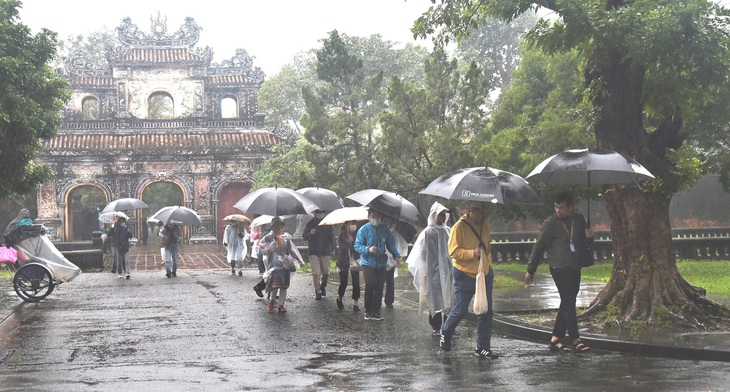
The National Center for Hydro-Meteorological Forecasting reports that today, April 24, the weather in the Northeast and North Central regions will be cool due to the influence of weak cold air. The lowest temperature during this cold spell is 20-23 degrees Celsius, with mountainous areas possibly dropping below 20 degrees Celsius.
The Northern region will have scattered showers and thunderstorms.
At sea, the Gulf of Tonkin will have scattered showers and thunderstorms. During thunderstorms, there is a risk of tornadoes and strong gusts of wind at level 6-7.
From last evening until the end of today, the North Central region will experience moderate rain and thunderstorms with rainfall of 20-40mm, locally over 90mm.
Meanwhile, from last evening until tomorrow, the Central Central region will have showers and thunderstorms with rainfall of 10-30mm per 24 hours, locally heavy rain over 70mm per 24 hours (rain concentrated in the late afternoon and night).
In the Central Highlands and Southern regions, the weather is locally hot with the highest daytime temperature in some places exceeding 35 degrees Celsius. Widespread heatwaves are likely to occur in the Southern region in the coming days.
Due to the influence of heat combined with low air humidity, there is a risk of fire and explosion in residential areas due to increased electricity demand.
The forecasted temperature in heatwave bulletins and the actual outdoor perceived temperature may differ by 2-4 degrees Celsius, or even higher, depending on ground conditions such as concrete and asphalt roads.
Detailed weather forecast for today, April 24:
Hanoi City is cloudy, with showers and thunderstorms in the night and morning. Cool weather. Lowest temperature 22-24 degrees Celsius, highest 26-28 degrees Celsius.
Northwest region is cloudy, with showers and locally heavy rain in the night and morning, then scattered rain. Cool weather. Lowest temperature 19-23 degrees Celsius, highest 28-31 degrees Celsius.
Northeast region is cloudy, with showers and thunderstorms in the night and morning, locally heavy rain. Lowest temperature 20-24 degrees Celsius, highest 25-28 degrees Celsius.
Thanh Hoa to Hue – Northern part: cloudy, moderate rain, locally heavy to very heavy rain; Southern part: showers, locally heavy rain. Lowest temperature 22-25 degrees Celsius, highest 29-32 degrees Celsius.
South Central Coast is partly cloudy, with showers and locally heavy rain in the north; sunny in the south. Lowest temperature 23-26 degrees Celsius, highest 31-34 degrees Celsius.
Central Highlands is partly cloudy, sunny during the day, with some places experiencing heat. Lowest temperature 20-23 degrees Celsius, highest 31-35 degrees Celsius.
Southern region is partly cloudy, sunny during the day, with some places experiencing heat. Lowest temperature 24-27 degrees Celsius, highest 32-35 degrees Celsius.
Ho Chi Minh City is partly cloudy, sunny during the day, with some places experiencing heat. Lowest temperature 24-26 degrees Celsius, highest 33-35 degrees Celsius.
Gulf of Tonkin
The Gulf of Tonkin is a body of water located off the coast of northern Vietnam and southern China, historically significant as the site of the 1964 Gulf of Tonkin Incident, which led to the escalation of U.S. involvement in the Vietnam War. The incident involved alleged attacks on U.S. Navy vessels, prompting Congress to pass the Gulf of Tonkin Resolution, granting President Lyndon B. Johnson broad military authority in Southeast Asia. Today, the gulf remains an important economic and geopolitical area, supporting fishing and shipping industries.
Thanh Hoa
Thanh Hoa is a province in north-central Vietnam, renowned for its rich history as the birthplace of several national heroes, including the legendary Le Loi, who led a revolt against Ming Chinese rule in the 15th century. The area is home to the UNESCO World Heritage site of the Ho Dynasty Citadel, a 14th-century stone fortress that exemplifies ancient Vietnamese architecture. Today, Thanh Hoa blends historical significance with natural beauty, featuring coastal beaches and the rugged landscapes of the Pu Luong Nature Reserve.
Hue
Hue, located in central Vietnam, was the imperial capital of the Nguyễn Dynasty from 1802 to 1945. The city is renowned for its historic Citadel, a sprawling complex of palaces, temples, and gates that reflects the grandeur of Vietnamese feudal architecture. Today, it is a UNESCO World Heritage site and a major cultural destination, preserving the legacy of the nation’s last ruling dynasty.
Da Nang
Da Nang is a major coastal city in central Vietnam, known for its sandy beaches and vibrant history. It played a significant role during the Champa Kingdom and later became a key port under French colonial rule, serving as a U.S. military base during the Vietnam War. Today, it is a popular tourist destination, home to attractions like the Marble Mountains and the Golden Bridge.
Central Highlands
The Central Highlands is a region in Vietnam known for its rugged terrain, dense forests, and rich volcanic soil, which supports extensive coffee, tea, and rubber plantations. Historically, it was home to various indigenous ethnic groups and became a strategic area during the Vietnam War, serving as a key location for the Ho Chi Minh Trail. Today, it is celebrated for its unique cultural heritage and natural attractions, including waterfalls and national parks.
Ho Chi Minh City
Ho Chi Minh City, formerly known as Saigon, is Vietnam’s largest city and economic hub. It played a pivotal role during the Vietnam War as the capital of South Vietnam before being renamed in 1976 after reunification. Today, the city blends historic French colonial architecture with modern skyscrapers, preserving landmarks like the Notre-Dame Cathedral and the War Remnants Museum.
Hanoi City
Hanoi, the capital of Vietnam, is one of the oldest cities in Southeast Asia, with a history dating back over a thousand years to its founding in 1010 as the imperial capital of the Ly Dynasty. The city has been shaped by centuries of Chinese, French, and Soviet influence, evident in its blend of ancient temples, colonial architecture, and modern developments. Today, Hanoi is known for its vibrant street life, historic Old Quarter, and cultural landmarks like the Ho Chi Minh Mausoleum and the Temple of Literature.
South Central Coast
The South Central Coast of Vietnam is a historically significant region known for its ancient Cham civilization, with sites like the Po Nagar Cham Towers in Nha Trang dating back to the 7th–12th centuries. During the Vietnam War, the coastline was a strategic area, and today it features vibrant cities like Da Nang and the UNESCO World Heritage site of Hoi An, a well-preserved ancient trading port. The region is also famous for its beautiful beaches, such as those in Nha Trang and Mui Ne, blending cultural heritage with natural attractions.