Notable news: The National Assembly considers removing the 500 million VND/year revenue threshold for business households; Comprehensive assessment of personnel arrangements after mergers; Hanoi apartment prices increase 288% after 10 years…
National Assembly considers removing the 500 million VND/year revenue threshold for business households
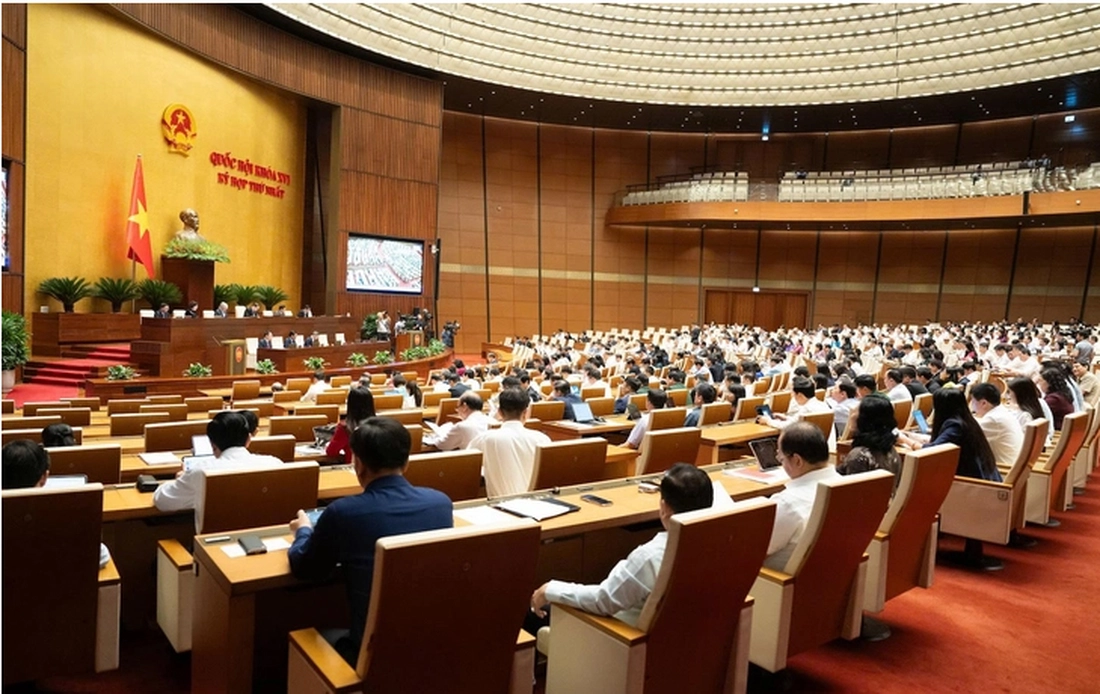
According to the session agenda, this morning, April 23, the National Assembly will discuss in the plenary hall the draft law amending and supplementing a number of articles of the Law on Value Added Tax, the Law on Corporate Income Tax, and the Law on Special Consumption Tax.
Notably, in the draft law, the government proposes not to specify the revenue threshold exempt from personal income tax or the VAT-exempt revenue threshold for business households and individuals as currently regulated.
The current law sets the revenue threshold for value-added tax and personal income tax on income of business households at 500 million VND per year.
Thus, if this draft law is passed, there will no longer be a specific tax-exempt revenue threshold for individuals and business households in the Law on Value Added Tax and the Law on Personal Income Tax, and instead, the government will be tasked with specifying the specific level.
Prime Minister Le Minh Hung stated that according to a report from the Ministry of Finance, the expected tax-exempt revenue threshold for business households will be raised to 1 billion VND per year.
At the end of the discussion session, the Minister of Finance will address the content that delegates are interested in.
Also in the morning, the National Assembly will discuss in the plenary hall the draft oversight program of the National Assembly for 2027.
In the afternoon, the National Assembly will vote to pass 8 draft laws, including the amended Capital Law, the amended Civil Status Law, amendments to the Notarization Law, etc., and pass one draft resolution.
Following that, there will be a discussion on the results of monitoring the resolution of voters’ petitions sent to the 10th session of the 15th National Assembly.
Comprehensive assessment of personnel arrangements after mergers
Deputy Prime Minister signed Decision No. 706 issuing a plan to preliminarily review one year of implementing the rearrangement of administrative units at all levels and the operation of two-tier local governments.
Accordingly, the Deputy Prime Minister requires an assessment of leadership, direction, management, and organization of implementing the rearrangement of administrative units and the operation of two-tier local
National Assembly
The National Assembly is the legislative body of a country, often with a rich history tied to the nation’s political development. For example, the National Assembly of France was formed during the French Revolution in 1789, marking a pivotal shift from absolute monarchy to representative government. Today, it serves as the lower house of Parliament, where laws are debated and passed.
Law on Value Added Tax
The Law on Value Added Tax (VAT) is a legislative framework that governs the imposition of a consumption tax on goods and services at each stage of production and distribution. First introduced in France in 1954, VAT has since been adopted by over 160 countries worldwide as a major source of government revenue. Its history reflects a shift from older sales tax systems to a more efficient, self-enforcing tax model that minimizes cascading taxes.
Law on Corporate Income Tax
The Law on Corporate Income Tax is a legal framework that governs the taxation of corporate profits in many countries, typically outlining tax rates, deductions, and compliance requirements. Its history often traces back to early 20th-century reforms, such as the U.S. Revenue Act of 1909, which introduced the first modern corporate tax to fund government operations. Over time, it has evolved to address economic changes, international trade, and efforts to prevent tax evasion.
Law on Special Consumption Tax
The “Law on Special Consumption Tax” (SCT) is a fiscal policy tool used by governments, including Vietnam, to regulate the consumption of certain goods and services deemed harmful or non-essential, such as alcohol, tobacco, and luxury items. Its history reflects evolving public health and economic goals, with Vietnam first enacting the law in 1990 and subsequently amending it to adjust tax rates and expand coverage. The law serves both to generate revenue and to discourage excessive consumption through higher prices.
Law on Personal Income Tax
The “Law on Personal Income Tax” is not a physical place or cultural site, but rather a piece of legislation that governs how individuals’ earnings are taxed in a given country. Its history varies by nation, often evolving alongside economic reforms to ensure fair revenue collection and social equity. For example, in many countries, such laws were introduced in the 20th century to fund public services and have been periodically amended to adjust tax rates and exemptions.
Ministry of Finance
The Ministry of Finance is a key government department responsible for managing a country’s economic and fiscal policies, including taxation, budgeting, and public spending. Its history often dates back to the establishment of modern state governance, with roots in earlier treasury systems that managed royal or national funds. Today, it plays a central role in shaping financial regulations and ensuring economic stability.
Capital Law
“Capital Law” does not refer to a specific place or cultural site, but rather a legal concept or a firm name. In a legal context, “capital law” often relates to laws governing financial capital, corporate finance, or securities. If you meant a specific location or institution, please provide additional details for an accurate summary.
Civil Status Law
The “Civil Status Law” is a legal framework that governs the registration of vital events such as births, marriages, divorces, and deaths, typically managed by a government agency. Its history often traces back to the 19th century, when European nations like France and Germany established secular systems to replace church records, aiming to standardize and centralize personal documentation for administrative and legal purposes. Today, such laws are essential for establishing citizenship, family rights, and access to public services in many countries.