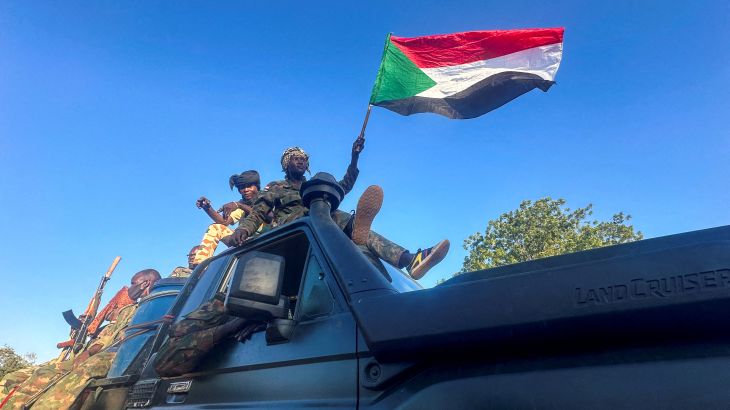
The army announced on Monday the recapture of the strategic town of “Mqaja” in the Blue Nile region of southern Sudan after fierce battles with the Sudan People’s Liberation Movement-North.
Military sources reported that intense fighting broke out during the early hours of Monday between the army and its supporting forces on one side, and the Rapid Support Forces backed by the SPLM-N on the other.
The sources stated that the major ground offensive launched by the army on the Mqaja area inflicted heavy losses on the enemy in military equipment and fighters, enabling the armed forces to fully retake the town.
A correspondent reported from the city of Ed Damazin, the capital of the Blue Nile region, that field developments are unfolding rapidly on the southeastern front along the Ethiopian border.
He noted that battles have been raging in the region in recent weeks, with continuous pledges from the army command and supporting forces that the town of Al-Kurmuk will soon be recaptured and brought back under army control.
Impending Move
Meanwhile, the commander of the Sudan Shield Forces, Abu Aqla Kekel, announced an impending move by the army and allied forces to take control of areas held by what he called “rebel forces,” with the declared military advance reaching the Yabus border area with Ethiopia, the historical stronghold of the SPLM-N, indicating an expansion of operations eastward.
On another front, the United Nations Office for the Coordination of Humanitarian Affairs (OCHA) warned that more than 50,000 civilians in the city of Al-Dilling in central Sudan face serious risks threatening their safety.
OCHA noted in its latest report extreme difficulty in reaching those affected in Al-Dilling due to the city’s growing isolation, escalating fighting within it, and disruption of main supply routes.
In this context, the United Nations called for enhanced collective efforts to protect civilians and facilitate humanitarian aid access, as fighting continues in the three Kordofan states with no signs of an imminent halt.
The war broke out in mid-April 2023 between the Sudanese army and the Rapid Support Forces, resulting in tens of thousands of deaths and the displacement of up to 14 million people inside and outside the country.
Blue Nile region
The Blue Nile region, located in northwestern Ethiopia, is historically significant as the source of the Blue Nile River, which originates from Lake Tana and flows through dramatic gorges like the Grand Ethiopian Renaissance Dam site. This area was a key part of the ancient Kingdom of Aksum and later the Ethiopian Empire, serving as a vital waterway and trade route. Today, it remains culturally rich, home to diverse ethnic groups and renowned for its stunning landscapes, including the Blue Nile Falls.
Mqaja
Mqaja is a historic village located in the Gori region of central Georgia, known for its ancient rock-cut monastery complex. Carved into a cliffside, the site dates back to the early medieval period and features a church, cells, and tunnels, reflecting Georgia’s rich Christian heritage. It served as a secluded refuge for monks and played a role in the region’s religious and cultural development.
Ed Damazin
Ed Damazin is the capital of Sudan’s Blue Nile State, located near the Blue Nile River. Historically, it grew as a regional administrative and agricultural hub, particularly after the construction of the Roseires Dam upstream, which facilitated irrigation and hydroelectric power. Today, it serves as a key market town and a center for trade in crops like sorghum and sesame, though the area has experienced conflict related to regional governance disputes.
Al-Kurmuk
Al-Kurmuk is a historic town located in the Blue Nile State of southeastern Sudan, near the border with Ethiopia. It was once a key center for trade and cultural exchange, serving as a meeting point for various ethnic groups, including the Berta, Gumuz, and Uduk peoples. The area has a complex history shaped by both ancient local traditions and modern conflicts, including its role during the Sudanese civil wars.
Yabus
Yabus is a traditional form of Japanese mounted archery, with roots dating back to the Kamakura period (1185–1333) when it was practiced by samurai to hone their combat skills. It involves archers shooting blunt-tipped arrows at wooden targets while riding a galloping horse. Today, Yabus is preserved as a ceremonial and martial art, often performed at Shinto shrines and cultural festivals.
Al-Dilling
Al-Dilling is a town in the Nuba Mountains of South Kordofan, Sudan, known for its strategic location and cultural significance. Historically, it served as a key administrative and trade center during the Anglo-Egyptian condominium period, and later became a focal point in the conflicts between the Sudanese government and the SPLM-N (Sudan People’s Liberation Movement-North). The area is also notable for its diverse ethnic communities, including the Nuba people, who have preserved rich traditions despite decades of unrest.
Kordofan
Kordofan is a historical region in central Sudan, known for its diverse cultures and traditional industries such as gum arabic production. It was once part of the Sultanate of Sennar and later came under Ottoman and Anglo-Egyptian rule, playing a significant role in the Mahdist War of the late 19th century. Today, it is a primarily agricultural area, home to various ethnic groups like the Nuba and Baggara Arabs.