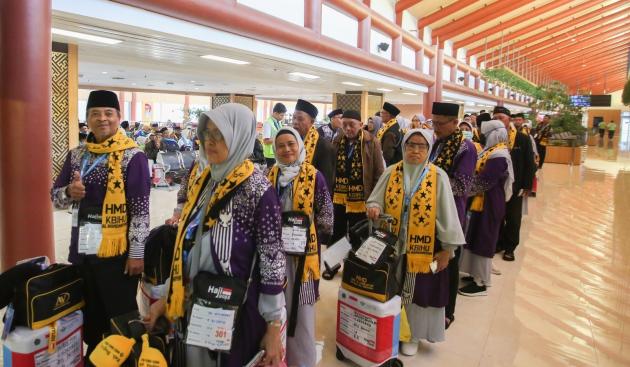
Soekarno-Hatta International Airport (Soetta) has declared full readiness to serve the departure of 35,285 Hajj pilgrims for the 1447 Hijriah/2026 Hajj season.
From Wednesday, April 22 to May 21, 2026, pilgrims from 84 flight groups will depart from Indonesia’s busiest airport to the Holy Land.
To ensure pilgrim comfort, the airport management has centralized all integrated Hajj services at Terminal 2F. This facility will serve pilgrims from three embarkation points: Banten, Jakarta–Bekasi, and Jakarta–Pondok Gede.
One of the highlights of this year’s service is the reactivation of the Makkah Route. This feature allows pilgrims to complete Saudi immigration procedures directly at Terminal 2F before departure.
“We have prepared 10 special counters in the terminal’s sterile area for the Makkah Route service. With this, pilgrims will no longer have to wait in long queues at immigration upon arrival in Saudi Arabia,” said the General Manager of Soekarno-Hatta International Airport.
Terminal 2F, covering an area of 27,418 square meters, has been designed to manage large-scale crowd movements in an orderly manner.
Key facilities include a waiting room with a capacity of up to 3,000 people and a mosque covering 3,136 square meters that can accommodate 800 pilgrims.
In terms of flow management, the airport management implements a group-based system from arrival at the airport, document checks, to boarding the aircraft.
“We have strengthened coordination with all stakeholders to ensure the departure process is orderly, smooth, and on time,” added the General Manager.
With Terminal 2F’s capacity reaching 6.1 million passengers per year, the airport management is optimistic that this year’s Hajj services will be more comfortable and safe for the guests of God.
“This commitment is part of Soekarno-Hatta Airport’s ongoing efforts to support a high-quality national Hajj pilgrimage focused on pilgrim comfort, especially for the elderly,” concluded the General Manager.
Soekarno-Hatta International Airport
Soekarno-Hatta International Airport, located near Jakarta, Indonesia, is the country’s main international gateway. Named after Indonesia’s first president and vice president, Soekarno and Mohammad Hatta, the airport opened in 1985 to replace the aging Kemayoran and Halim Perdanakusuma airports. It has since expanded to become one of the busiest airports in Southeast Asia, serving as a major hub for domestic and international travel.
Terminal 2F
Terminal 2F is one of the main departure and arrival halls at Charles de Gaulle Airport in Paris, France. It was originally built for the 1998 FIFA World Cup to handle increased passenger traffic, and it is notable for its distinctive, curved glass architecture. Today, it serves as a major hub for Air France and other airlines, connecting travelers to destinations worldwide.
Holy Land
The “Holy Land” refers to a region in the Middle East, primarily encompassing modern-day Israel, Palestine, and parts of Jordan, that holds profound religious significance for Judaism, Christianity, and Islam. Historically, it is the setting for key biblical events, including the lives of Abraham, Moses, and Jesus, and contains sacred sites such as Jerusalem’s Western Wall, the Church of the Holy Sepulchre, and the Dome of the Rock. The area has been a focal point of pilgrimage, conflict, and cultural exchange for millennia, shaping its complex and deeply layered history.
Makkah Route
The Makkah Route is a Saudi government initiative launched in 2019 to streamline the pilgrimage process for Hajj and Umrah travelers. It allows pilgrims from participating countries to complete immigration, customs, and baggage handling procedures at their departure airport, enabling a smoother arrival in Saudi Arabia. This service reduces waiting times and enhances the overall travel experience for millions of pilgrims heading to the holy city of Makkah.
Saudi Arabia
Saudi Arabia is a country in the Middle East known for its vast deserts, rich oil reserves, and its role as the birthplace of Islam. Its history includes the rise of the first Saudi state in the 18th century, the unification of the kingdom under King Abdulaziz Al Saud in 1932, and its transformation into a global economic powerhouse. The country is home to the holy cities of Mecca and Medina, making it a central destination for millions of Muslim pilgrims each year.