Delhi Police, acting on intelligence, have arrested four radicalized youths from Maharashtra, Odisha, and Bihar. These youths were preparing for Ghazwa-e-Hind… read more
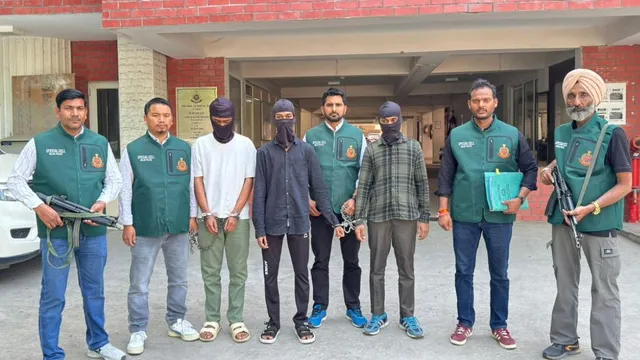
In an intelligence-based operation, Delhi Police have arrested four radicalized youths from Maharashtra, Odisha, and Bihar. These youths believed that an army with black flags would emerge from Khorasan, which would establish a Khilafat (Islamic State) in the Indian subcontinent and beyond.
They were preparing themselves to join this army and participate in Ghazwa-e-Hind. They were also engaged in radicalizing other youths. Materials for making an IED were also recovered from one of the accused.
The NDR team of Delhi Police’s Special Cell has arrested a total of four misguided youths—two from Maharashtra, one from Odisha, and one from Bihar. All were inspired by the ideology of Khilafat and were preparing for Ghazwa-e-Hind.
An FIR has been registered in the Special Cell police station under relevant sections in this case. Materials for making an IED were recovered, and the mobile devices of the accused have been seized.
The names of the arrested accused are Mosaib Ahmed alias Sonu, Mohammad Hammad, Sheikh Aamir, and Mohammad Sohail. Mosaib and Hammad were apprehended from Pune, Maharashtra, while Sheikh Imran and Sohail were caught from Katihar, Odisha and Bihar respectively.
How They Were Carrying Out Terrorist Activities
The accused were admins or members of various closed groups on encrypted social media platforms. They were engaged in radicalizing and recruiting other youths for jihad to establish Khilafat/Islamic State.
Two members of the module were in the process of making a remote-controlled IED by collecting locally available materials, which could have been used for a terrorist attack.
Collected Funds by Sharing QR Code
One member was inciting other members to collect weapons and explosives so they could participate in Ghazwa-e-Hind. He had even shared his bank account/QR code on his social media channel for crowdfunding in support of jihad.
Another member promised to arrange weapons training for the module’s members and asked for money to be sent for this. In December 2025, he visited several sensitive locations including the Red Fort in Delhi and posted a photo of the Red Fort with a black flag to try and radicalize other members.
Each Had Different Responsibilities
Was Making a Bomb with a Remote-Controlled Car
Mosaib Ahmed alias Sonu alias Kalam: Originally a resident of Azamgarh, Uttar Pradesh. Studied up to 10th grade. Worked as a welder, auto mechanic, and auto electrician in India and abroad.
Currently, he was working in a private automobile workshop in Thane. He was a member of several online groups where discussions related to Lashkar-e-Mahdi and jihad took place.
He helped co-accused Mohammad Hammad in making an IED by opening the circuit of a remote-controlled toy car and shared its photo in a closed group.
12th Grade Student Gathered Materials for Bomb
Mohammad Hammad: A resident of Mumbai. Studying 12th grade through correspondence. Around January 2026, he joined a closed group where Mosaib Ahmed alias Kalam was also active. The group discussed jihad and Ghazwa-e-Hind.
He shared photos of ball bearings, nails, a remote-controlled toy car, and a box, which were materials for making an IED. He handed over these materials to Mosaib Ahmed, who, being a mechanic, was tasked with assembling the IED.
Strayed from the Path While Listening to Sermons
Sheikh Imran: Born into a lower-class family in Bhubaneswar, Odisha. Studied up to 10th grade, after which he worked as a security guard and delivery boy. From 2024, he started listening to lectures/sermons and gradually adopted radical ideology.
He connected