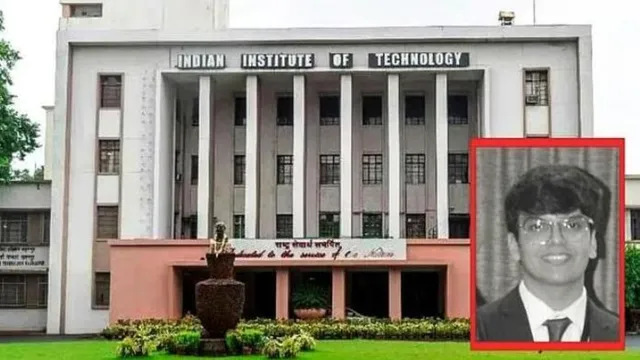
A wave of shock has swept through the IIT Kharagpur campus following the mysterious death of a student, Jayveer Singh Doria. The blood-stained body of Jayveer, a resident of Ahmedabad, was found in front of the Atal Bihari Vajpayee Hall.
A wave of shock has swept through the campus of the Indian Institute of Technology, Kharagpur, located in the railway town of West Medinipur district, following the mysterious death of a student.
The deceased student has been identified as 21-year-old Jayveer Singh Doria, a resident of Ahmedabad, Gujarat. He was a third-year student of Manufacturing Engineering.
Jayveer’s blood-soaked body was found on Saturday morning in front of the Atal Bihari Vajpayee Hall. Upon receiving the information, police from the Hijli police station reached the spot. They are investigating the entire matter.
Repeated incidents like these at the IIT Kharagpur campus raise questions about student safety and mental well-being.
According to police sources, campus security guards were the first to see Jayveer lying in a blood-soaked state. They informed the institute authorities.
After receiving the news, police who arrived at the spot took the blood-soaked Jayveer to the B.C. Roy Hospital on campus. After a preliminary examination, the doctor declared him dead.
The cause of this incident is not yet clear. The institute and the police have begun separate investigations. In the initial investigation, police suspect that Jayveer may have committed suicide by jumping from the roof of the eight-story building.
The police have sent the body for an autopsy. Police suspect that the real cause of death will only be known after the autopsy report arrives. However, institute authorities have not yet issued any statement on the incident.
Eight Mysterious Student Deaths in 16 Months
It is noteworthy that the series of mysterious student deaths at IIT Kharagpur shows no signs of stopping. In the past 16 months, a total of eight students and researchers have died in this series. Of these, seven deaths occurred inside the campus.
Among the deceased, the hanging bodies of five students were recovered. The death of one student after another has created a sensation on the IIT Kharagpur campus.
The question of why talented students are choosing such a difficult path still remains incomprehensible. The campus also has a good counseling setup. Various measures for depression prevention have been taken.
IIT Kharagpur
IIT Kharagpur is the first and largest of the Indian Institutes of Technology, established in 1951 in West Bengal. It was founded in the historic Hijli Detention Camp building, a site significant for its role in India’s independence struggle, symbolizing the nation’s transition from colonial rule to a focus on technical education and development. Today, it is a premier engineering and research institution renowned globally.
Atal Bihari Vajpayee Hall
The Atal Bihari Vajpayee Hall is a prominent convention center located in the Pragati Maidan complex in New Delhi, India. It was inaugurated in 2017 and named in honor of Atal Bihari Vajpayee, the former and much-revered Prime Minister of India. The hall serves as a major venue for large-scale national and international exhibitions, trade fairs, and cultural events.
Ahmedabad
Ahmedabad is a historic city in western India, founded in the 15th century by Sultan Ahmed Shah on the banks of the Sabarmati River. It is renowned for its rich architectural heritage, including intricately carved stepwells
IIT Kharagpur
IIT Kharagpur is the first and largest of the Indian Institutes of Technology, established in 1951 in West Bengal. It was founded in the historic Hijli Detention Camp building, a site symbolizing India’s struggle for independence, to foster advanced technical education and research in post-independence India. Today, it is a premier engineering and technology institution renowned globally for its academic excellence and alumni.
Atal Bihari Vajpayee Hall
The Atal Bihari Vajpayee Hall is a prominent convention center located in the Pragati Maidan complex in New Delhi, India. It was inaugurated in 2017 and named in honor of Atal Bihari Vajpayee, the former Prime Minister of India, to commemorate his legacy and contributions to the nation. The hall serves as a major venue for large-scale national and international exhibitions, trade fairs, and cultural events.
Ahmedabad
Ahmedabad is a historic city in western India, founded in the 15th century by Sultan Ahmed Shah on the banks of the Sabarmati River. It is renowned for its rich architectural heritage, including the intricately carved stepwells and the iconic Jama Masjid mosque, and served as a major center for India’s textile industry and Mahatma Gandhi’s non-violent independence movement. In 2017, its walled historic center was declared a UNESCO World Heritage Site for its unique legacy of *pol* neighborhoods (traditional residential clusters) and centuries-old wooden architecture.
B.C. Roy Hospital
B.C. Roy Hospital, officially known as Dr. B.C. Roy Post Graduate Institute of Paediatric Sciences, is a major children’s hospital in Kolkata, India. It was established in 1998 and named after Dr. Bidhan Chandra Roy, a renowned physician and the second Chief Minister of West Bengal, to honor his legacy in public health. The hospital serves as a key tertiary care and teaching institution dedicated to pediatric medicine in eastern India.
Hijli Detention Camp
The Hijli Detention Camp, located in present-day Kharagpur, India, was established by British colonial authorities in 1930 as a detention center for Indian political prisoners during the independence movement. It gained tragic prominence for its harsh conditions and is notably remembered as the site where two young freedom fighters, Santosh Kumar Mitra and Tarakeswar Sengupta, were shot dead by guards in 1931. Today, the site houses the prestigious Indian Institute of Technology Kharagpur (IIT KGP), with a memorial, Shaheed Bhawan, preserving its history as a symbol of colonial repression and nationalist sacrifice.
Pragati Maidan
Pragati Maidan is a large exhibition and convention center located in New Delhi, India. It was originally developed in 1972 to host the Asia ’72 trade fair, marking the 25th anniversary of India’s independence, and has since been the country’s premier venue for major international trade shows and cultural events. The complex is currently undergoing a significant redevelopment, being transformed into the modern, integrated “India International Convention and Expo Centre (IICC).”
Sabarmati River
The Sabarmati River is a seasonal river in western India that flows through the state of Gujarat, most notably the city of Ahmedabad. It holds significant historical and cultural importance as Mahatma Gandhi established his **Sabarmati Ashram** on its banks in 1917, which became a pivotal center for India’s independence movement. Today, the riverfront is a major urban development project, featuring parks and promenades, though it continues to face challenges related to water flow and pollution.